Is market preparing for "Frexit"?


Morning Observers,
Never in this century have bonds been more interesting than they are today. But this time it's not Treasuries.
On Friday, the extra yield investors demanded to hold French rather than German 10-year bonds hit 159 basis points, its widest level since late 2011.
France and Germany issue their own debt, and investors price each country's risks separately. But both use the euro and follow the same ECB interest-rate policy.
So what gives?
The best explanation so far is that the market is pricing in the risk of a Frexit.
French five-year CDS under the 2014 contract costs 86.6 basis points, versus 35 under the 2003 contract. The reason is that the 2014 rules cover euro redenomination more clearly, while the 2003 rules don't.
That means the 51.6-basis-point gap is a proxy for euro-exit risk. The last time the gap grew so aggressively was during the 2017 election.
Japan is another possible source of selling. Japanese investors held about $145 billion of French bonds in July. That's roughly 4% of France's marketable government debt and 6.6% of Japan's overseas bond holdings.
After currency hedging, a 4.9% French bond yield works out to about 3.6% for Japanese investors, not much more than they can earn at home.
Not surprisingly, their French holdings have already fallen 2.5% since year-end. If more investors decide the extra yield isn't worth the risk, Japan could help push French yields higher in the near term.
- Dan Runkevicius, Editor

🛢️ G7 releases emergency oil reserves
The Group of Seven will release 100 million barrels of oil and fuel from emergency reserves over the next four months. The first phase will last 20 days and focus mostly on diesel. Members also agreed not to restrict petroleum exports, keeping supplies moving through global markets.
📉 September hiring falls short of forecasts
The U.S. added just 29,000 jobs in September, well below the 80,000 economists expected. Unemployment edged up to 4.2% from 4.1%, though it remains low by historical standards. The report also changed rate-cut expectations: the odds of an October cut fell to 17%, down from 75% earlier last week.
🏢 Four companies are now worth more than the Russell 2000
Nvidia, Apple, Alphabet, and Microsoft are each worth more than the entire Russell 2000. The index's 2,000 companies have a combined market value of about $3.5 trillion and make up just 7% of the U.S. stock market. It's another sign of how much the market's value is concentrated in a handful of giants.
🏦 Fed officials say they have time before deciding on rates
Fed Vice Chair Philip Jefferson and New York Fed President John Williams signaled that policymakers can take time to assess the economy before deciding whether to raise rates again. Economists cited by Bloomberg saw the remarks as an effort to cool expectations about the Fed's next move. Evercore ISI's Krishna Guha called their joint message "authoritative."
🚗 Tesla sales beat expectations despite an annual decline
Tesla delivered 486,532 vehicles in the third quarter, beating expectations even as deliveries fell 2.1% from 497,099 a year earlier. That's a modest decline in a difficult year for the EV market, suggesting Tesla's auto business is holding up better than many competitors.
“Own assets or be left behind”
Inflation is making it harder to build wealth from a paycheck. Americans are saving less, while households that already own assets are seeing their wealth grow much faster.
Americans are saving less
The U.S. personal saving rate fell to 4.1% in August, down 1.6 percentage points since January 2025, according to the Bureau of Economic Analysis. Outside the inflation spike in 2022, it hasn't been this low since 2008.
The five-year average has also fallen to 5.4%, its lowest in 14 years and below the roughly 6% average before the pandemic.That leaves people who rely on wages with less money to put aside and invest.
Asset owners keep pulling ahead
The latest Fed data show how differently things look for households at the top of the wealth ladder.
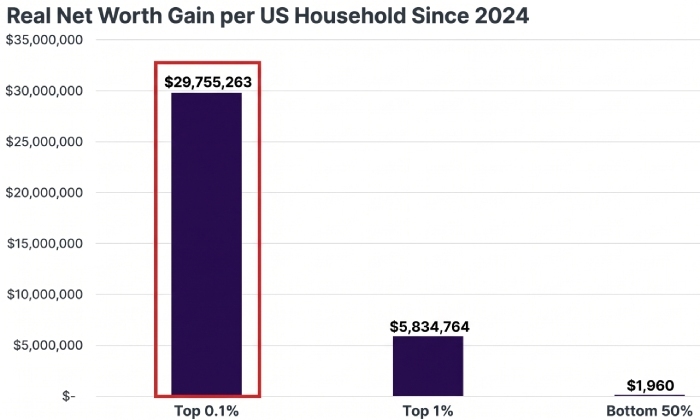
From the fourth quarter of 2024 through the second quarter of 2026, inflation-adjusted net worth rose by an average of $29.76 million per household for the top 0.1% and $5.83 million for the top 1%.
For the bottom 50%, it rose by just $1,960 per household.
📌 Bottom line: "Own assets or be left behind" has become a familiar line in an inflationary economy. But for people living mainly on wages, the path to owning those assets is getting harder as less of each paycheck is left to save and invest.
SpaceX’s $2 trillion valuation rests on Starlink
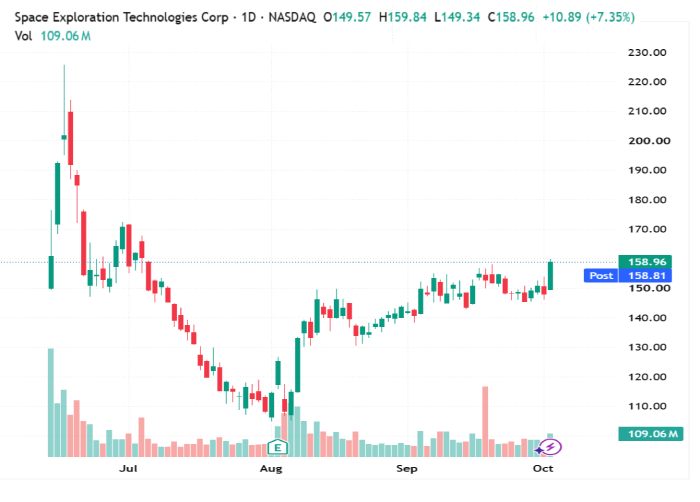
Elon Musk recently said commercial customers will account for 90% of SpaceX's business this year, while government contracts will make up less than 5% by the fourth quarter.
Frankly, Musk has made big forecasts before that didn't pan out, but SpaceX's latest results show how much Starlink has already changed the business.
Starlink Is Already Making the Money
SpaceX's Connectivity segment, which includes Starlink, brought in $4.29 billion in revenue and $1.66 billion in operating income in the second quarter. Adjusted EBITDA reached $2.6 billion.
Starlink ended Q2 with 12 million subscribers, but the average revenue per subscriber fell to $66 a month from $85 a year earlier. How those two numbers develop will help determine how much more profitable Starlink can become.
Starlink is now SpaceX's biggest source of revenue, and it's helping fund the rocket business that made the company famous in the first place.
By comparison, the Space segment lost $542 million on $962 million in revenue as SpaceX kept spending heavily on Starship.
SpaceX Has Another Way to Make Money From Its Rockets
Most launch companies earn money by carrying someone else's payload into orbit. SpaceX can also use its rockets to launch its own Starlink satellites, then collect monthly fees from customers who use the network.
That model matters even more for a company valued at $2 trillion. But these results alone may be not enough to justify that price tag.
📌 Bottom line: Sure, SpaceX has a moat like any other company. But three months into trading on public markets, investors are still waiting for a clear story about how it will turn that moat into explosive revenue growth.