🇯🇵 Is Japan about to kill the carry trade?

Morning Observers,
Japan has been bending over backward to save the yen without killing the famous carry trade. But it looks like it may now have no choice.
Prime Minister Sanae Takaichi is now vouching for another rate hike as soon as September or October, which is a remarkable about face for her.
Takaichi has historically been wary of aggressive tightening.
Yet another hike would mark Japan's fastest three-hike tightening cycle in a 12-month period since 1989, which took place at the peak of Japan's infamous asset bubble.
The reason is that Tokyo can buy yen all it wants. It can threaten speculators. It can even convince the U.S. Treasury to offload its other reserve currencies to buy yen.
But none of that changes the reason investors want to sell this currency in the first place.
Japan still has some of the lowest interest rates in the developed world. And that has made the yen one of the world's favorite funding currencies.
Investors borrow cheap yen, sell those yen, and move the money overseas into everything from higher-yielding bonds to stocks and other risk assets.
So if Washington and Tokyo can't offset selling from the famous yen carry trade, the only way to prop up the yen is to stop the carry trade itself.
That's where rate hikes come in.
Every Bank of Japan hike makes borrowing yen a little more expensive. At the same time, a stronger yen increases the cost of paying those loans back.
Eventually the economics of the carry trade falls apart.
But one of the reasons Japan waited so long is that this is not just a Japanese currency story. The cheap yen is funding hundreds of billions of dollars' worth of leveraged trades around the world.
If Japan really decides it must give up that role to stabilize its currency, some of that money may have to come home. In August 2024, we saw a hint of what it can do.
The catch here is that Takaichi may be simply jawboning the most speculative “yen flippers” without the intent of unwinding the whole trade.
- Dan Runkevicius, Editor

📉 Rate-hike bets retreat after CPI falls
Traders are dialing back expectations for a September rate hike after the latest inflation data came in largely as expected. July headline CPI dropped to 3.4%, while core inflation dipped to 2.5%, pushing the implied odds of a September hike down to roughly 34% from more than 70% earlier this month.
🥇 Gold is on a tear
Gold futures broke above $4,500 an ounce Wednesday for the first time in more than two months, extending their rally to 14% since July 17 as rate-hike expectations faded. Silver followed suit, climbing above $66 for the first time since mid-June.
🚀 Super Micro rides the AI wave
Super Micro stock surged more than 19% after the server maker delivered a revenue forecast that topped Wall Street estimates, another sign that AI infrastructure demand remains strong. The company expects $14.5 billion to $15.5 billion in revenue for the quarter ending in September, with adjusted earnings of $1.01 to $1.10 per share.
🇨🇳 China’s AI boom shows up at Tencent
China’s AI spending boom is accelerating. Tencent more than doubled its spending on AI projects last quarter to roughly $7.8 billion as it poured money into computing infrastructure supporting its gaming, social media, and other businesses. The push sent overall capital expenditures up 176% from a year earlier.
🤖 AI investment is driving a record share of the U.S. economy
America’s AI buildout is reaching a new scale. In its latest forecast, Goldman Sachs expects U.S. investment in AI to approach $600 billion this year, or roughly 2% of GDP. That marks remarkable growth since 2022 when ChatGPT launched and AI spending barely registered in the broader economy.
Silver is getting a bullish signal from an unusual place
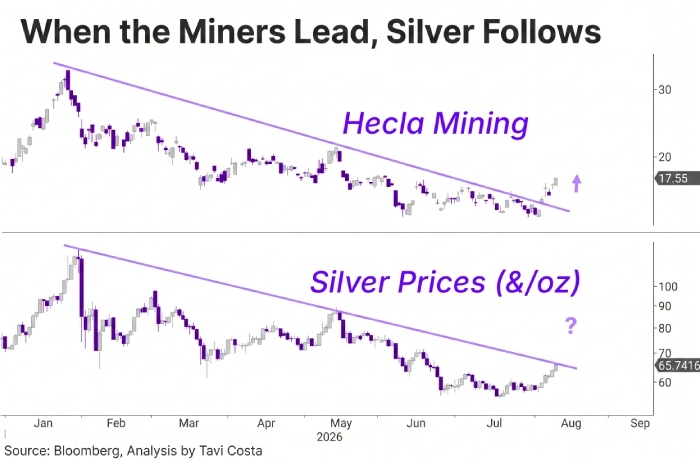
Silver miners are supposed to follow silver prices. But in an unusual reversal of one of the commodity market’s most established relationships, they may be front-running it.
So if miners are signaling what comes next, silver may have some catching up to do.
The miners moved first
Recent data from Bloomberg and Azuria Capital highlights the divergence.
Hecla Mining, one of America’s largest and longest-running primary silver producers, has already broken above a downtrend stretching back to January.
Silver hasn’t. The metal has rallied toward its own multi-month resistance line but has yet to decisively clear it.
Normally, the sequence runs the other way. Rising silver prices improve miners’ economics, since much of the cost of pulling an ounce from the ground is already fixed.
A higher silver price can therefore produce an outsized increase in miners’ cash flow and earnings. This time, Hecla broke out first.
There’s more behind the breakout
There’s an obvious alternative explanation: Hecla is rallying because Hecla is doing well.
Hecla stock has climbed more than 13% over the past five days following a strong second-quarter report, with roughly $334 million in revenue and $136 million in free cash flow despite production challenges at its Keno Hill operation.
But silver has started moving in the same direction.
The metal has recovered more than 7% over the past week, helped by a broader precious-metals rebound and persistent industrial demand from solar, electronics, and electrification.
The timing creates an interesting possibility: Hecla’s breakout may be less of an isolated stock move and more of an early signal for silver itself.
📌 Bottom line: The next test is silver’s resistance level. If it breaks while miners hold their gains, the setup may be a broader bullish signal for silver.
The bond market has overruled the Fed
The Fed has cut interest rates six times since 2024. But for many borrowers, rates have gone up anyway.
That means the bond market is effectively canceling out the Fed’s cuts, making what policymakers do next especially important for where borrowing costs go from here.
The rate that matters is going the wrong way
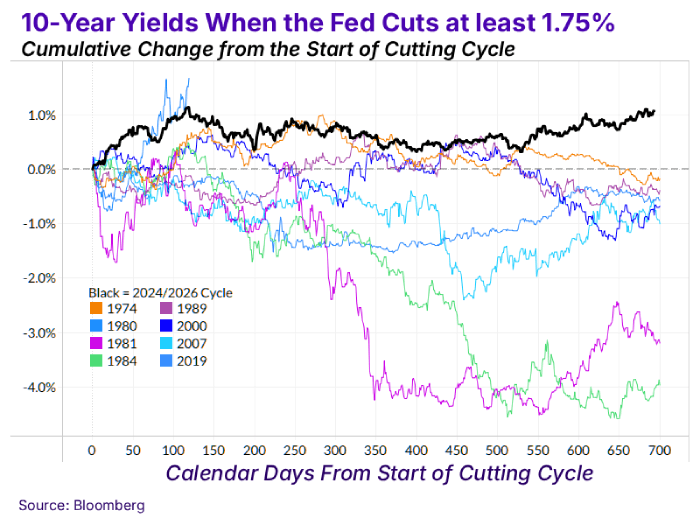
Since the Fed began cutting in September 2024, it has lowered rates by 175 basis points.
Over the same period, the 10-year Treasury yield has risen 98 basis points, while the 30-year yield has climbed roughly 125 basis points.
So while the Fed has been trying to lower borrowing costs, the market has been pushing many of them higher. Historically, that almost never happens.
Across more than five decades of cutting cycles, the only comparable episode came in 1980. It lasted 119 days before the Fed reversed course and started hiking.
This time, the disconnect has lasted nearly two years.
Warsh inherits a credibility problem
Every rate cut now risks pushing long-term yields even higher if investors fear inflation will stick around. That leaves new Fed Chair Kevin Warsh with an unusual problem.
He may have to convince markets that he’s willing to hike rates in order to get long-term rates down.
That’s essentially what happened in 1980, the closest historical precedent. The Fed cut rates from 13% to 10%, bond yields surged, and policymakers quickly reversed course and started hiking.
Today, the bond market is already delivering the higher rates the Fed has avoided.
📌 Bottom line: The Fed can cut rates all it wants, but if it keeps losing the bond market’s trust, mortgages and other borrowing costs will keep rising.