Iran deal that wasn't

Morning Observers,
The Iran deal is turning into an already classic case of “signed the same deal and walked away with different conclusions.”
Trump says Iran requested the meeting. Iran says there will be no direct talks with the Americans unless they unfreeze its assets and lift sanctions.
Instead, Tehran says it is sending a technical team to Qatar to discuss whether the US is actually implementing the interim agreement.
And this is where things get interesting. The whole dispute now seems to revolve around one line in the deal: Article 5.
Iran reads it as permission to organize traffic through Hormuz during the 60-day negotiating window. The US reads it as Iran stepping aside and letting ships pass freely.
That is a big difference in interpretation.
Iran is also objecting to new shipping routes near the Omani side of the strait, arguing they were opened without Tehran’s coordination. At the same time, Iran says it has reached a “common understanding” with Oman on managing the waterway, while Oman says it does not support transit fees but is open to voluntary charges for maritime, environmental, and navigation services.
For now, markets are acting like this is manageable. Brent crude actually dipped on the possibility of talks. But while traffic through Hormuz is still moving, it is nowhere near where it was.
So the risk is not that Iran fully closes Hormuz tomorrow.
It's that Hormuz quietly becomes a controlled, negotiated, fee-adjacent chokepoint where every tanker has to think about routes, permissions, insurance, and geopolitics before moving through one of the world’s most important energy arteries.
The good news is that this buys time for the rest of the world to adapt.
- Dan Runkevicius, Editor
|
Five things to know before opening bell
📈 U.S. stocks eye strongest quarter since 2020
The S&P 500 is on track to gain more than 13% this quarter after falling 4.6% in the first three months of the year, putting the benchmark on pace for its best quarterly performance since the pandemic rebound in 2020. The rally suggests investors remain focused on AI-driven growth while betting geopolitical tensions between the U.S. and Iran will continue to ease.
🚀 Rocket Lab makes an $8 billion move against SpaceX
Rocket Lab, a space company that builds rockets and satellites, has agreed to acquire satellite communications provider Iridium Communications in an $8 billion cash-and-stock deal. The combination would pair Rocket Lab’s launch and manufacturing capabilities with Iridium’s global low-Earth orbit satellite network, creating a stronger competitor to SpaceX. Iridium shares jumped more than 20% following the announcement.
☁️ Goldman says Big Tech could regain leadership
After a difficult June for large-cap technology stocks, Goldman Sachs believes investors may want to rotate back into hyperscalers such as Microsoft, Amazon, and Alphabet if AI momentum remains strong. Strategist Christian Mueller-Glissmann argues semiconductor stocks have become the more turbulent part of the AI trade, while the biggest cloud companies could offer a more attractive risk-reward profile.
✂️ Comcast plans major corporate split
Comcast is preparing to separate its media and connectivity businesses as it faces mounting competitive pressure, according to The Wall Street Journal. Under the plan, NBCUniversal and Sky would become a standalone media company, while Comcast’s broadband business would operate independently as its own publicly traded company. Investors welcomed the news, sending shares of the combined company nearly 10% higher.
🪙 Precious metals remain under pressure
Gold and silver prices fell sharply at the start of the week as expectations for higher interest rates continued to support yield-producing assets over precious metals. Gold futures slipped 1.1% to $4,049 per troy ounce, while silver declined 1.7% to $58.62. Both metals remain near their lowest levels of the year, extending a sharp reversal from the strong gains seen earlier in 2026.
What if the U.S. rewrote its own debt?
For years, investors assumed Washington had two ways out of its now $39 trillion debt problem: inflate it away or borrow even more. Now a third possibility is entering the conversation.
The bond king’s warning
In a recent Bloomberg interview, DoubleLine CEO Jeffrey Gundlach floated a scenario where the U.S. government cuts the interest payments on existing Treasury bonds instead of changing when they’re repaid.
Gundlach, known as the “bond king,” gave the following scenario.
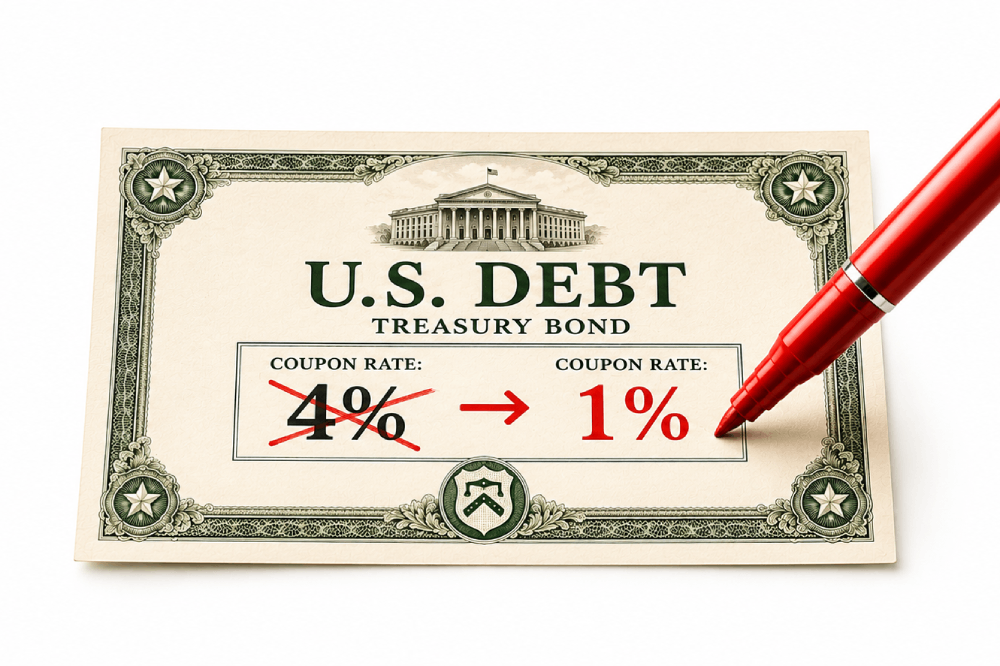
Imagine buying a Treasury note that pays 4% interest for two years. Then, during a fiscal crisis, the government announces it will instead pay 1% interest instead of 4%.
Investors eventually get their principal back, but they earn far less income in the process.
Economist Peter Schiff believes this is one way Washington could avoid either outright default or an inflation spiral. However, he takes the idea a step further.
Schiff argues Washington could both reduce interest payments and extend the bond’s maturity, forcing investors to wait much longer to get their money back.
“You go to sleep owning a 2-year note with a 4% coupon and wake up owning a 30-year bond with a 1% coupon,” Schiff said.
No one expects this to happen anytime soon. The point is that one of the world’s largest bond investors now thinks it’s worth discussing, and that alone says a lot.
📌 Bottom line: Treasury investors are supposed to worry about inflation risk. Increasingly, they’re debating fiscal risk instead.
Welcome to the stealth bear market
The S&P 500 is sitting just a few percent below record highs. But beneath the index, a lot of the market is already in a bear market.
For example, many of the companies that powered the AI rally have already fallen more than 20%, and some of Wall Street’s biggest tech companies have shed nearly half their value:
- Oracle: -57%
- Salesforce: -57%
- Netflix: -48%
- Palantir: -48%
- Microsoft: -37%
- Meta Platforms: -37%
- Arm Holdings: -27%
- Broadcom: -26%
Even Nvidia is on the cusp of entering a bear market, down 19% from its recent high.
Bear markets don’t always start with the index
For two years, investors rewarded companies for spending as much as possible on AI. Suddenly, they’re asking what all that spending will actually earn.
Oracle’s collapse is a good example.
The stock had its worst weekly drop since the dot-com crash because investors questioned whether billions in AI spending would ever generate acceptable returns.
The same goes for other S&P 500 laggards tied to the AI race.
“There’s concern around how much hyperscalers are turning to debt markets in order to finance the infrastructure buildout,” said Kate Brennan, associate director of independent research institute AI Now, referring to companies like Alphabet, Amazon, Meta Platforms, and Microsoft.
“The returns are not coming in, and the claims that are being made, in terms of efficiency or productivity numbers, are not netting out,” she said.
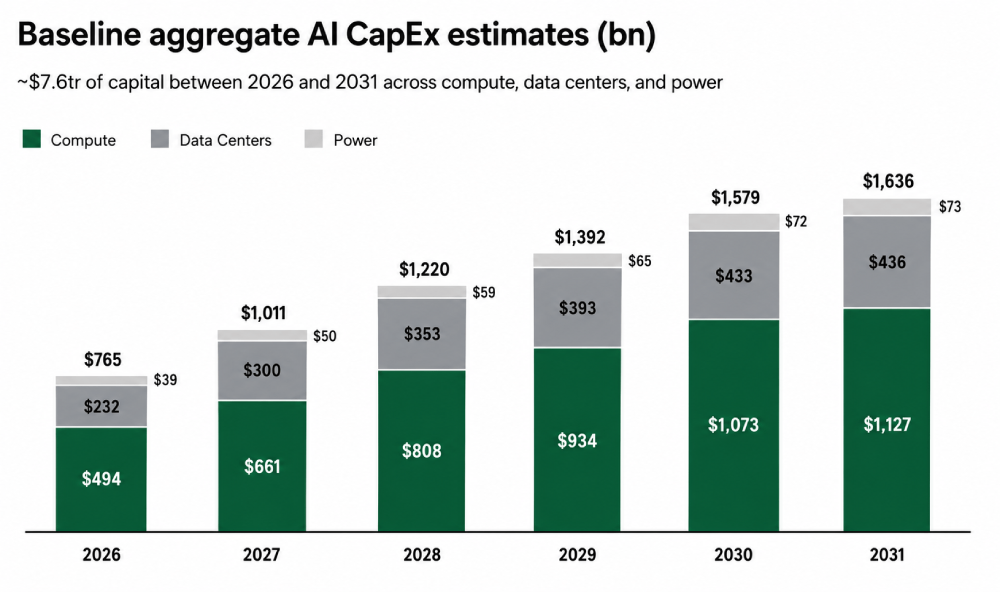
📌 Bottom line: Goldman estimates tech companies will spend $7.6 trillion on AI infrastructure through 2031. If investors stop rewarding spending before those investments begin producing meaningful returns, today’s “stealth bear market” could spread beyond a handful of AI names.