⚠️ Invisible regime change

Morning Observers,
At the risk of overgeneralizing, all economic risk can be put into two buckets: demand-side risks and supply-side risks.
Between 2000 and 2020, investors mainly worried about financial crises stemming from demand shocks like consumption slowdowns, housing busts, or credit crunches.
These kinds of crises tend to create a positive stock–bond yield correlation (see chart).
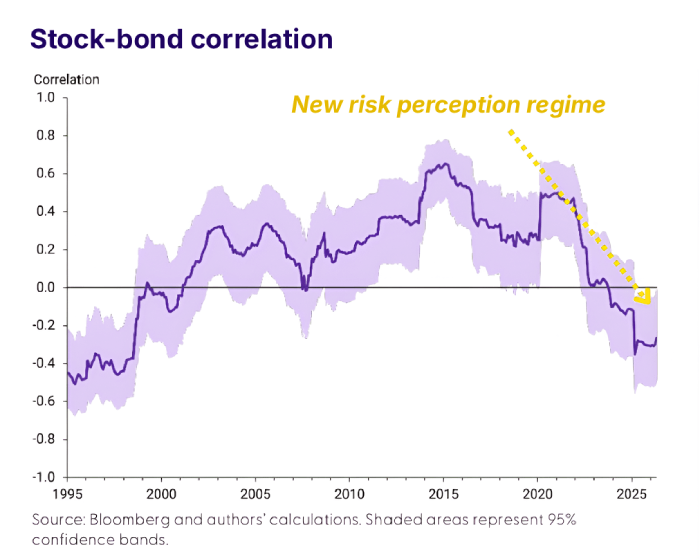
Stocks go down because a slowing economy weighs on earnings, but so do bond yields (yields down = bond prices up) because a slowing economy doesn’t have much pricing power, and inflation falls.
This correlation is a textbook setup for a 60/40 portfolio and bonds’ ability to cushion stock losses.
But since Covid, the market has been largely operating in fear of supply-driven shocks: pandemic bottlenecks, tariffs, and oil shocks.
In a supply shock-driven crisis, the Fed can’t easily rescue a slowing economy by cutting rates because doing so can aggravate inflation.
That’s why these crises create the opposite: a negative stock–bond yield correlation (see chart).
Stocks fall because the economy is slowing, but yields rise (= bond prices down) because supply-side inflation is getting worse and the Fed's hands are tied.
This regime shift from demand-shock fears to supply-shock fears creates an interesting paradox for investors.
On one hand, bonds are generating more income because yields are higher.
On the other hand, bonds lose their role as a hedge because stock prices and bond prices move more in tandem.
In fact, bond returns were negative in 17 of the 19 months when stocks fell at least 2% between 2020 and March 2026 (source: BlackRock).
So while yields are making a comeback, they come with less of the insurance policy they used to offer.
- Dan Runkevicius, Editor

🔥 Israel-Hezbollah fighting flares again
Israel and Iran-backed Hezbollah clashed again in Lebanon over the weekend, threatening to derail a U.S.-brokered ceasefire. The deal calls for Hezbollah’s disarmament, an eventual Israeli withdrawal from occupied territory, and the Lebanese army taking responsibility for security.
🛍️ Consumer spending weakens across the board
U.S. retail sales came in weaker than expected in July, adding to signs that consumers may be running out of steam. Sales fell 0.6%, versus expectations for a 0.1% gain, while sales excluding autos dropped 0.3%. Combined with the latest inflation data, the weak spending numbers are making a September rate cut look increasingly unlikely.
💻 Workday takeover talk could give software stocks a lift
Software stocks may finally have a catalyst after a brutal stretch. Workday (WDAY) surged nearly 18% following reports that tech-focused private equity firm Silver Lake has held preliminary talks about acquiring the enterprise software company. Evercore ISI says a major deal could signal that beaten-down software valuations are starting to attract serious buyers.
🚀 SpaceX completes $60 billion AI bet
SpaceX has completed a $60 billion acquisition of AI coding startup Cursor, escalating Elon Musk’s push to compete with Anthropic and OpenAI. The deal gives SpaceX a bigger foothold in AI-powered coding, one of the industry’s most lucrative markets.
😟 The hidden warning in consumer sentiment
University of Michigan consumer sentiment fell more than expected in July, but the bigger story may be inflation expectations. Americans now expect inflation to run at 4.3% over the next year despite recent moderation. The disconnect suggests households remain squeezed, largely thanks to higher energy costs.
Companies got their tariff refund, but price increases are here to stay
Here’s an odd consequence of the Supreme Court striking down many of Trump’s tariffs: Companies are getting billions of dollars back, but the consumers who helped pay for them may not.
They are likely not getting any price relief either.
More than 40 S&P 500 companies have disclosed about $9.6 billion in tariff refunds, including $2.1 billion already received in cash. Yet they are keeping the price increases.
The great tariff reversal
The refunds are already showing up in government revenue data.
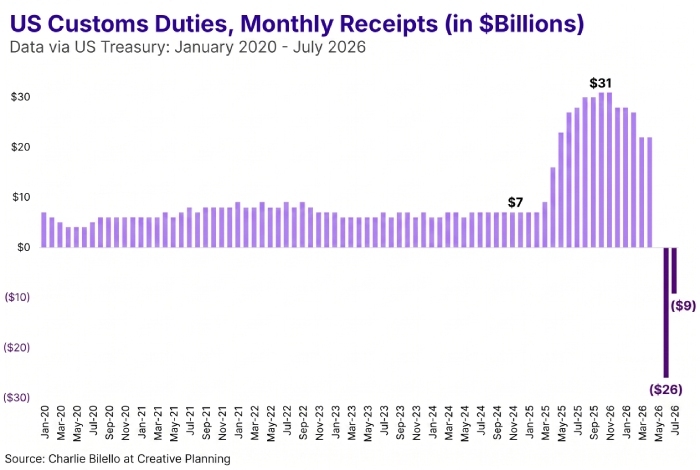
U.S. customs-duty collections climbed from roughly $7 billion a month in late 2024 to a peak of $31 billion in late 2025 as tariffs kicked in.
Then the money started flowing the other way: net customs receipts swung to negative $26 billion in June and negative $9 billion in July as the government began issuing refunds.
Here’s the catch: When tariffs raised companies’ costs, many businesses raised prices. Now those companies can recover their tariff costs without necessarily reversing the price increases they made along the way.
Prices went up. Will they come back down?
It’s impossible to pin every price increase on tariffs, but the evidence suggests consumers absorbed a significant chunk of the cost.
The Tax Foundation estimates Trump’s tariffs amounted to an average tax increase of about $1,000 per U.S. household in 2025.
The Budget Lab at Yale found another clue. Prices of imported core consumer goods and durable goods rose 1.5% from the start of 2025 through January 2026, far more than in comparable earlier periods.
Its estimates suggest that roughly half to most of the tariff increase showed up in prices of imported consumer goods.
📌 Bottom line: The government is unwinding billions of dollars in tariffs, but there’s no equivalent mechanism for unwinding the prices consumers paid because of them.
An investment lesson from Norway's $2.3T fund
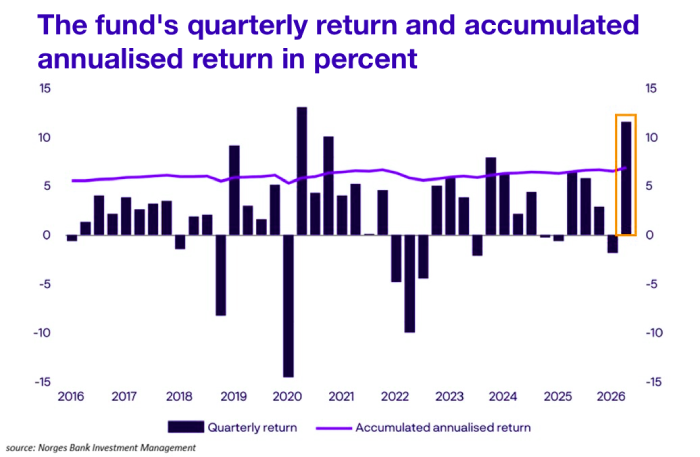
Norway has fewer than 6 million people, but it has one of the world's best-performing sovereign wealth fund worth $2.3 trillion.
And this fund just had its best quarter in six years without trying to call the top or bottom… or letting fears about AI valuations keep it on the sidelines.
A blockbuster quarter
Norway’s fund returned 11.5% in the second quarter, its strongest performance since 2020.
Stocks returned 16%, driven largely by the AI boom. Nvidia was its biggest holding at midyear, followed by Microsoft and Apple.
Norway isn’t just sitting on a passive portfolio, either. The fund trades, picks securities, and rebalances when its mix of stocks and bonds moves too far from its targets.
What it generally doesn’t do is overhaul its portfolio every time the market outlook changes.
Bad timing still works
That’s a useful distinction for regular investors.
Schwab looked at 80 different 20-year periods going back to 1926. Even an investor who consistently put money into stocks at the worst possible time generally ended up ahead of someone who stayed in cash waiting for a better entry point.
Norway takes a similar idea to an enormous scale.
Its managers change what the fund owns without making big shifts in its overall market exposure. That means suffering through quarters like those in 2020 and 2022.
But that also means staying heavily invested when AI stocks suddenly deliver a huge quarter.
📌 Bottom line: Norway’s blockbuster quarter came with a price: staying exposed for the ugly ones, too. If you have time, even terrible market timing beats waiting for the perfect moment.