Investors rushing into Treasuries

Morning Observers,
Treasuries are finally acting like a hedge.
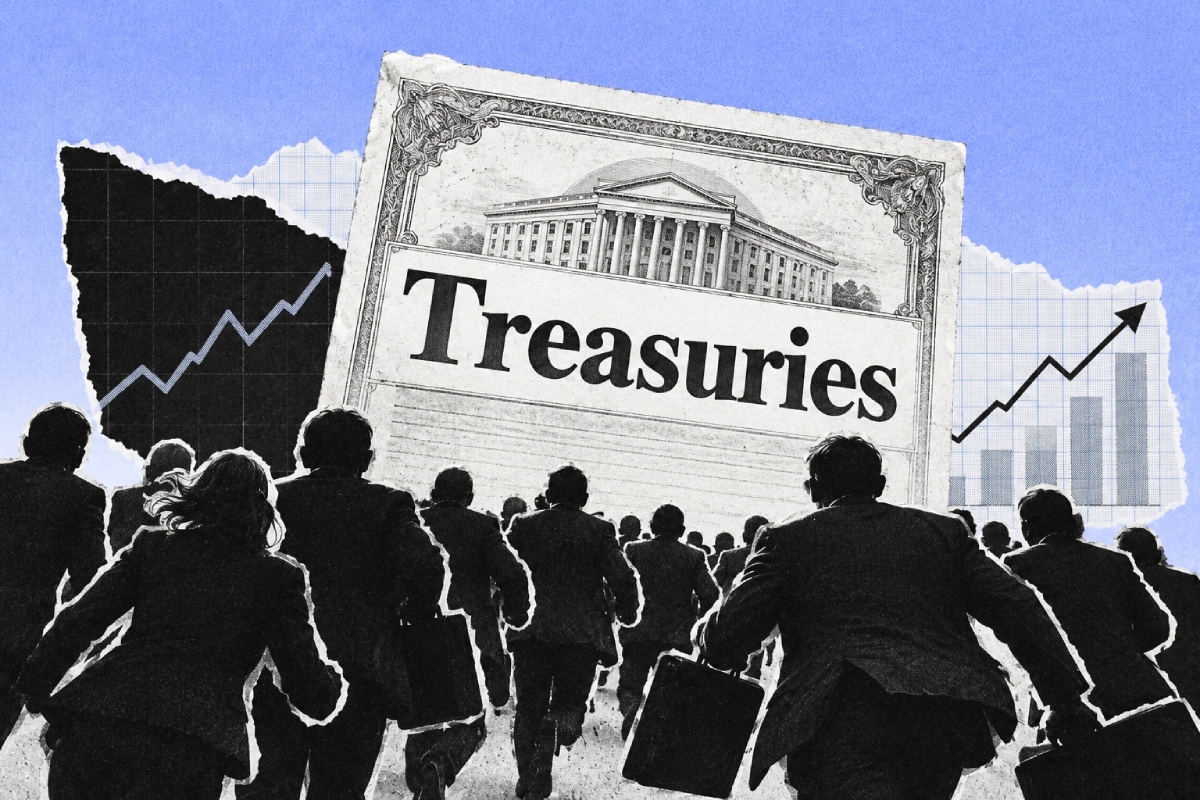
For much of this year, they offered little protection when stocks fell. But during this AI rout, investors rushed into government bonds, sending short-term Treasury yields down as much as 20 basis points.
The tendency for Treasuries to rally when AI stocks fall is now at its strongest in a year. That suggests investors are starting to see a potential AI reset as a threat to both valuations and economic growth.
It's even more striking that this is happening at a time when oil hit $113 after attacks in Saudi Arabia.
Higher oil usually pushes bond yields up because investors fear more inflation.This time, however, Treasuries rallied anyway, probably because worries about an economic downturn outweighed inflation fears.
Corporate bonds are sending a separate warning. Global spreads have widened to their highest since May 2025, while spreads on higher-rated Asian dollar debt are at their widest since July 2025.
Most of the spread widening is in AI-related debt, so the bigger question now is whether that repricing stays concentrated there or spreads across credit markets.
Let's dive in!
- Dan Runkevicius, Editor
|
|

📉 Treasury bonds rally as AI fears hit tech stocks
Investors piled into Treasurys on Thursday as semiconductor stocks suffered heavy losses. "Tech stocks came under pressure amid renewed AI valuation fears," said Ian Lyngen of BMO Capital Markets. The 10-year Treasury yield plunged 18 basis points to 4.96%, while the Philadelphia Semiconductor Index fell 6.7%.
⏸️ IPO market is "paralyzed" ahead of Anthropic listing
Uncertainty over AI valuations is putting the IPO market on hold, leaving billions of dollars in capital on the sidelines. Anthropic's highly anticipated IPO could come as soon as next month, but investors are wary of new stock offerings. "People are truly paralyzed," said Truist Financial's West Riggs. IPO activity has slowed sharply since SpaceX went public in June.
🚗 Tesla shocks investors with $20 billion spending cut
Tesla delivered better-than-expected earnings, but its decision to cut full-year spending plans by roughly $20 billion surprised Wall Street. Investors had been expecting an "all-in" push into AI, Cybercab, and robotics. Instead, the pullback raised questions about Tesla's near-term priorities, and its stock fell more than 3% on Thursday.
🔗 Tokenized stock trading is exploding
Crypto prices may still be well below their 2025 highs, but tokenized stocks are surging. Onchain trading volume for tokenized stocks and ETFs topped $37 billion in the third quarter, an 18-fold increase since January, according to a new report from Dune Analytics. It's another sign that interest in blockchain-based versions of traditional assets is growing, even as the broader crypto market struggles.
🛢️ U.S. emergency oil reserves keep shrinking
America's Strategic Petroleum Reserve fell by another 300,000 barrels last week to 282.7 million barrels, its lowest level since October 1982. Since March 20, reserves have dropped by 132.8 million barrels, or 32%, as the U.S. continues exporting crude amid hostilities with Iran. The government has now drawn down its emergency oil stockpile in 29 of the past 30 weeks.
The key to bringing inflation down? "Build more data centers"
Americans are already paying more for electricity because of the data center boom. But BlackRock CEO Larry Fink argues that not building enough data centers could be even more inflationary.
It's a counterintuitive argument at a time when there's evidence that AI infrastructure is already pushing up energy costs.
The cost of not building
"If we don't build out these data centers, it is actually more inflationary because the cost of compute is so high right now," Fink said in a recent interview.
"And the faster we can build out more data centers, the more compute we have, the faster we can bring down the cost."
His argument is that expanding computing capacity will lower the cost of using AI, allowing businesses to reduce labor costs and improve productivity.
In theory, those savings could help bring down inflation in the future, but not without short-term pain because building more data centers could push up costs in the first place.
Americans are already paying more
Electricity bills are already going through the roof, making Fink's argument a hard sell.
U.S. residential electricity prices have risen 40% since 2019, with increases of 70% to 90% in states such as Maine, California, and New York, according to Fed and BLS data.
While not all of those increases are related to AI, data centers are adding to electricity demand at a time when energy costs are already rising.
📌 Bottom line: Fink's idea rests on two assumptions: 1) businesses will become more productive, and 2) businesses will pass their cost savings on to consumers through lower prices. The problem is that trickle-down economics hasn't been largely disproven.
Netflix's biggest rival doesn't produce any TV shows
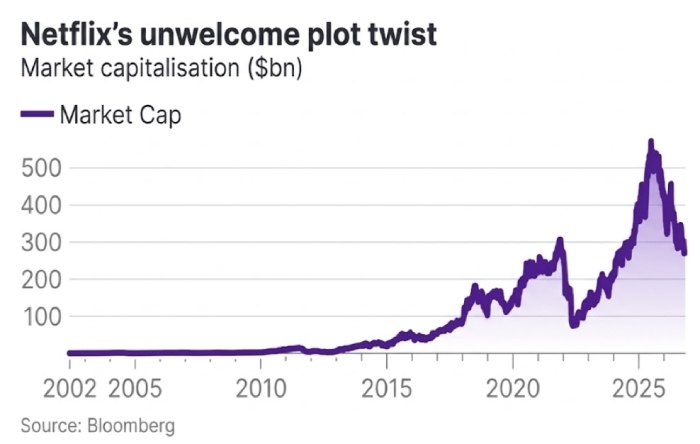
Netflix has lost roughly $300 billion in market value since its 2025 peak, but its biggest competitor may no longer be Disney+ or Paramount+.
It could be the growing number of young viewers who'd rather watch a 30-second video than a 30-minute TV show.
Changing generational habits
John Arnold, co-chair of the philanthropic Arnold Ventures, believes Netflix is competing with an entirely different form of entertainment.
"People are losing the attention span to even watch 30-minute TV shows as short-form video eats the world," he wrote, likely referring to the growing popularity of platforms like TikTok and Instagram.
There's some data to support his argument.
Deloitte research from 2025 found that half of Gen Z prefer social media videos over streaming services. A separate 2026 Bango survey found that 43% of Gen Z would rather watch highlights than full TV episodes.
Engagement is stalling
Despite spending roughly $20 billion annually on programming, Netflix reported that viewing time increased by just 2% in the first half of 2026.
Meanwhile, its internal "qualified play days" metric, which measures how frequently subscribers watch Netflix, has been declining, according to the Financial Times.
Netflix no longer publishes quarterly subscriber figures, but analytics platform Antenna estimates that the company added no net new U.S. subscribers during the first nine months of 2026.
This partly explains the stock's nearly 40% plunge over the past 12 months.
📌 Bottom line: Netflix can keep cranking out blockbusters all it wants, but that won't necessarily translate into more viewing time if short-form video keeps taking a larger share of younger audiences' attention.