Inflation’s biggest problem isn’t energy


Morning Observers,
Investors usually wait for earnings to fall before punishing a stock. Newspaper companies were the exception.
Long before print advertising collapsed, newspaper stocks had already begun a relentless decline. Investors recognized the internet would disrupt publishing and sold off the industry roughly five years before it showed up in earnings.
Software may now be entering a similar phase. The market is increasingly pricing in what software businesses could look like in an AI-first world years from now.
And that foresight is singling out this industry and the rest of tech.
The iShares Expanded Tech-Software Sector ETF (IGV), one of the broadest benchmarks for publicly traded software companies, is down more than 16% over the past year.
Meanwhile, the Philadelphia Semiconductor Index, whose companies supply the chips powering the AI boom, has gained more than 100%.
That doesn’t mean software is destined to become the next newspaper industry. But if AI permanently changes how software is built, priced, and sold, investors may not wait for earnings to tell them.
Let’s dive in.
— Sam Bourgi, Interim Editor
|
|


🏦 Fed rate hike bets are fading
Markets continue dialing back expectations for a Fed rate hike. The odds of a July increase have dropped to just 10%, while September has become a near coin toss, according to CME’s FedWatch Tool. Cooler-than-expected CPI and PPI reports have reinforced the view that the Fed may not need to raise rates anytime soon.
📺 Netflix’s growth story is losing steam
Netflix shares tumbled more than 7% after second-quarter revenue missed expectations and the company issued a disappointing outlook, highlighting the increasingly competitive streaming market. The stock is down roughly 50% over the past year, badly lagging the S&P 500’s 20% gain.
💰 Corporate insiders are selling at a record pace
Corporate executives are cashing out at the fastest rate in more than two decades. U.S. insiders sold $77.6 billion worth of company stock during the first half of 2026, marking a 20% jump from last year, according to EPFR Global Market Intelligence. Heavy insider selling isn’t a market-timing tool, but it can be an early warning that valuations are looking stretched.
🧠 The chip pullback is getting deeper
Semiconductor stocks remained under pressure on Friday, dragging the Nasdaq lower. The Philadelphia Semiconductor Index is now down about 20% from its record high, though that follows an extraordinary rally earlier this year. Some analysts see the correction as a potential buying opportunity given chips’ central role in the AI boom.
🛡️ Safe havens are back in demand
Investors rotated into defensive assets as the tech selloff intensified. The Japanese yen and Swiss franc outperformed, while U.S. Treasurys rallied as investors sought safety, highlighting a more cautious tone heading into the new trading week.
Software’s biggest problem isn’t the SaaSpocalypse
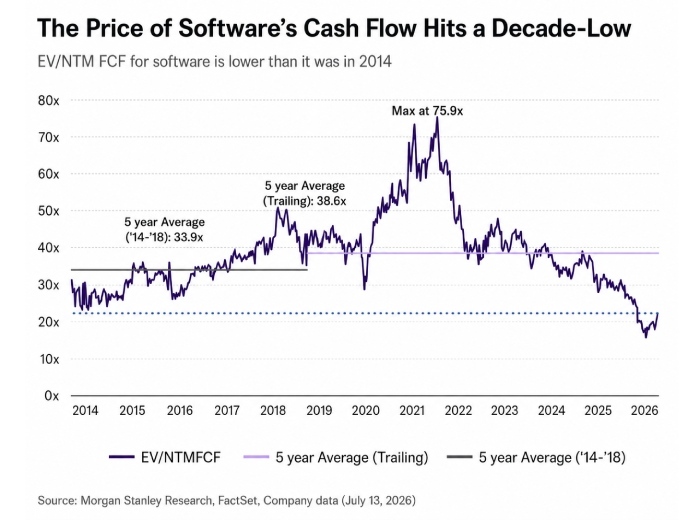
For all the talk of a coming ‘SaaSpocalypse,’ software companies are still generating plenty of cash. What has changed is investor confidence that they’ll keep generating it.
If AI were already destroying software businesses, earnings would be rolling over. They're not. Instead, what has collapsed is the price investors are willing to pay for those cash flows.
Software lost its premium
Between 2014 and 2018, software companies traded at roughly 34x enterprise value to next-twelve-month (NTM) free cash flow, according to Morgan Stanley Research. That means investors paid about $34 for every $1 of cash a company was expected to generate over the following year.
As cloud adoption accelerated and capital became abundant, it climbed to a whopping 75.9x in 2021.
Today, the multiple is back to roughly 20–22x… below not only the post-pandemic average, but even 2014 levels.
In other words, investors are paying less for software’s future cash flow than at any point in more than a decade.
The market is pricing an expiration date
The interesting part is that software companies, broadly speaking, aren’t performing poorly. Many continue to produce healthy free cash flow. But investors no longer assume today’s cash flow will still be there five years from now.
AI has introduced a new question into every software stock: How long can this company keep making this much money?
The market isn’t worried about the next 12 months. It's worried about the 12 months after that and whether AI compresses pricing or makes today’s software easier to replace.
📌 Bottom line: Until investors regain confidence that current cash flows will still exist years from now, software stocks may stay cheap even if profits keep growing.
Inflation’s biggest culprit isn’t energy. It’s jobs.
The energy crisis tied to the Iran war may have reignited inflation, but it isn’t what’s keeping it alive.
The labor market that won’t quit
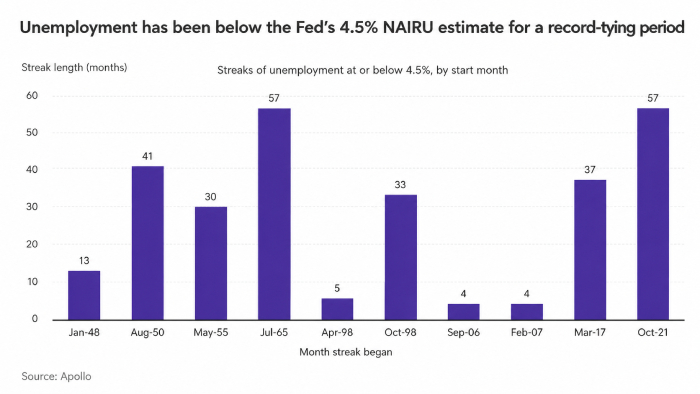
Although job growth has slowed over the past 12 months, the job market remains surprisingly healthy. According to Apollo Asset Management, the Fed assigns an unemployment rate of 4.5% as the cut-off point where inflation no longer accelerates.
The official unemployment rate has been at or below that level for 57 consecutive months, matching the record high that was initially set in the 1960s.
This unusually long stretch of low unemployment has kept pressure on wages and prices upward. This “helps explain why the ongoing inflation overshoot since 2021 has been so stubborn,” wrote Apollo chief economist Torsten Slok.
While temporary factors like energy prices have contributed to inflation, they’re not the primary cause, according to Slok.
The Fed’s dilemma
The analysis is timely, given that Fed Chair Kevin Warsh recently argued that the central bank’s goals of lowering inflation and supporting full employment do not contradict.
Warsh is effectively arguing that bringing inflation down doesn’t necessarily require sacrificing employment, a notable shift from the classical Fed thinking.
Markets aren’t sure whether to believe him, with rate-hike odds shifting on an almost weekly basis.
📌 Bottom line: Energy may have restarted inflation, but the labor market is what’s keeping it alive. Until hiring weakens meaningfully, investors shouldn’t expect the Fed to declare victory over inflation.