Indexes are hiding giant rotations


Morning Observers,
If you passively invest in global ETFs, this year may have seemed like a pretty average year.
The MSCI World Index has returned 12.3% so far. And for everything happening in the world, index volatility has stayed within one standard deviation.
But this relatively smooth year at the index level hides four giant rotations that happened inside of it.
The first quarter was effectively: "Sell expensive AI, buy everything else that's cheap."
The global economy was holding up well, and earnings were looking strong, but there was this growing paranoia that AI companies had gotten ahead of themselves.
So, investors began rotating into more value-oriented sectors like energy, materials, and utilities. The thinking was that if AI fell apart, you'd be better off in stocks that were making money right here and now.
Then the Iran war broke out and messed up the math behind the previous rotation.
In Q1, investors worried about a dot-com-style crash where multiples compress, meaning expensive stocks crash, while fairly valued stocks hold up because the economy remains intact.
The Iran war added a stagflation layer to this equation, which also didn't sit well with the defensive stocks investors had rotated into during Q1.
The result was an all-out sell-off in which every sector fell except energy. And since AI stocks were the most sensitive to both fears, they were hit the hardest.
The third rotation was a relief rally over peace deal hopes, along with a shift back to AI but with a twist. Investors wanted exposure to AI but were still skeptical of valuations, so they flocked to bottlenecks like memory stocks.
The thinking was that if you invest in AI at these valuations, you better be in stocks that have the backlog that backs up their growth projections.
The result was a very narrow AI rally focused on memory chipmakers with the biggest contracts, while the AI giants continued to sell off.
That brings us to the last rotation. It was probably the least visible at the index level, yet probably the most impactful for the market.
By mid-summer, the AI giants had learned their lesson: the market wanted proof that their capex spending was generating some kind of ROI. So they did their homework and showed it during their summer earnings releases.
The turning point was the earnings release from Amazon, which effectively addressed every major AI concern.
The company showed that its AI businesses had reached $25 billion in annualized revenue, that its capex spending was backed by customer commitments, and that these investments could break even within a few years.
Although the index barely budged during this period, Amazon's earnings helped kick off a massive rotation out of AI bottlenecks into the rest of the AI stocks, including hyperscalers.
That's a good illustration of how much can be packed into what looks like an "average" year for the index.
- Dan Runkevicius, Editor

📈 Stocks rally after the Fed's rate hike
U.S. stocks rose in the first session after the Fed raised interest rates, helped by moderating oil prices and a pullback in bond yields. Investors also appeared relieved to have the Fed decision behind them as policymakers try to rein in inflation. "Now that we are past this rate hike, stocks can move on, as uncertainty has faded," said Bob Edwards, chief investment officer at Edwards Asset Management.
🛢️ Energy stocks outperform
Higher oil prices have been a headache for much of the economy, but a boon for energy stocks. The S&P 500 Energy sector has gained 8% over the past month, making it the index's best-performing sector. The gains stand out against sharp declines elsewhere, with industrials, consumer discretionary, and utilities down between 6% and 9%.
🛡️ GM makes a surprising move into defense
General Motors delivered its first Patriot missile parts to Lockheed Martin less than a month after the two companies announced their partnership. The quick turnaround shows how GM is putting its manufacturing capacity to work as the U.S. defense industry tries to replenish ammunition and weapons stockpiles. GM stock rose nearly 3% on the news.
🪙 SEC clears a path for tokenized stocks
The SEC is opening the door to tokenized stocks after the CLARITY Act failed to advance in Washington. The regulator said approved trading platforms can offer digital tokens that track publicly traded stocks without having to follow some of the rules that previously stood in the way. The change could make tokenized stocks more widely available to investors.
🤖 Nvidia expects another big jump in AI chip sales
Nvidia CEO Jensen Huang said Thursday the company expects to sell twice as many chips over the coming year as demand for AI computing continues to climb. Nvidia last month projected 70% sales growth for its next fiscal year and said revenue could grow even faster if it can produce enough chips to meet demand.
“If you want to know where 10-year U.S. yields are going, watch the U.K.”
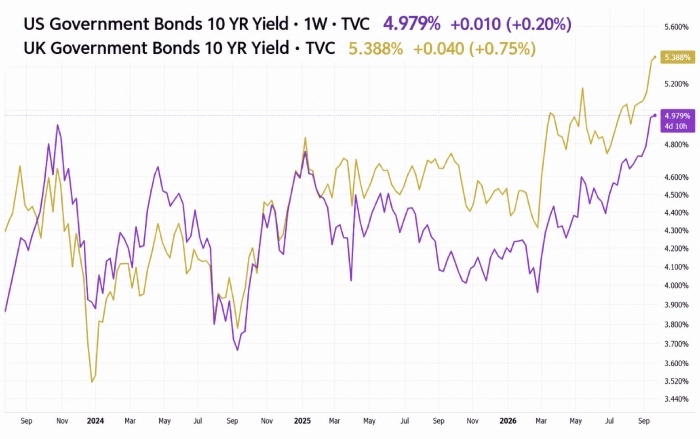
All eyes are on the bond sell-off in the United States, but no G7 country has higher borrowing costs than the U.K.
Recent history suggests that British bond yields offer an early signal of where U.S. Treasurys are headed, raising the prospect that American borrowing costs could climb further in the coming weeks.
What Japan did
Macro analyst Luke Gromen traces the relationship back to July 2023, when the Bank of Japan loosened its grip on 10-year Japanese government bond yields.
For years, the BOJ had used yield-curve control to keep the 10-year JGB yield near a predetermined level by buying bonds whenever yields threatened to rise too far.
In July 2023, it raised the ceiling from 0.5% to 1%, giving Japanese yields more room to rise. Since then, Gromen says, British yields have tended to move ahead of their U.S. counterparts.
"If you want to know where 10-year U.S. Treasury yields are going, just watch U.K. 10-year yields," he wrote.
Britain's early warning sign
The U.K. 10-year gilt yield recently climbed above 5.4%, reaching its highest level since July 2007. The same happened with U.S. yields, with the 10-year Treasury yield recently crossing 5.04% for the first time since 2007.
Gromen expects Treasurys to close the gap. "5.4%, here we come," he wrote.
📌 Bottom line: If this macro analyst is right, the next move in U.S. yields may already be playing out in Britain.
Anthropic passes OpenAI in a key business metric
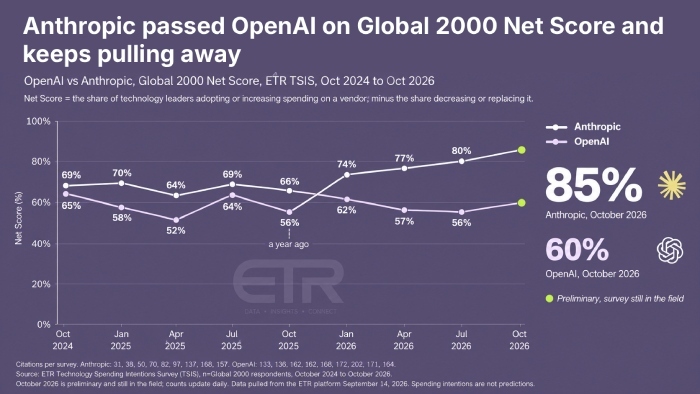
OpenAI may still be the biggest name in AI, but Anthropic is pulling ahead in one of the biggest areas of corporate technology spending.
Anthropic breaks away from OpenAI
Research from ETR shows a widening gap between Anthropic and OpenAI among Global 2000 companies.
Anthropic's Net Score, which measures the share of technology leaders adopting or increasing spending with a vendor minus those cutting spending, climbed from 56% in October 2025 to 85% this year.
OpenAI, by comparison, sits at 60%.
The timing overlaps with the rise of Claude Code, which has given companies a practical way to measure whether AI is actually saving developers time and money.
Anthropic's score began climbing sharply around the same time, reaching 74% in January and continuing higher throughout 2026.
Anthropic takes its enterprise lead to the IPO market
Anthropic recently told shareholders that it was profitable for a second consecutive quarter. Its gross margin is also above 80% before accounting for revenue shared with distribution partners.
Rising corporate adoption and high gross margins give investors two numbers to watch as Anthropic moves toward an IPO. The question is how much of that increased enterprise spending is showing up in revenue.
📌 Bottom line: Anthropic's growing share of corporate AI spending puts enterprise customers at the center of its IPO story. The trajectory of that spending will likely have the biggest effect on its public-market valuation.