IBM pays the price for transparency


Morning Observers,
Investors often say they want transparency from management. IBM just tested that theory… and it backfired badly. Management openly admitted its second quarter had been a bust.
On the surface, the story didn’t look that bad: preliminary second-quarter revenue totaled $17.2 billion, below analysts’ estimates of $17.9 billion, with sales from IBM’s infrastructure division dropping 7%.
The bigger problem wasn’t the miss itself. Customers are redirecting spending toward AI chips and infrastructure, fueling fears that traditional software is getting squeezed by the “SaaSpocalypse.”
CEO Arvind Krishna didn’t try to sugarcoat it. “We faltered,” he wrote in a blunt letter to shareholders.
Instead of rewarding the honesty, investors headed for the exits. The stock plunged 25% in a single day… the worst drop in IBM’s storied history.
The episode says as much about today’s market as it does about IBM. Investors may praise transparency in theory, but in practice they’re far less forgiving when management confirms their biggest fears. That’s why The New York Times called IBM’s earnings miss the “canary in the tech coal mine” for software companies.
That’s particularly awkward for IBM, which has spent years and tens of billions of dollars acquiring cloud and infrastructure software companies like Red Hat, HashiCorp, and Confluent to position itself for AI.
Whether IBM can reinvent itself remains to be seen, but investors are far less forgiving once a narrative starts to look like reality.
Let’s get to it.
— Sam Bourgi, Interim Editor
|
|


📉 TSMC earnings fail to calm AI valuation fears
Tech stocks fell Thursday despite strong earnings from Taiwan Semiconductor Manufacturing Co., as investors looked past the results and questioned whether massive AI spending can continue to justify today’s lofty valuations. Analysts called the move a classic “sell the news” reaction, but the broader concern is that AI-related capital spending may be outpacing the earnings needed to justify it.
⚠️ BoA CEO warns advanced AI poses new risks
Bank of America CEO Brian Moynihan warned that powerful AI models, including Anthropic’s Mythos, could make it easier for hackers to find weaknesses in banks’ computer systems. BoA is one of several Wall Street firms, including JPMorgan, raising concerns about Mythos as the industry tries to understand how the technology could be used in more advanced cyberattacks.
🚗 Uber makes $14.8 billion bet on global food delivery
Uber agreed to acquire European food-delivery platform Delivery Hero for $14.8 billion, offering €41.50 per share in cash after raising its initial bid. The acquisition would expand Uber’s delivery operations across roughly 50 markets spanning Asia to Latin America, strengthening its position against rival DoorDash in the increasingly competitive global delivery business. Uber stock rose nearly 2% on the news.
⛽ Weak gas sales mask resilient consumer spending
U.S. retail sales rose a modest 0.2% in June, but the headline figure was weighed down by a 5.3% decline in gas station sales as lower gasoline prices reduced spending at the pump. Excluding gas stations, retail sales climbed a healthy 0.7%, suggesting consumers are still spending at a solid pace despite signs of a slowing economy.
📈 Wall Street trading desks are on track for a record year
The five largest Wall Street banks are on track to generate a record $180 billion in trading revenue in 2026, following the Iran conflict that sparked a surge in second-quarter market activity. They’re also financing bigger client trades, with Goldman Sachs reporting a 91% jump in equities financing revenue.
The U.S. dollar has an AI problem
Most investors think the U.S. dollar is trading on the Fed. It might actually be trading on Nvidia.
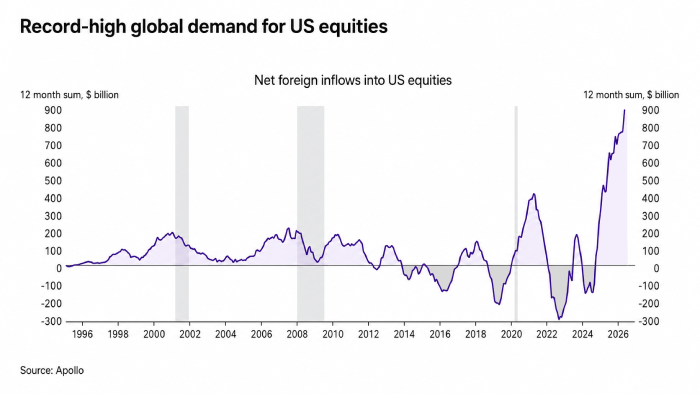
The U.S. Dollar Index (DXY) has remained remarkably strong this year as markets increasingly price in higher interest rates. But the Fed may not be the whole story. Data from Apollo Asset Management suggests foreign investors chasing U.S. AI stocks have become another powerful source of demand for the greenback.
Buying AI means buying dollars
Net foreign investment in U.S. stocks has climbed to nearly $900 billion over the past 12 months, according to Apollo… far above the peaks seen during the dot-com boom or before the 2008 financial crisis.
The buying began to surge as the AI boom took off in late 2022, then accelerated again as U.S. chipmakers and tech giants pulled further ahead of overseas rivals.
Outside the U.S., there simply aren’t many companies with comparable AI exposure. So global investors keep piling into Nvidia, Microsoft, and Broadcom… and they usually need dollars to do it.
That means the AI trade may be lifting two assets at once: U.S. stocks and the currency used to buy them.
What happens if AI cools off?
Some foreign investors protect themselves against moves in the dollar. Many don’t, leaving them exposed to both the stock and the currency.
That works both ways. As long as AI stocks keep rising, money keeps flowing into U.S. markets. But if the trade cools, foreign investors could sell stocks and the dollars they no longer need.
That’s what makes Apollo’s data so unusual. The dollar isn’t just benefiting from strong foreign demand for U.S. stocks — it has become increasingly reliant on it.
📌 Bottom line: The dollar may no longer be driven primarily by interest rates… it may increasingly be driven by global demand for American AI. If that’s true, Nvidia earnings could matter almost as much for the greenback as the next Fed meeting.
The Russell 2000’s upside-down rally
Warren Buffett built his fortune by asking a simple question: Does this business make money?
Today’s market seems to be asking a different one: Could this business become important to AI?
That shift is showing up most clearly in small caps, which are quietly having their best year in decades.
The Russell 2000: When potential beats profits
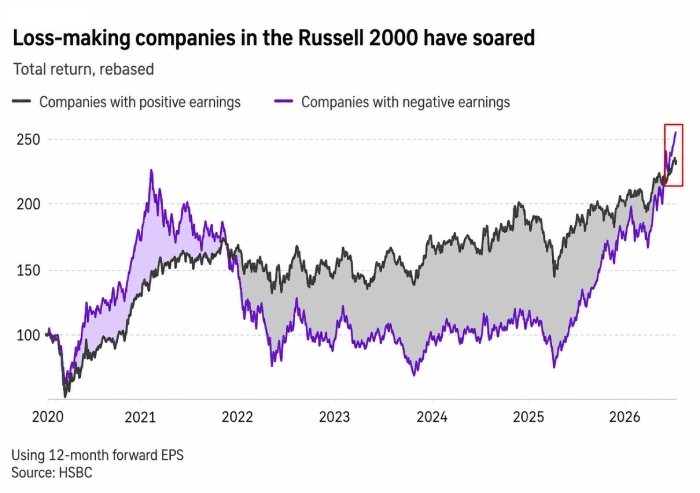
Since mid-2025, Russell 2000 companies with negative earnings have returned 154%, versus 34% for profitable companies, according to HSBC.
It’s the opposite of how markets are supposed to price risk.
Much of the rally has been concentrated in smaller technology and infrastructure companies tied to the AI buildout. Investors are treating future AI relevance as more valuable than current earnings.
The Russell 2000 is now up 20% in 2026, outperforming both the S&P 500 (+11%) and even the Magnificent Seven (+4%).
Narratives have replaced earnings
Experienced investors have seen this movie before.
During the dot-com boom and the 2020-21 stock frenzy, investors also prioritized future narratives over current earnings. Eventually, fundamentals caught up, contributing to the dot-com bust in 2000 and the 2022 bear market.
Today’s trigger doesn’t have to be a recession. It could simply be slower AI spending, higher interest rates, or disappointing earnings.
Charles Schwab notes that many smaller companies also carry higher levels of floating-rate debt, making them particularly vulnerable if financing costs stay elevated.
📌 Bottom line: The market is currently rewarding potential over profitability. That can last longer than most expect, but when the narrative changes, companies without earnings tend to have the furthest to fall.