High CAPE, low returns?

Morning Observers,
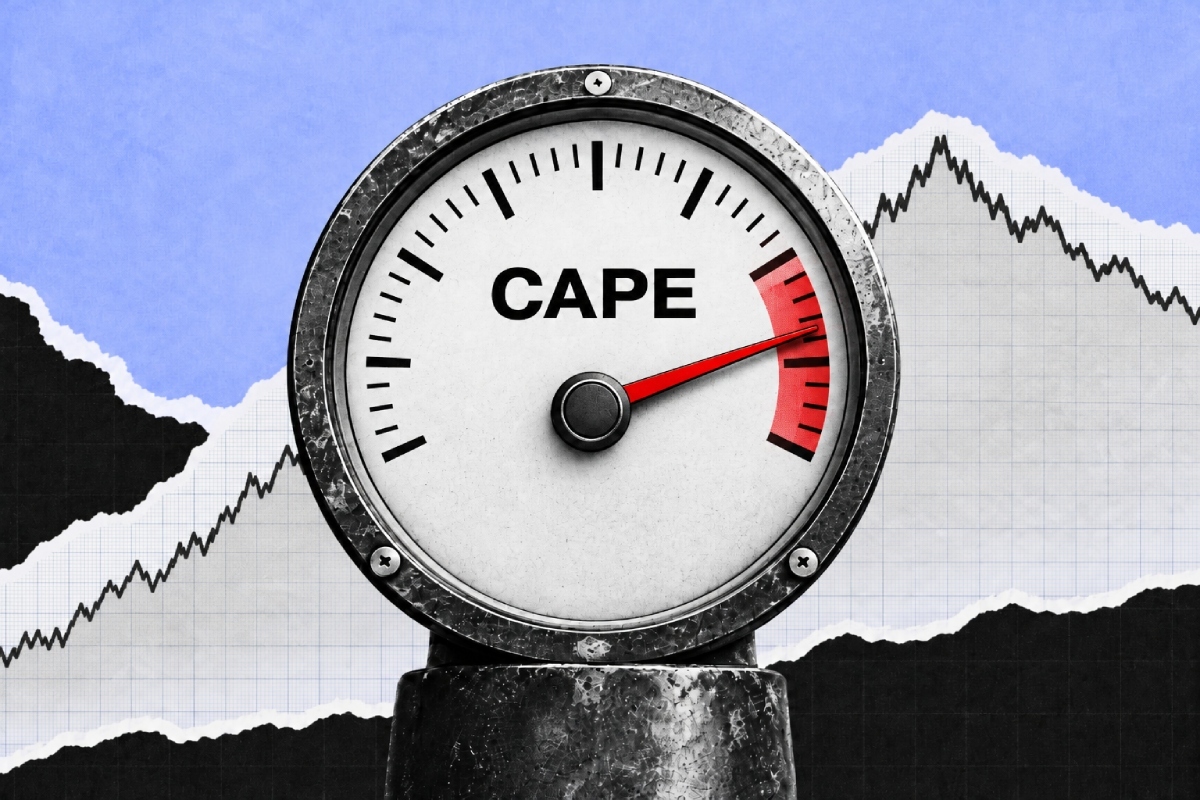
The CAPE is one of the most well-researched predictors of your future returns.
It's a cyclically adjusted P/E ratio that divides the stock price by earnings. But instead of using the last or next 12 months, it averages real earnings over the past 10 years.
The reason we use such a long timeframe is that earnings often peak late in the cycle, but nobody knows the cycle is peaking until it does. And so companies extrapolate those short-term gains into the future.
After all, no one wants to guide for an earnings recession when the economy is firing on all cylinders.
So the CAPE gives us something of a reality check. Statistically, the higher the CAPE, the lower the returns over the next 10 years, and vice versa.
The problem is, again, that nobody knows where the peak is until after the fact. So what do we do? We look at history. The media, in particular, loves those historic milestones: "Stocks are most expensive since..."
But although they make for great headlines, CAPE milestones often happen too early in the cycle.
Here are a few anecdotal examples:
- In late 1995, the CAPE reached its highest reading since 1930. 65 years! After that, the S&P 500 gained roughly 150% before peaking in 2000
- In July 2017, the CAPE crossed 30 for the first time since the dot-com bubble. The S&P 500 then nearly doubled before peaking in 2022
To be clear, these are cherry-picked data points. But they're exactly the kind of anecdotal evidence that mainstream financial media pick up on and individual investors pay attention to.
That said, the CAPE has been way above its long-term median for 30 years or so.
There are a few reasons why, and some of them may now be at risk. But that's a topic for another day.
- Dan Runkevicius, Editor

🇨🇦 Trump may walk back on Canadian tariffs, but there's a catch
President Trump is reportedly preparing to lift 50% tariffs on certain Canadian agricultural and forestry products. According to sources familiar with the matter, the proposed relief is meant to help Maine Senator Susan Collins and other Republicans facing difficult midterm races.
🗳️ BofA warns investors to wait until after the midterms
Bank of America is staying cautious on stocks until after the November midterms, citing election uncertainty and concerns about AI valuations. "We stay tactically risk-off until mid-Nov," strategists led by Michael Hartnett wrote in a client note, predicting declines in stocks, Treasury yields, and the U.S. dollar.
📉 Chip stocks suffer their longest weekly losing streak since November
The Philadelphia Semiconductor Index just posted its fourth consecutive weekly decline, its longest losing streak since November. The index also recently suffered eight straight daily losses, its worst stretch since 2008, and is now down more than 26% from its June peak.
📡 SpaceX's wireless push continues
Elon Musk's SpaceX is seeking access to at least 80,000 cell sites across the U.S. and has held talks with at least one major cellular infrastructure company. The move could put SpaceX in direct competition with wireless giants AT&T, Verizon, and T-Mobile.
🛢️ Oil re-emerges as Wall Street's biggest threat
Rising oil prices could overtake credit as the biggest threat to the S&P 500, according to Bloomberg macro strategist Michael Ball. He warned that "rising oil is taking the baton from credit concerns" after escalation in Iran sent Brent crude back toward $120 a barrel. The U.S. benchmark, West Texas Intermediate, has also climbed above $103.
Peace could spoil the party for Big Oil
Peace in the Middle East would be welcome news for everyone struggling with high energy costs. But for investors, an end to the Iran war could threaten one of 2026's most profitable trades.
Energy stocks are crushing the S&P 500
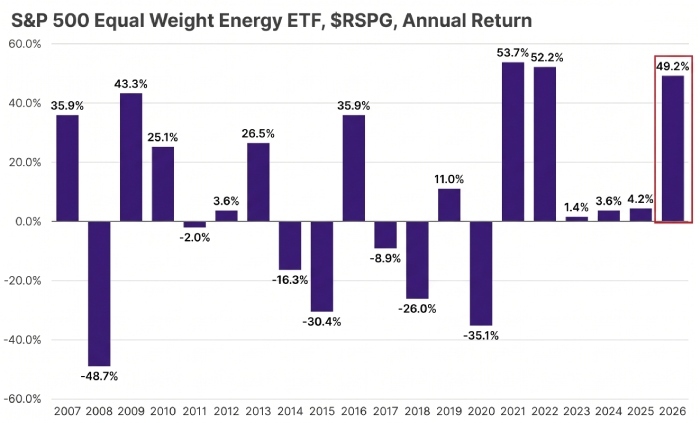
The Invesco S&P 500 Equal Weight Energy ETF (RSPG) has surged more than 49% this year, compared with a roughly 11% gain for the S&P 500, according to Investing.com.
RSPG is on track for its third-best annual return since 2006, trailing only 2021 (53.7%) and 2022 (52.2%). It's also heading for its sixth consecutive annual gain, its longest-ever winning streak.
The fund has climbed another 7.5% over the past two weeks, putting a new annual return record within reach.
Big Oil's windfall
The industry's windfall is already showing up in earnings. ExxonMobil reported $14.5 billion in second-quarter profits, more than double the $7.1 billion it earned a year earlier.
Chevron's quarterly earnings surged to $12.1 billion from $2.5 billion.
Exxon also expects higher refining margins to boost third-quarter downstream profits by $4.5 billion from the previous quarter.
Trump has pledged to refrain from strikes on Iran until after the midterms, if at all. But renewed military preparations have raised fears of another escalation.
And oil prices have already rebounded 65% from their July low.
📌 Bottom line: For passive index investors, a crash in energy stocks isn't a big deal because the energy sector makes up less than 4% of the S&P 500. But for investors who have piled into energy stocks, an Iran deal could become a problem.
JPMorgan's "base case": Bitcoin outperforms stocks, bonds, and gold over the next decade
2026 has been a difficult year for Bitcoin, but JPMorgan analysts expect the cryptocurrency to outperform traditional assets over the next decade.
Bitcoin could more than double by 2036
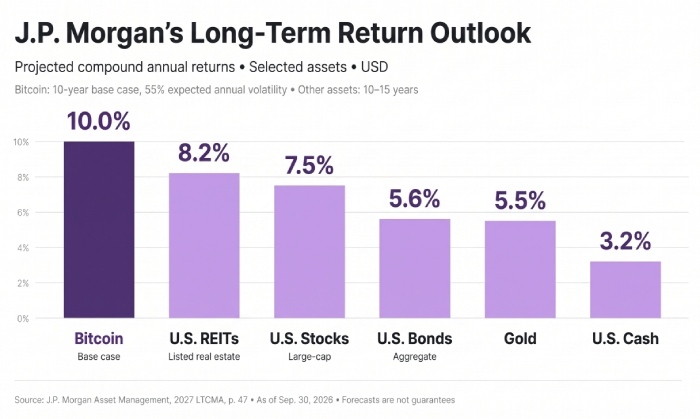
In its latest long-term capital market assumptions, JPMorgan projects Bitcoin will deliver annualized returns of 10% over the next decade, higher than U.S. REITs, U.S. stocks, bonds, gold, and cash.
At Bitcoin's current price of around $80,000, a 10% compound annual return would put it above $207,000 by 2036.
For comparison, JPMorgan expects annualized returns of 7.5% for U.S. large-cap stocks, 5.6% for bonds, and 5.5% for gold.
Bitcoin ETFs are changing the ownership picture
Before U.S. spot ETFs were approved, individual investors were the biggest Bitcoin buyers. But that's changed because Institutional investors now have easier access to Bitcoin through regulated investment products.
U.S. spot Bitcoin ETFs have accumulated nearly 1.3 million BTC since launching in early 2024, accounting for more than 6.1% of the total supply, according to BitBo data.
At current prices, those holdings are worth more than $104 billion.
One caveat is that JPMorgan's 10% return forecast assumes annual Bitcoin volatility of 55%, meaning investors should expect quite a roller coaster along the way.
The real test is whether institutional investors will tolerate those swings for a projected return just 2.5 percentage points above U.S. stocks.
📌 Bottom line: After a year or so of radio silence, Wall Street is once again warming up to Bitcoin as a portfolio diversifier relative to traditional assets and gold.