Great news from Asian chipmakers

Morning Observers,
Asian chipmakers dropped two important reports this morning.
Samsung released preliminary Q3 revenue (+127% YoY) and earnings (+783% YoY). TSMC reported its September revenue (+51% YoY).
At first glance, Samsung's numbers look wild, and at almost any other point in time, a company delivering this kind of earnings growth would be put on a Wall Street pedestal.
Yet despite the nearly eightfold surge in profits, the stock is down 2.5% this morning and 26% from its June peak.
Considering all the evidence (DRAM price increases, Samsung's margin expansion, and analyst estimates), this is overwhelmingly a memory pricing story.
Samsung may pull in enormous profits now that AI companies desperately need memory, but those profits can crash just as fast the moment that pricing power disappears.
This just shows how much scrutiny AI companies are under and how well the market is distinguishing between temporary bottleneck winners and structural AI winners.
That brings us to TSMC.
TSMC's numbers are less headline-worthy, but they carry much more weight. Because it’s the world’s biggest chip foundry, its revenue is a much better indicator of structural demand.
And the numbers didn't disappoint. Now that September revenue is in, we know TSMC wrapped up Q3 with 51% revenue growth and a beat.
That means chip demand is still alive and kicking. And considering high-performance computing makes up the majority of TSMC's revenue, much of that growth is likely coming from U.S. chipmakers.
Plus, because TSMC guided for a slight drop in margins in Q3, we can assume the revenue increase is a result of more orders rather than margin expansion.
So if Samsung can retain these margins on memory and TSMC continues beating expectations on demand, this coming earnings season is looking up for the AI trade.
Probably not without a reason Big Tech has been doing so well lately.
- Dan Runkevicius, Editor

📈 10-year Treasury yield breaks 5.35%
The 10-year Treasury yield climbed above 5.35% on Wednesday for the first time in 24 years, as stocks fell and oil prices jumped. It has risen more than 140 basis points from its low before the Iran war, which is pushing up borrowing costs across the economy.
🚀 SpaceX wants $40 billion for Nvidia chips
SpaceX is in talks with banks and investors to raise $40 billion to finance Nvidia chip purchases. The proposed financing includes $10 billion in bank loans and $30 billion in investment-grade debt, as Elon Musk's companies face what he has described as "insatiable" demand for AI computing power.
🤖 UBS favors AI winners as yields stay high
Long-term Treasury yields may remain high even if the Fed stops raising rates, as investors demand more compensation to hold government debt, according to UBS's Ulrike Hoffmann-Burchardi. She recommends staying invested in companies benefiting from AI-driven productivity while diversifying across stocks and high-quality fixed income. Within bonds, she favors shorter durations.
📉 Short sellers pile into small caps
Short interest in the Russell 2000 has climbed to 8% of shares outstanding, the highest level since at least 2019 and nearly double its level at the start of 2025, according to JPMorgan data. The increase follows another rough quarter for small caps: the S&P 500 beat the Russell 2000 by 9.6 percentage points in Q3, the widest gap since the first quarter of 2020.
🛒 Consumers expect inflation to rise again
Americans' one-year inflation expectations rose to a median 3.9% in September, according to the New York Fed's latest Survey of Consumer Expectations. Households also reported weaker finances for a second straight month, even as expected spending growth climbed to its highest level since May 2023.
Michael Burry's $175 billion AI accounting problem may not be a problem after all
Michael Burry of The Big Short thinks Big Tech is overstating the strength of its AI business through shady accounting. Steve Eisman, who also made millions betting against the subprime mortgage market, thinks Burry is focusing on the wrong thing.
Who's right could have enormous implications for AI stocks and their valuations.
The $175 billion depreciation debate
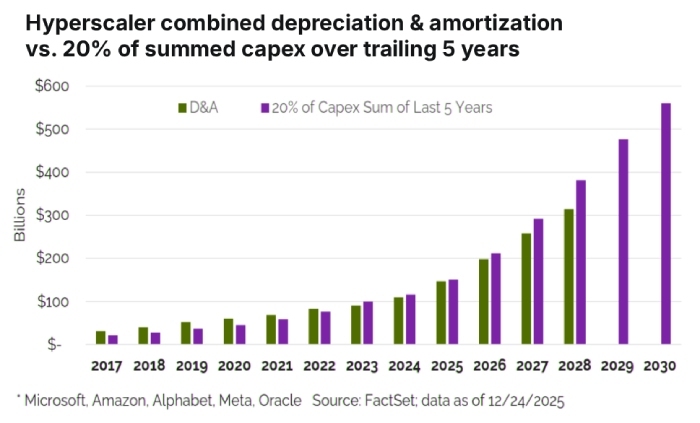
Burry estimates that hyperscalers including Microsoft, Amazon, Alphabet, Meta Platforms, and Oracle will understate depreciation by more than $175 billion between 2026 and 2028.
His argument is that AI chips are becoming obsolete faster than Big Tech is accounting for.
Hyperscalers have extended the expected life of some equipment from 3-4 years to 5-6 years, allowing them to record smaller depreciation expenses each year and, in turn, higher profits.
While Eisman agrees with the accounting logic, he doesn't think older chips have outlived their use.
Old chips are still making money
"His argument is too academic," Eisman recently told the New Money podcast.
Eisman believes demand for computing power is so strong that older chips still command high prices, even as Nvidia rolls out newer hardware.
Nvidia CEO Jensen Huang recently offered some evidence for Eisman's case. Rental prices for Nvidia's older H100 GPUs rose 22% in August to $3.28 an hour, even as newer generations entered the market.
So while Burry focuses on how quickly the chips become outdated, Eisman is looking at how long they remain commercially useful.
📌 Bottom line: For hyperscalers spending billions on Nvidia hardware, another year or two of useful life means more time to earn back the original investment. Burry's case gets harder to make if the chips he considers obsolete still command strong prices years later.
The S&P 500's diversification problem is bigger than Big Tech
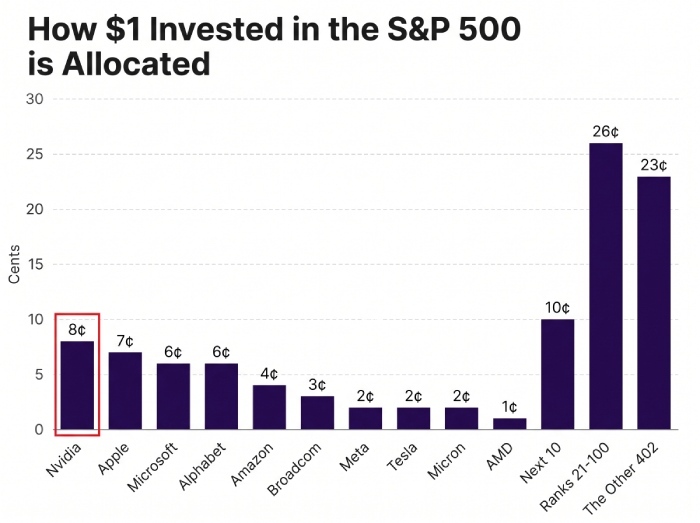
A bet on the S&P 500 Index was intended to be a bet on the U.S. stock market. But now, roughly 41 cents of every dollar invested in the large-cap index goes to just 10 stocks.
More surprisingly, even money outside the stock market isn’t providing the same diversification it once did.
The myth of diversification
According to data from Citadel Securities, 8 cents of every $1 invested in the S&P 500 goes toward Nvidia, 7 cents toward Apple, 6 cents each to Microsoft and Alphabet, and 4 cents to Amazon.
The next five mega-cap names, Broadcom, Meta Platforms, Tesla, Micron, and AMD, represent another 10 cents combined.
The top 10 stocks now account for nearly twice the allocation of 402 other companies in the index, which together account for just 23 cents of every $1.
According to S&P Global, the 10 largest companies in the S&P 500 now have their greatest weight in the index since the mid-1960s.
The diversification problem goes beyond stocks
The concentration problem has made the traditional 60/40 portfolio less reliable, according to BlackRock.
Stocks have become more concentrated, while bonds have become a less reliable hedge. Since 2020, bonds have declined in 17 of the 19 months when stocks fell by at least 2%.
This poor track record is one reason BlackRock says investors are looking beyond the traditional 60/40 portfolio for diversification, including alternative assets that can move independently.
📌 Bottom line: Passive investors may need to reconsider what counts as a "diversified" portfolio. If stocks are increasingly driven by the same handful of companies and bonds aren’t consistently offsetting losses, the traditional mix leaves less room for error.