🎉 Good news for AI bulls

Morning Observers,
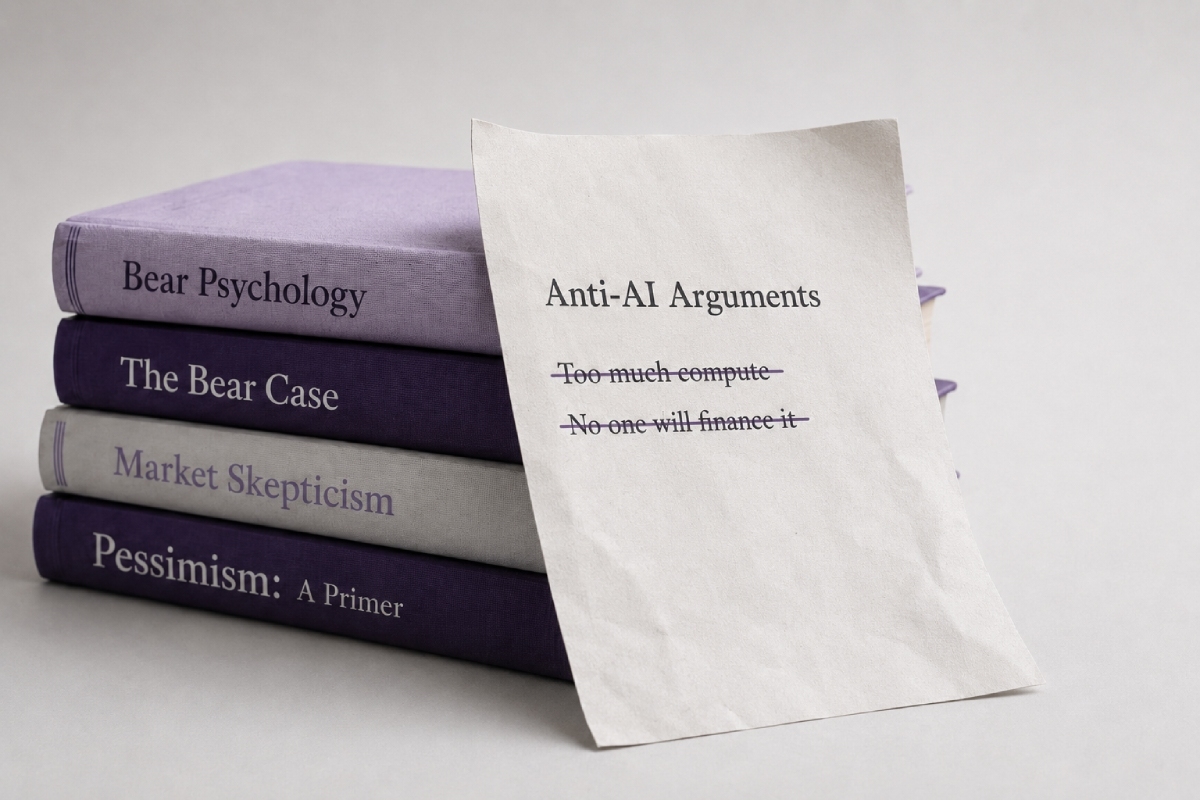
Two of the biggest arguments against the AI trade have been debunked within 24 hours.
The first is that we are building far more AI infrastructure than anyone actually needs. Earnings from neocloud giant CoreWeave just proved the opposite.
The company's revenue backlog climbed to roughly $104 billion, with another $25+ billion in customer commitments already added in early Q3.
In other words, despite hundreds of billions already poured into AI infrastructure, compute is still scarce.
The second bear argument has been harder to dismiss: Who is going to keep paying for all of this?
Until now, much of the AI boom has ultimately depended on the balance sheets of a relatively small group of hyperscalers, AI companies, and Nvidia itself.
That raised concerns about circular financing, especially when Nvidia began helping customers finance infrastructure that would ultimately buy more Nvidia chips.
But this week, Nvidia convinced Wall Street to take over its role as financier.
It struck partnerships with Apollo, BlackRock, Blackstone, Brookfield, Goldman Sachs, and KKR to create financing platforms designed to mobilize more than $500 billion in third-party capital for AI infrastructure.
Individual projects will be independently underwritten rather than simply financed by Nvidia.
That's potentially very bullish for the AI trade.
If demand is outrunning available compute at the same time that trillions of dollars of institutional capital are figuring out how to finance more supply, this infrastructure cycle may have considerably more runway than the bears expect.
Of course, that's contingent on these partnerships not being just part of an Nvidia PR gimmick because that $500 billion is not a commitment.
Let's dive in!
- Dan Runkevicius, Editor

🏅 Individual investors are pouring back into gold
Appetite for gold appears to be returning. The SPDR Gold Trust (GLD), the largest U.S. physically backed gold ETF, has attracted roughly $1.4 billion so far in August, putting it on pace for its first positive month of inflows since February, according to JPMorgan data.
💉 Hims & Hers runs into the GLP-1 margin trap
Hims & Hers reported a wider-than-expected second-quarter loss because its shift from high-margin compounded GLP-1 drugs to branded pharmaceuticals drove up costs. Even though its revenue has climbed to more than $753 million, and subscribers have increased by more than 300,000, Hims' strong growth increasingly comes at the expense of profitability.
💴 Yen intervention is already losing its punch
The Japanese yen is weakening again despite coordinated U.S.-Japan intervention aimed at supporting the currency. The dollar climbed back above 159 yen and erased a significant portion of the yen’s initial gains. The reversal underscores how difficult it is to rein in the yen’s decline driven by Japan’s relatively low interest rates and persistent carry-trade demand.
🛢️ Hormuz optimism is back
Pakistan says the U.S. and Iran are moving closer to an agreement over the Strait of Hormuz, despite the fact that rhetoric between Washington and Tehran remains heated. But with U.S. commercial crude inventories already at 45-year lows, markets are looking for concrete evidence that energy shipments through one of the world’s most important oil chokepoints can normalize.
🤖 Claude’s invisible watermark sparks a backlash
Anthropic is rolling out invisible, machine-readable watermarks for text generated by newer Claude models, with some files also carrying signed provenance data showing Claude was involved in creating them. The system is meant to comply with new EU AI transparency rules, but users cannot opt out, and some writers and developers are pushing back over fears that even lightly edited or proofread text could be flagged as AI-generated.
Japan’s $96 billion bond problem
Japan’s bond selloff has already rattled global currency markets. But the bigger risk may be lurking on the balance sheets of some of the country’s largest financial institutions.
$96 billion and counting
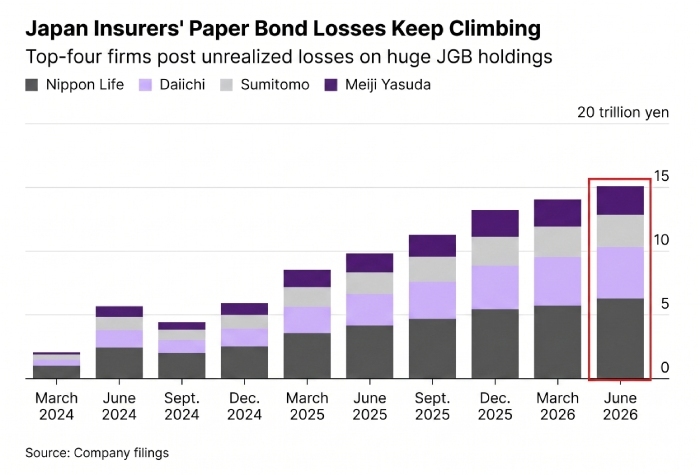
Unrealized losses on domestic bonds held by Japan’s four largest life insurers rose another 7% in Q2 to a record $96 billion, according to company filings.
Nippon Life, Daiichi Life, Sumitomo Life, and Meiji Yasuda all reported higher losses. It was the seventh consecutive quarterly increase, with the total more than tripling over that period.
The culprit is surging long-term Japanese yields, which have crushed the value of bonds insurers already own.
The 30-year JGB yield topped 4% in May for the first time since the maturity was introduced in 1999, as concerns over increased government spending sent yields sharply higher.
Normally, that isn’t a crisis. Life insurers buy long-dated bonds to match long-dated liabilities, meaning they can often hold them to maturity and ignore swings in market value.
However, a surge in policy cancellations or other liquidity needs could force insurers to sell bonds at depressed prices, turning paper losses into real ones.
The risk is who has to sell first
There’s a second-order problem that could matter even before that happens.
Japan’s insurers are major buyers of government debt. As losses pile up, they could become less willing or able to absorb new long-term JGB issuance.
This creates an uncomfortable feedback loop: fewer natural buyers push yields higher, which deepens insurers’ losses and further weakens demand.
📌 Bottom line: If one of the government’s biggest natural buyers retreats as borrowing needs rise, the next leg higher in JGB yields could become much harder to contain.
Wall Street’s profit boom has a big asterisk
Corporate America is supposedly in the middle of an AI-driven profitability boom.
There’s just one problem: so far, nearly all the margin expansion is happening at the companies selling the technology, not the ones buying it.
And the gap is getting much harder to ignore.
AI’s profits aren’t trickling down
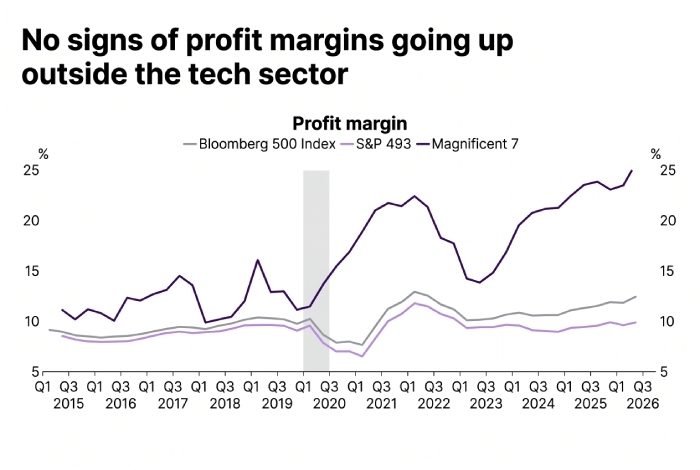
Profit margins for the Magnificent 7, Apple, Microsoft, Alphabet, Amazon, Nvidia, Meta, and Tesla, have climbed to roughly 25%, more than doubling from a decade ago.
Meanwhile, margins for the other 493 S&P 500 companies have barely budged.
Healthcare margins have roughly halved since 2018, consumer staples are near 6%, consumer discretionary is around 8%, and energy and materials have surrendered most of their 2022–23 gains.
That means despite rising AI adoption, non-tech stocks aren't seeing a payoff in terms of productivity yet.
The trillion-dollar ROI problem
The risk here is that the AI investment boom is becoming increasingly important to the economy without yet delivering productivity gains for corporate America.
“The longer it takes the S&P 500 to generate ROI,” Apollo chief economist Torsten Slok cautioned, “the bigger the downside risks to an economy and a market this concentrated in the AI trade.”
The stakes are getting bigger. AI-related investment is already contributing to U.S. GDP at an annualized rate of $1.5 trillion this year, according to Commerce Department data.
📌 Bottom line: If ROI doesn’t start showing up across the S&P 493, the spending fueling both economic growth and Big Tech’s record profits could become the first thing companies cut.