Gold's historic asymmetry


Morning Observers,
Bhanu Baweja's (UBS) op-ed about a new asymmetry in gold is making the rounds on the internet. So what does it mean for your portfolio?
The chart below shows the relationship between gold prices and real yields since 2003.
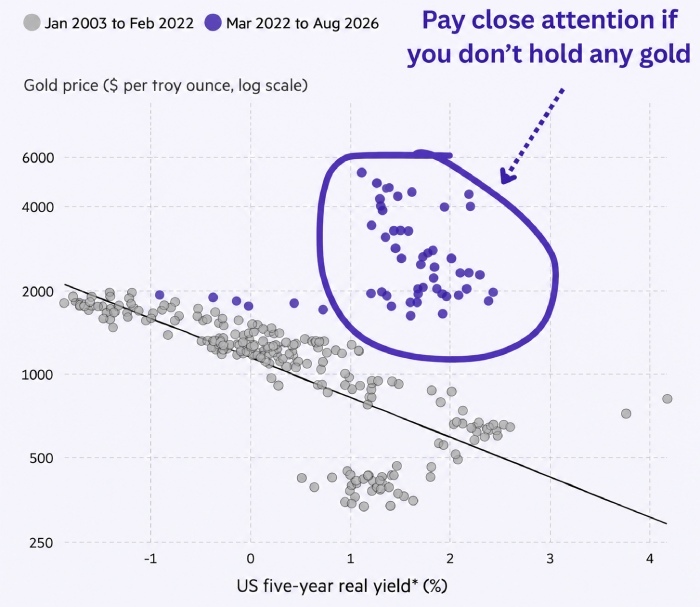
Grey dots represent the period before Russia's invasion of Ukraine, when gold was symmetrically responsive to real yields.
When real yields rose, gold prices tended to fall. And vice versa, when real yields fell, gold prices went up.
This is how gold is supposed to work in an ideal world, and the reason simply comes down to the opportunity cost of holding gold.
Because gold doesn't generate any income, its price has to be attractive enough to offset the lost income from money invested elsewhere, e.g., bonds.
For this very reason, a 1 percentage point increase in real yields typically led to a 14% decrease in gold prices.
The downside of this relationship broke down after Russia invaded Ukraine and the West seized its reserve assets (see violet dots).
Since then, gold has typically risen when real yields fell, but it refused to retreat when real yields rose.
By Baweja's estimates, between March 2022 and October 2023, when real yields rose by 4 percentage points, gold was supposed to lose nearly half of its value. Instead, it rose 7%.
There are two main reasons behind this asymmetry.
First, yield-agnostic central banks started hoarding gold and became the biggest marginal buyer.
The seizure of Russia's assets was a wake-up call not to put all eggs in dollar-denominated assets. And Trump's erratic policies have only made the dollar system look less dependable.
This is ushering central banks into swapping Treasuries and dollars for gold.
Second, gold has become the new bond. While bonds are yielding much more than a few years ago, they are the most positively correlated with stock prices in two decades.
Because of constant supply shocks, from oil and food to chips, the market is more often pricing in a stagflationary crisis than an ordinary recession driven by a demand shock.
This is the scenario in which both bonds and stocks tend to lose value.Recession = lower earnings -> lower stock prices. Inflation = higher yields -> lower bond prices.
That explains both high stock allocations and rising allocations to gold.
Buffett famously trashed gold as one of the worst investments because it doesn't generate income or earnings that can eventually be returned to shareholders.
But gold isn't an investment. It's an insurance policy, and with any insurance, the best-case scenario is never having to use it.
- Dan Runkevicius, Editor

📈 Wall Street keeps raising the earnings bar
After a blockbuster second-quarter earnings season, Wall Street is still betting on more upside from corporate America. More analysts have raised U.S. earnings estimates than cut them for 21 consecutive weeks, according to Citigroup data. The streak suggests that AI-related investment and a resilient economy so far offset high borrowing costs and persistent inflation.
🇨🇦 Canada pivots to Europe
Canada is deepening its ties with Europe as its trade relationship with the U.S. becomes more strained. European Commission President Ursula von der Leyen is expected to unveil new trade and security initiatives with Canada on Sept. 16 alongside Prime Minister Mark Carney. The push builds on a partnership that has already expanded into energy, technology, critical minerals, and defense.
🛢️ Oil flirts with $100
Brent crude broke above $99 a barrel Tuesday for the first time since July 24 as the U.S. and Iran exchanged strikes around the Strait of Hormuz. The renewed fighting pushed oil closer to $100 and raised concerns that another jump in energy prices could add to inflation.
⚡ Qualcomm lands Amazon
Qualcomm, the world's largest maker of smartphone processors, signed Amazon as a data center chip customer in a deal spanning "multiple generations." The agreement gives Amazon the right to buy up to $4 billion of Qualcomm stock, with the warrants tied to as much as $60 billion in business between the companies. Qualcomm stock briefly jumped more than 7% Tuesday.
🎲 Prediction markets get another heavyweight deal
Robinhood is expanding its prediction market business through a new partnership with Crypto.com, agreeing to offer the exchange's yes-or-no event contracts and take minority stakes in both Crypto.com and its prediction-market business, OG. The popularity of prediction markets is exploding, with Bernstein estimating annual trading volume could grow from $51 billion in 2025 to $1 trillion by 2030.
Big Tech’s $500 billion depreciation problem
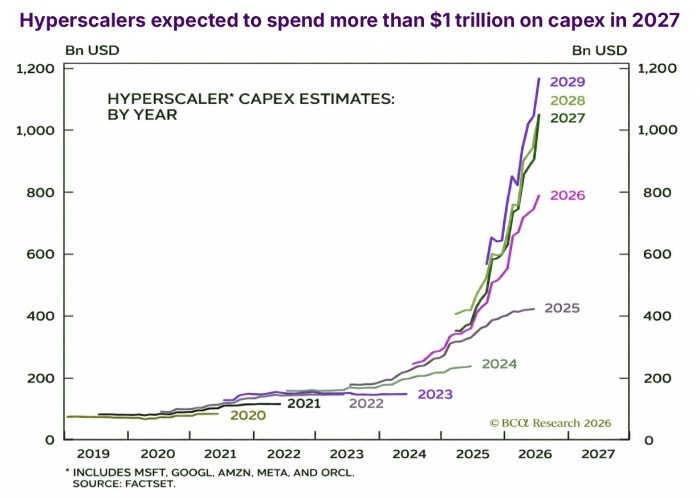
Big Tech's AI spending spree is creating an expense that will soon be much harder to ignore.
Depreciation at Amazon, Microsoft, Alphabet, Meta, and Oracle is projected to exceed $500 billion a year by 2030. That's roughly on par with the combined operating profits of all five companies expected this year.
Capex is turning into depreciation
The five hyperscalers are expected to spend more than $1 trillion on capex in 2027, much of it on the data centers, chips, and other infrastructure behind AI.
Depreciation has already climbed from less than $100 billion in 2020 to roughly $250 billion today. BCA Research's Peter Berezin expects it to more than double by the end of the decade.
"Hyperscaler depreciation expense is set to jump to over $500 billion by 2030, equal to the expected operating profits of all five companies in 2026," Berezin wrote.
While that level of depreciation would normally weigh on earnings, Wall Street expects hyperscalers to outgrow that cost line.
Analysts are betting on a margin boom
So how do hyperscalers absorb more than $500 billion in depreciation? Wall Street expects profits to grow even faster.
Analysts see EBITDA margins climbing from roughly 37% today to more than 50% by 2030, enough to keep depreciation from taking a much bigger bite out of net earnings.
Berezin is skeptical. He estimates hyperscalers would need to generate trillions of dollars in annual revenue to justify their AI investments.
📌 Bottom line: There's a lot of financial alchemy in how today's earnings are being attributed to AI. The coming depreciation boom will be the ultimate test of whether earnings can grow fast enough to absorb it.
The AI debt boom is creating a dangerous feedback loop
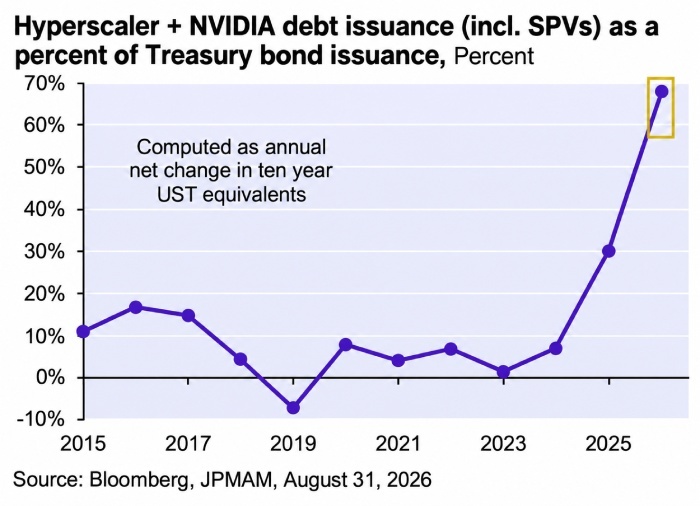
The AI boom is creating a new problem for the bond market.
It's not just driving up tech inflation, but also forcing Big Tech to borrow at a scale that is becoming impossible for fixed income investors to ignore.
The AI debt boom is getting bigger
Big Tech and its special purpose vehicles, separate entities often used to finance large projects, are expected to issue a record $320 billion of bonds this year.
That's up $120 billion, or 60%, from last year.
The number is even more striking when compared with the Treasury market. Big Tech bond issuance is expected to equal roughly 70% of Treasury bond issuance this year.
That's more than double its share in 2025 and nearly nine times its 2024 level.
The point isn't simply that hyperscalers are competing with Washington for investors' money. It's the speed and scale of the change.
In just a few years, the AI buildout has created a new source of long-term debt that is large enough to alter the balance of supply across the entire credit market.
The bond market is asking for more compensation
The timing is not ideal for the Treasury.
The 10-year Treasury recently topped 4.8%, while the 30-year climbed above 5.2%, near levels last seen around 2007.
The Treasury has doubled its long-dated bond buybacks and even considered tapping its general account. But those measures have only temporarily slowed the rise in yields.
That suggests the problem is bigger than a single auction or a temporary inflation scare.
Investors are being asked to absorb more long-duration debt from both the government and the private sector. And because many of those investors are price-sensitive, they can demand higher yields or move into other assets if the compensation is not attractive enough.
The AI boom could create a feedback loop
The irony is that AI is supposed to make the economy more productive and help support growth. But before those productivity gains arrive, the buildout requires enormous upfront borrowing.
That creates a feedback loop: More AI spending creates more bond issuance. More bond issuance raises yields. Higher yields make it more expensive to finance the next round of data centers and chips.
And that may force Big Tech to borrow even more aggressively before it starts generating enough cash to fund the buildout itself.
📌 Bottom line: The AI boom is no longer just a technology story. It is becoming a major source of bond supply.