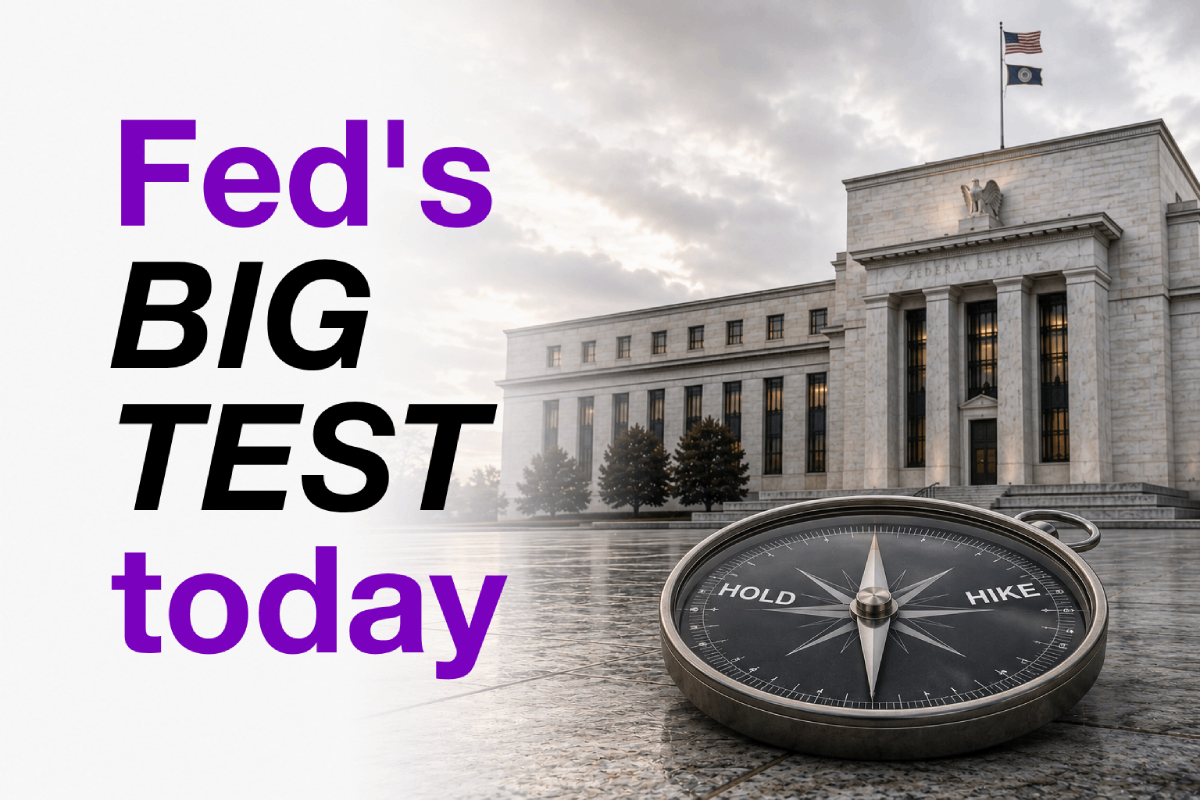
🏦 Fed's big test today

Morning Observers,
Wall Street is heading into Fed day with something it has almost forgotten how to handle: a genuine surprise.
Traders currently see roughly a 68% chance that the Federal Reserve holds rates steady today and about a 32% chance that it raises them by 25 basis points.
That makes a hold the most likely outcome, and the market is pricing in exactly that. But it is nowhere near the level of certainty investors became accustomed to under Jerome Powell.
In fact, Bank of America found that since 1994, the Fed has never raised rates when markets were pricing less than a 60% chance of a hike beforehand.
So if Kevin Warsh raises rates today, he will not merely be tightening monetary policy but also breaking with more than three decades of carefully choreographed Fed decisions.
And that may be exactly the point.
Since taking over the central bank, Warsh has deliberately stepped away from the Powell-era practice of telling markets what the Fed intends to do weeks before it does it.
He wants every meeting to be genuinely “live.” Today is the first real test of whether he meant it.
Let's dig in!
- Dan Runkevicius, Editor

📉 Nasdaq 100 edges toward correction
The Nasdaq 100 is on the cusp of a correction after falling for a fifth consecutive session, led by semiconductor stocks. Jefferies analyst William Beavington said investors are shifting from the AI trade’s early excitement to demanding proof that the industry’s massive spending will ultimately generate meaningful returns.
🏗️ BlackRock bankrolls Meta’s AI expansion
Meta is partnering with BlackRock on a massive 1-gigawatt data center complex in Texas, highlighting how Wall Street is increasingly financing Big Tech’s AI ambitions. BlackRock will reportedly cover about 80% of the project’s cost, underscoring confidence that demand for AI infrastructure will remain strong despite growing investor scrutiny over the sector’s profitability.
🇨🇳 China's AI race puts Nvidia back in focus
Chinese startup Moonshot AI is reportedly seeking additional Nvidia Blackwell chips to train the next version of its Kimi model, a sign that competition with U.S. AI leaders continues to intensify. The launch of Kimi K3 earlier this week rattled AI-related stocks, and renewed demand for Nvidia’s most advanced hardware is likely to fuel further debate over China’s ability to narrow the gap with companies like OpenAI and Anthropic.
🚀 SpaceX’s $1.2 trillion roundtrip
SpaceX has shed roughly one-fifth of its market value since reaching a record high in mid-June, wiping out more than $1.2 trillion in market capitalization as investors rotate away from higher-risk technology names. The stock now sits nearly 47% below its post-IPO peak, while short interest has climbed to around 30% of the available float, suggesting many traders expect further downside if it breaks below $100.
💳 PayPal’s turnaround gains traction
PayPal delivered stronger-than-expected second-quarter results, with its restructuring efforts continuing to show progress. Adjusted earnings and total payment volume both topped Wall Street estimates, providing another sign that the payments company is stabilizing after a difficult stretch. Even so, PayPal remains below the $60-per-share takeover proposal made earlier this year by Stripe and Advent.
The part of China everyone forgot to watch
For years, the China narrative has revolved around everything that isn’t working: a property bust, weak consumer spending, and persistent deflation.
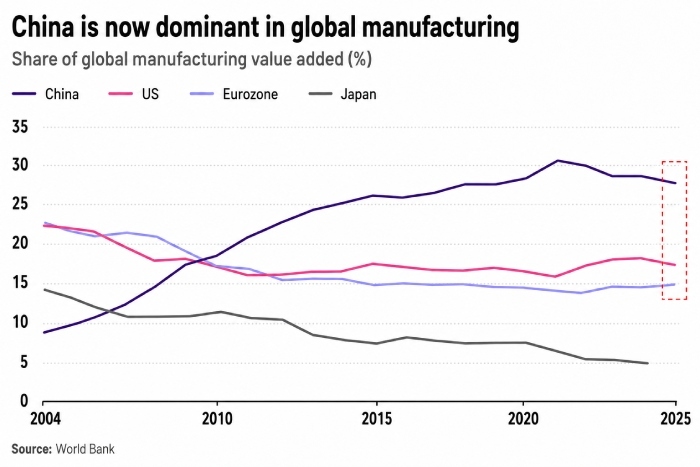
Yet while investors obsessed over apartment prices, China’s factories quietly kept taking market share from the rest of the world, tightening the country’s grip on global manufacturing.
China’s factory boom never really ended
China now produces roughly 28% of the world’s manufacturing output, according to World Bank data. That’s more than the U.S., Eurozone, and Japan individually, and the share has nearly tripled since 2004.
The U.S., by comparison, has seen its share fall from roughly 22% to 17% over the same period.
In other words, China’s economy may have slowed, but its manufacturing dominance has only grown.
And increasingly, that manufacturing isn’t just low-cost exports. It’s EV batteries, industrial automation, renewable energy equipment, power electronics, and other high-value hardware.
Markets figured it out before headlines did
This shift has shown up in stock markets long before it became a mainstream narrative.
The MSCI China Industrials Index, a benchmark tracking China’s large and mid-sized industrial companies, has generally outperformed the broader MSCI China Index since 2011.
So while property developers imploded and internet giants lost favor, industrial companies kept delivering returns.
The catch is that there isn’t an easy ETF tracking this specific index, making it harder for investors to ride the theme directly. But it’s still one of the best barometers for whether China’s industrial machine continues to pull ahead.
📌 Bottom line: China’s housing bust still dominates headlines, but the country’s industrial champions continue gaining global market share.
The software that's outperforming the market
Investors are indiscriminately treating software as the biggest loser of the AI boom. But that’s only half the story.
While many software companies have sold off, another group has not only escaped the “SaaSpocalypse” but also become one of the market’s biggest winners.
The software split
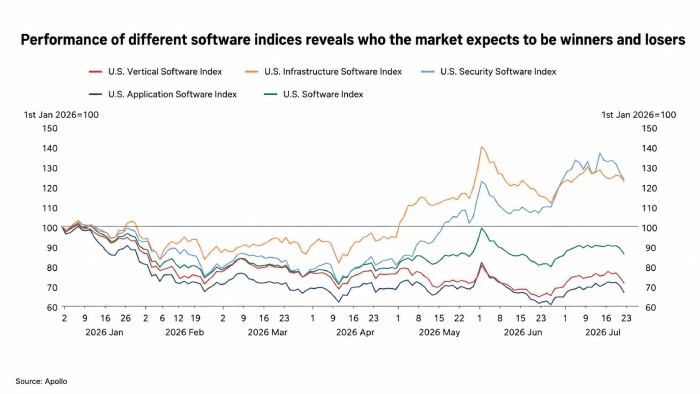
New data from Apollo shows a striking divergence since the start of 2026.
Security and infrastructure software stocks are up roughly 25%–30%, while business software companies are down by a similar amount. That’s a performance gap of more than 50 percentage points.
Meanwhile, the broader U.S. software index remains down about 10%.
Companies that provide AI infrastructure, cybersecurity, cloud monitoring, and data platforms are increasingly viewed as beneficiaries.
For example, Palo Alto Networks, CrowdStrike, and Datadog have surged between 50% and 80% this year, dramatically outperforming both the software sector and the broader market.
Meanwhile, companies selling software for everyday business tasks, from HR and accounting to CRM, are increasingly seen as vulnerable.
The SaaSpocalypse is real but selective
The divergence also explains why broad software funds have continued to disappoint.
The iShares Expanded Tech-Software Sector ETF (IGV) is down more than 15% this year, even as cybersecurity and infrastructure stocks have surged.
Investors increasingly expect AI agents to automate many existing software workflows, putting pressure on the subscription models that dominate much of the rest of the sector.
📌 Bottom line: The AI trade isn’t “software” versus “no software.” It’s more like infrastructure versus applications.