📉 Did Fed blow up Situational Awareness?


Morning Observers,
We’ve had two localized volatility events this year that wiped out a lot of capital but were effectively contained: the Korean stock market (KOSPI) and Situational Awareness.
Both imploded for the same reason: too much leverage in AI stocks.
And while these blowups haven’t yet turned into a 2008-style meltdown, policymakers are getting uneasy because leverage in the system just keeps growing.
Take anything: leveraged ETFs, margin debt, options positioning.
Almost every financial instrument that gives you disproportionate exposure for your cash is at or near an all-time high... and on a swoosh-like growth trajectory.
One explanation for why investors are getting so aggressive is that markets have become increasingly predictable. Even Trump’s policy back-and-forth has, in a way, become a pattern.
So Robert Armstrong (ex-Deutsche Bank) has a theory that Warsh is deliberately trying to bring volatility back into the market to flush out some of that leverage.
That may explain why he withdrew forward guidance and is now mulling less frequent Fed meetings.
Think of it as the wildfire paradox.
For years, policymakers have rushed to extinguish every small market fire before it could spread. But putting out every fire also allows the financial equivalent of dry brush to accumulate.
So at the end of the day, you risk turning what would have been a series of manageable corrections into one systemic blowup.
- Dan Runkevicius, Editor

📈 Wall Street risk appetite is soaring
S&P 500 call option volume reached an all-time high of 4 million contracts earlier this week, more than double the level seen just a few weeks ago. At the same time, demand for downside protection has fallen off a cliff, according to the S&P 500’s put/call skew. That suggests investors are increasingly confident the rally will continue.
🧠 AI chip rally hits another speed bump
Weaker results from memory chip makers are raising fresh questions about the AI trade. Shares of SanDisk and Western Digital fell after both companies issued disappointing revenue outlooks, weighing on the broader technology sector and sending the Nasdaq 100 lower. The results added to recent weakness in AI-related stocks and suggest investors are becoming more selective after this year’s strong rally.
🍔 DoorDash earnings say consumers are still spending
Strong DoorDash results suggest Americans are still willing to pay for convenience. The food delivery company beat second-quarter revenue expectations, with sales rising 35.6% to $4.45 billion, and issued a profit forecast above Wall Street estimates. DoorDash credited strong growth in its paid subscription program. The results suggest that consumer spending on convenience and everyday services remains resilient.
🚀 SpaceX’s share unlock is far from over
SpaceX shares rose on Thursday even as a massive wave of previously locked-up stock became eligible for trading. More than 900 million shares were unlocked, while options trading surged to its highest level since the company’s June IPO. SpaceX will gradually release shares through mid-2027, driving the stock price for years to come.
💰 Investors are pouring record money into ETFs
Demand for ETFs is on pace for another record year. According to Goldman Sachs data, U.S.-listed ETFs have attracted $1.2 trillion in investor inflows so far this year, already double the amount seen at this point last year and more than any full year on record except 2025.
The S&P 500 just vetoed the recession narrative
Wall Street can’t seem to decide whether the U.S. economy is slowing, stalling, or already in recession after weaker GDP revisions. The stock market, however, appears to have already cast its vote...
Stocks usually sniff out recessions first
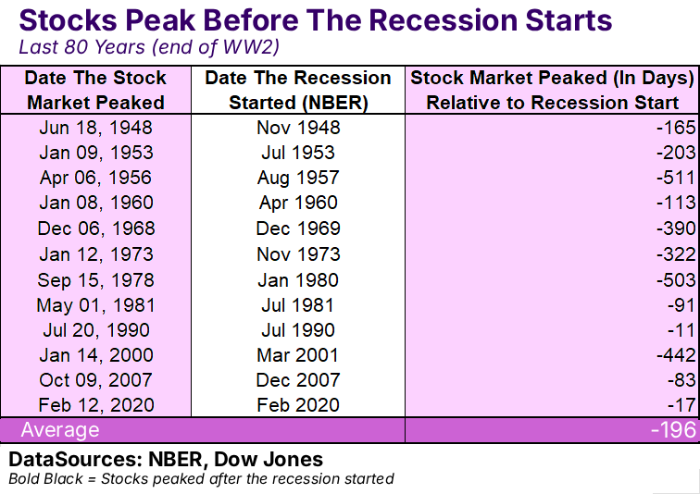
According to Bianco Research, stocks have never peaked after a recession begins.
Looking at every U.S. recession since World War II, the market topped out an average of 6.5 months before the National Bureau of Economic Research’s official recession start date.
The closest exceptions were both driven by extraordinary events: 11 days before the 1990 recession, following Iraq’s invasion of Kuwait, and 17 days before the Covid recession in 2020.
In other words, history suggests markets usually sniff out recessions months in advance.
The recession data isn’t as convincing as it looks
That doesn’t mean the economy is firing on all cylinders.
A prolonged government shutdown weighed on fourth-quarter 2025 growth, while severe weather and weak hiring weighed on the first quarter.
Yet neither the stock market nor the bond market is flashing the same warning.
The New York Fed’s recession probability model, based on the Treasury yield curve, currently puts the odds of a recession over the next 12 months at roughly 16%.
📌 Bottom line: Barring some external shock to the economy, investors appear more worried about persistent inflation than an imminent downturn.
The stock market has a bond market problem
For most of the past decade, rising Treasury yields were a sign the economy was getting stronger, corporate profits were improving, and stocks had room to rally.
That cause-and-effect doesn't work anymore.
The bond market just hit a 25-year extreme
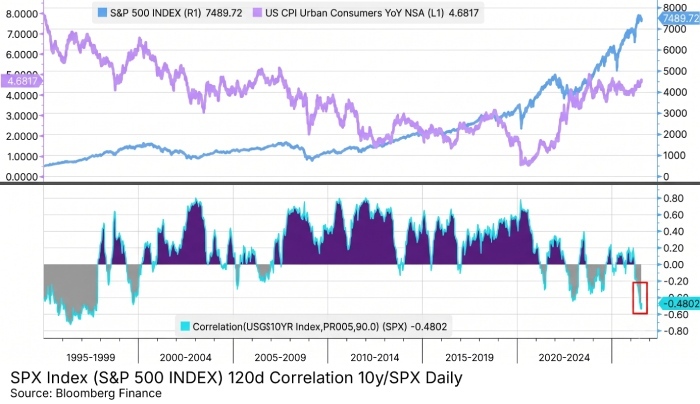
One way to measure the relationship between stocks and bonds is by looking at the 90-day correlation between the S&P 500 and the 10-year Treasury yield.
A positive reading means they generally move together; a negative reading means they move in opposite directions.
That relationship has now swung to an extreme. The correlation has now fallen to -0.48, its most negative reading since 1999 and even lower than the -0.42 reached during the 2022 bear market.
In practical terms, higher Treasury yields are no longer being interpreted as a sign of stronger growth. They’re increasingly acting as a drag on stock valuations.
The bond market is calling the shots
The biggest change is how investors are interpreting the bond market.
Before the pandemic, higher yields typically reflected confidence in economic growth. Today, they’re increasingly viewed as a symptom of policy risk.
That leaves stocks in an uncomfortable position.
The S&P 500 can continue making new highs, but every move higher in long-term Treasury yields now raises the hurdle for further gains, making money more expensive.
📌 Bottom line: If yields keep climbing, the biggest threat to this bull market may be the cost of money.