📉 CPI isn’t the whole story



Morning Observers,
America just auctioned off a 30-year bond at the highest yield since 2001.
There’s a lot of optimism that lower inflation is the answer to America’s debt problem, but higher prices aren't what’s driving long-term yields higher right now.
By various estimates, 80%–90% of this year’s increase in long-term Treasury yields has come from higher real yields (adjusted for inflation).
So if inflation isn’t the problem, what is?
Part of the answer is obvious. Washington is in a deep debt hole, and politics doesn’t help much either. But another part is that the people buying America’s debt have changed.
For years, some of the biggest Treasury buyers were the Fed and foreign central banks, which are relatively insensitive to price.
But since 2022, all marginal foreign demand for Treasurys has come from private investors! (Source: The Treasury Borrowing Advisory Committee.)
Same with domestic investors. Since 2021, half of the marginal demand for Treasurys has come from private investors, compared with 13% over 2009–2018.
Not only are private investors more price sensitive, but they also have options.
A mutual fund or insurance company doesn’t have to buy a 30-year Treasury just because Washington needs the money.
It can buy corporate bonds, mortgage debt, private credit, or any other asset. And right now, Uncle Sam has a very wealthy new competitor for that capital: hyperscalers.
Goldman Sachs expects hyperscalers to issue $400 billion worth of bonds next year, which is roughly 10% of what the entire U.S. government borrowed last year.
Those companies can offer investors Treasury yields plus an additional spread.
So the irony is that while all this AI spending is boosting GDP growth, at the same time, it's depriving America of cheap credit.
And this isn't just a theory. The Dallas Fed estimates that AI debt is equivalent to roughly one-eighth of the Treasury's duration supply this year.
BlackRock has also confirmed that hyperscalers are now competing directly with governments for capital.
Fun fact: In 2001, the Treasury actually stopped issuing the 30-year bond because it was deemed too costly for taxpayers. Washington was running a budget surplus, so it had a choice.
Not anymore.
- Dan Runkevicius, Editor

📉 Inflation delivers another welcome surprise
U.S. stocks climbed to record highs after July producer inflation came in below expectations, offering another sign that the recent energy-driven inflation may be subsiding. Headline PPI slowed to 4.7%, versus the 4.9% expected, while core PPI came in at 4.2%, matching forecasts.
💸 The U.S. just posted its biggest July deficit ever
Washington ran a record $432 billion budget deficit in July. Interest on the national debt jumped $26 billion from a year earlier to $118 billion for the month, bringing the fiscal-year total to $1.17 trillion. That means interest expense has now surpassed spending on national defense and Medicare.
💰 Corporate America is getting billions back from tariffs
Tariff refunds are starting to show up on corporate balance sheets, and some of the checks are enormous. The biggest reported refunds include nearly $2.2 billion for Apple, $986 million for Nike, roughly $800 million for FedEx, $640 million for Amazon, and $500 million for General Motors. For some companies, those refunds are large enough to provide a meaningful lift to earnings.
🤖 Cisco’s AI boom wasn’t big enough for Wall Street
Cisco crashed after its latest AI forecast failed to meet investors’ increasingly demanding expectations. The networking giant expects roughly $7.5 billion in AI data-center sales this fiscal year, even after accumulating $9.3 billion in AI-related orders over the past year. AI is projected to account for about 10% of Cisco’s expected fiscal 2027 revenue of $72.2 billion to $73.4 billion.
🏦 Investors are rotating from AI into banks
AI-wary investors are finding opportunity in a less flashy corner of the market: financials. The sector has been the S&P 500’s second-best performer over the past three months, behind only healthcare. The KBW Bank Index is also on track to outperform the broader market for a third straight year.
The Fed may have found its inflation escape hatch
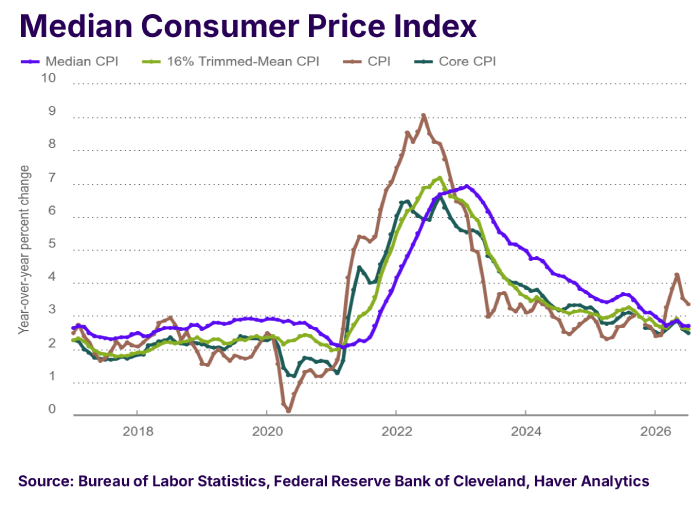
All eyes are on the monthly and annual CPI. But Goldman Sachs flagged another measure after the government’s latest inflation report: six-month annualized core CPI.
It fell to 2.5% in July, its lowest level in five years.
The six-month measure captures more of the recent trend than the standard 12-month reading, without overweighting any single month. As of now, it’s quietly closing in on the central bank’s 2% target.
That’s especially notable given fears that energy disruptions in the Persian Gulf would trigger a second inflation wave.
“Still very little evidence of the ‘second wave’ of inflation from the Iran war,” said Steno Research’s Andreas Steno Larsen. “Fed will likely continue to hold rates steady here.”
It’s not just one metric
The six-month core reading isn’t alone.
The 12-month median CPI, which tracks the price change in the middle of the distribution, away from a handful of extreme moves, slowed to 2.69% annually in July, according to The Wall Street Journal’s Nick Timiraos.
That’s its lowest level in five years.
The Cleveland Fed’s trimmed-mean CPI, which removes the biggest price increases and declines each month, also reached a five-year low at 2.6%.
📌 Bottom line: If these alternative inflation measures continue to move toward 2%, the Fed may be able to contain inflation without another hike, giving Kevin Warsh room to simply hold rates and wait.
Chip stocks are now as cheap as defensive healthcare
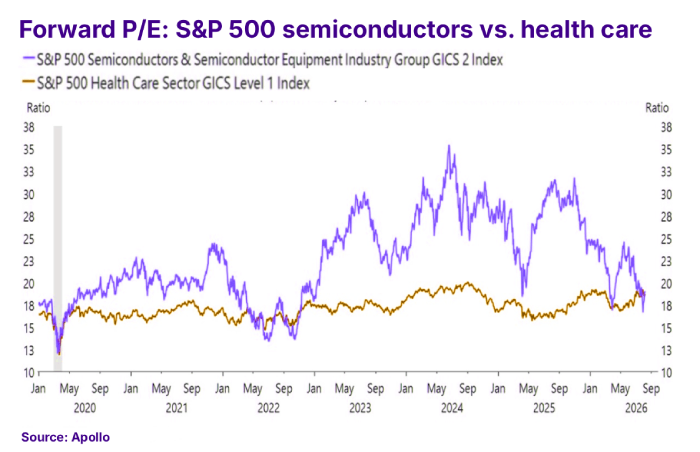
The AI boom has sent semiconductor stocks on a face-melting rally. But after the latest correction, these high-flyers now trade at roughly the same valuation as healthcare stocks.
The AI premium has vanished
After trading at dramatically different forward P/E multiples for much of the AI boom, the two S&P 500 groups are now valued at roughly 18–19x forward earnings, according to Apollo data.
Semiconductor valuations traded mostly in the high teens to low 20s in 2020–22 before climbing toward 30x in 2023 and eventually peaking near 35x in 2024 as investors piled into the AI trade.
During this period, healthcare barely moved. Its forward P/E has mostly stayed between 16x and 20x over the same period.
A valuation gap that once stretched into the double digits has now essentially disappeared.
Earnings estimates are doing some of the heavy lifting
The big reason semiconductor valuations have collapsed is that earnings expectations have pulled forward multiples lower.
Forward P/E is simply the price divided by expected earnings. So if analysts keep raising profit forecasts faster than chip stocks rise, the multiple falls even if the stocks themselves remain expensive in absolute terms.
And Wall Street is still expecting enormous profit growth from the industry.
Now if you’re weighing chips against healthcare stocks, valuation isn’t everything. The two sectors carry very different risks.
Healthcare earnings tend to be relatively stable. Semiconductor forecasts depend heavily on hyperscalers continuing to pour hundreds of billions of dollars into AI infrastructure.
So the valuation gap may be gone, but the earnings risk hasn’t.
📌 Bottom line: The usual criticism that chip stocks are simply too expensive has gotten much harder to defend. The bigger risk now is whether chipmakers can actually deliver the profits Wall Street is counting on.