📉 Chip stocks crash

Morning Observers,
The entire AI hardware boom has depended on a technology that China was not supposed to build.
It’s called deep ultraviolet lithography (DUV), and nearly every processor, memory chip, and AI accelerator passes through machines that use it.
A DUV lithography machine uses ultraviolet light to project microscopic patterns onto a silicon wafer, telling every other machine in the factory where to print billions of transistors inside it.
Modern chips can require as many as 100 of these patterned layers.
DUV technology is the predecessor to ASML’s newer EUV machines, which are used for the tiniest features. But every modern chip still relies on DUV equipment for most of the remaining layers.
Until now, only two companies could build competitive (immersion) DUV machines: ASML and Nikon. And most of the supply chain depended on Western products.
For example, ASML’s scanners use German ZEISS Group optics and American laser systems.
This Western monopoly on chip-printing equipment was the foundation of Wall Street’s belief that today’s chip shortage could last for years. Then the news broke.
An obscure state-backed company in Shanghai has begun manufacturing China’s first domestically produced immersion DUV machines (the more advanced type).
The initial units will go to SMIC, Hua Hong, and CXMT, a trio of chipmakers leading China’s effort to build processors, industrial chips, and DRAM without relying on Western equipment.
The catch is only five machines are expected this year, followed by approximately 20 in 2027. For perspective, ASML can currently produce around 130 immersion systems annually.
That's less than 4% of ASML’s output, and the machines reportedly remain behind ASML in reliability and performance.
So this is not the end of the chip shortage, and China is still years away from matching ASML.
On the other hand, you now have a state-backed company that Xi will give whatever it needs already putting its DUV machines into Chinese chip fabs.
With direct CCP support and rapid iteration, 20 machines can quickly become 50 or more.
China also doesn’t have to match ASML to disrupt global supply. It only needs machines that are good enough, cheap enough, and available in sufficient numbers to let Chinese fabs keep expanding.
That possibility throws a wrench into the assumption that demand for chips can grow almost indefinitely while the equipment required to manufacture them remains permanently scarce.
— Dan Runkevicius, Editor
|
|


🛢️ Fragile ceasefire knocks crude below $90
Investors are starting the week with renewed optimism after the U.S. and Iran avoided direct attacks for a third consecutive night. The de-escalation sent oil prices sharply lower, with Brent crude tumbling more than 7% to below $90 a barrel, less than a week after briefly topping $100. U.S. WTI also fell 6.7% to around $83 a barrel.
🚀 China just minted a $500 billion chip giant
Chinese memory maker CXMT surged an astonishing 466% in its trading debut, lifting its market value from roughly $85 billion at IPO pricing to nearly $500 billion. The blockbuster debut underscores investors’ appetite for domestic semiconductor champions as China continues pushing for chip independence.
🏦 1-in-3 chance Fed hikes on Wednesday
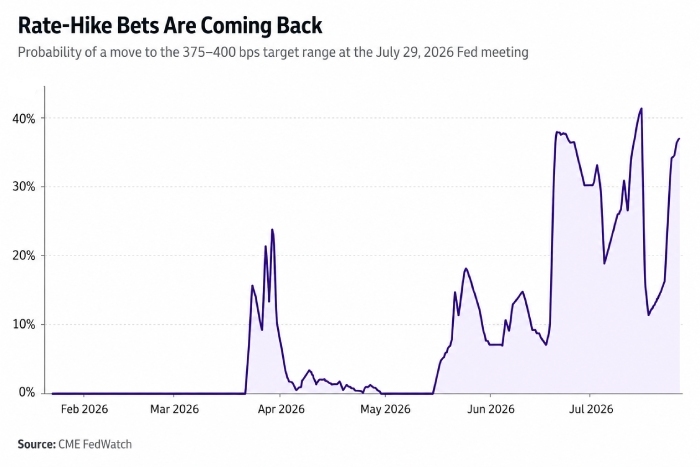
Markets now see a 33.7% chance the Federal Reserve raises interest rates at Wednesday’s policy meeting, a dramatic jump from just a week ago as Treasury yields continue climbing, according to CME Group. Traders are even pricing in better-than-75% odds of a hike by September, signaling that expectations for higher-for-longer rates are making a comeback.
📉 Chip stocks are still looking for a floor
Semiconductor stocks extended their slide for a third straight session, with the Philadelphia Semiconductor Index falling another 2%. The benchmark is now down more than 7% over the past three days and roughly 14% over the last month as investors continue taking profits after this year’s massive AI-driven rally.
🥪 IPO fever is spreading beyond tech
The next blockbuster IPO may not be another AI company. Jersey Mike’s Subs has reportedly attracted demand exceeding 10 times the shares available ahead of Wednesday’s pricing, highlighting that investor appetite for new listings is expanding well beyond the technology sector. The offering includes approximately 43.5 million shares priced between $21 and $25 each.
Micron may be replacing Nvidia as AI’s biggest bottleneck
For the past three years, investors have treated Nvidia as the company determining how fast AI can grow. But GPUs are becoming easier to find. Memory isn’t.
No company reflects that shift more clearly than Micron.
Margins unlike anything else in the semiconductor industry
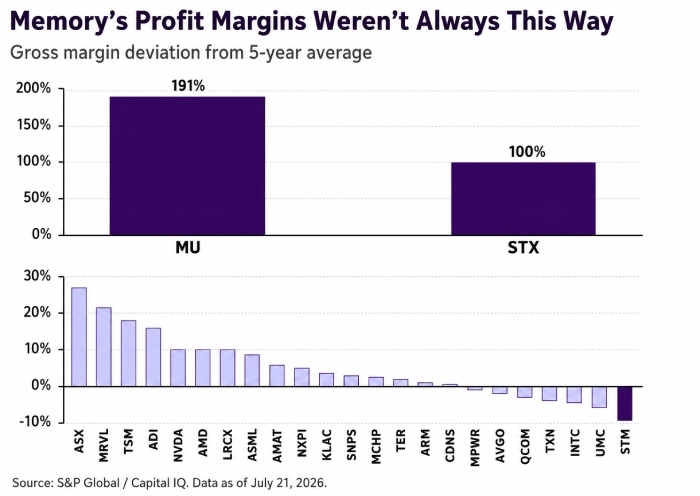
Even within the semiconductor industry, Micron stands alone. Its gross margin is 191% higher than its five-year average, according to S&P Global and Capital IQ data.
Seagate Technology ranks a distant second, with gross margins 100% above its historical average.
Most other semiconductor companies fall between 0% and 25% above their five-year averages, while companies such as Qualcomm, Intel, and United Microelectronics trade at or slightly below historical norms.
Why memory suddenly has pricing power
Micron’s margins reflect a severe supply-demand imbalance. AI servers require dramatically more DRAM and high-bandwidth memory than traditional servers, while expanding supply still takes years and tens of billions of dollars.
Building new memory capacity isn’t like flipping a switch. New fabs take years to build, making supply slow to respond even as AI demand accelerates.
That largely explains why Micron’s stock has surged more than 700% over the past year.
Whether those extraordinary gains prove sustainable depends on whether AI has permanently changed the economics of memory or whether this is simply another semiconductor cycle.
📌 Bottom line: If memory has become AI’s limiting resource, Micron’s extraordinary profitability may prove more durable than previous memory booms.
Why BoA’s Fed forecast may have been early, but not wrong
When Bank of America predicted the Fed would hike interest rates three times this year, it looked like one of Wall Street’s boldest calls.
Then oil fell below $70, tensions in the Middle East eased, and new Fed Chair Kevin Warsh sounded less eager to raise rates. Markets quickly wrote off BofA’s forecast.
Now it’s worth taking another look. Over the past week, several of the conditions BofA highlighted have quietly returned.
It was never just about oil
Higher oil prices initially push inflation higher, but the more interesting question is what happens after oil falls.
BofA argued that companies are quick to raise prices when fuel becomes more expensive, but much slower to lower them when costs fall. Airlines are a good example.
Airfares often jump after jet fuel rises, but they don’t usually fall by the same amount when fuel gets cheaper. Shipping companies and manufacturers often do the same thing.
That means a short-lived jump in oil prices can keep core inflation higher for much longer.
BofA also argued that oil doesn’t have to return to record highs to become a problem.
A price between $80 and $100 per barrel may be enough to keep inflation higher while leaving the job market strong enough that the Fed has no choice but to keep rates higher.
Warsh has a credibility problem
The second part of BofA’s forecast may be even more important. A new Fed chair will be judged on one thing above all else: whether inflation stays under control.
If Warsh raises rates too soon, he’ll be accused of unnecessarily slowing the economy. If he waits too long, he’ll be blamed for letting inflation take hold.
That dilemma suddenly matters a lot more than it did a week ago. Bond yields have climbed, and futures markets are now pricing in a 37% chance of a rate hike this week.
That may explain why some analysts expect this week’s Fed meeting to resemble a “family feud.”
A public split would be unusual, but it would also give Warsh the chance to show he isn’t simply following Jerome Powell’s lead.
📌 Bottom line: If this week’s Fed meeting reveals a committee that’s already debating higher rates again, the bank may have been early rather than wrong.