Broadcom drops a monster AI forecast


Morning Observers,
Broadcom just delivered one of the most aggressive forecasts of the entire AI boom.
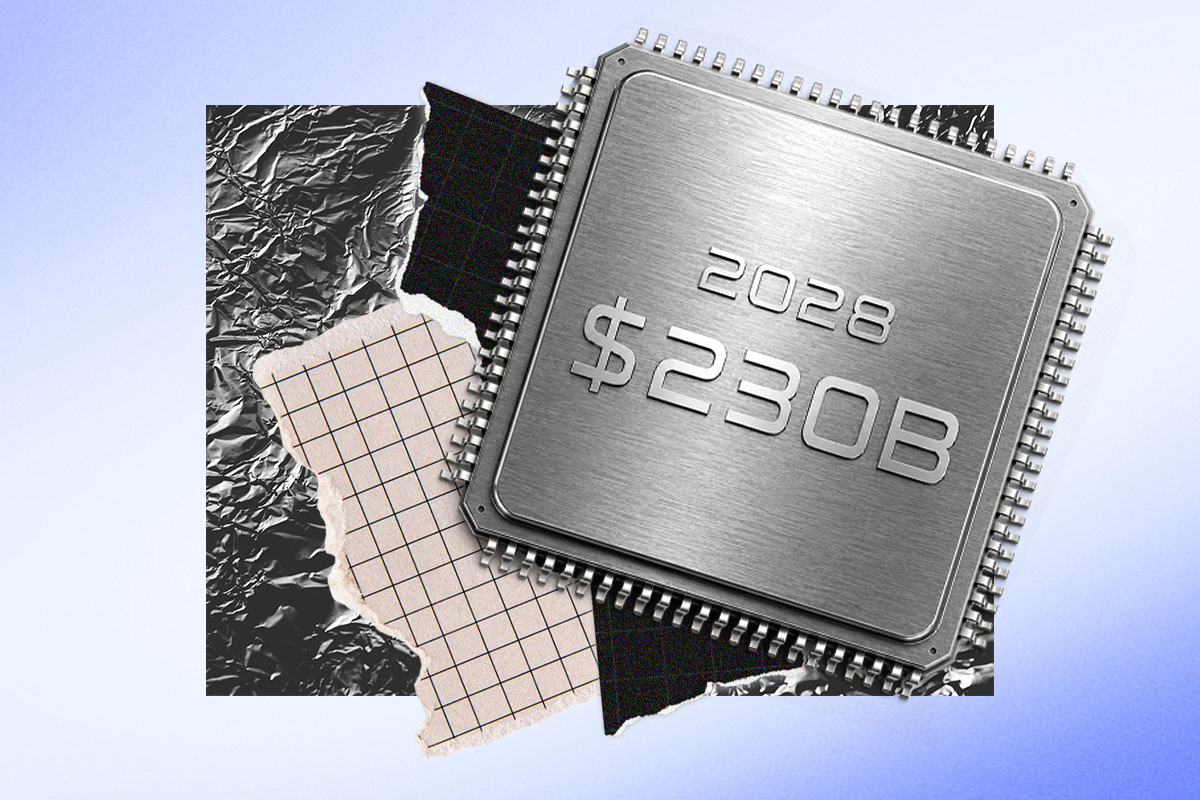
The chipmaker expects its AI semiconductor revenue to reach approximately $58 billion this year, double to $115 billion in 2027, and then double again to $230 billion in 2028.
That would give Broadcom's AI business alone more than three times the revenue the entire company generated just three years earlier.
The reason investors didn't immediately lose their minds is that expectations were already ridiculous.
Morgan Stanley was modeling roughly $120 billion in AI revenue for 2027, while some investors had pushed their estimates as high as $150 billion.
But they may be focusing on the wrong year.
Broadcom says demand already exceeds what it can supply in 2027, and it has secured enough production capacity to support another doubling in 2028.
Of its six custom-chip customers, Tan said four are going to be "huge."
More importantly, Google will no longer be doing all the heavy lifting. Anthropic is expected to become Broadcom's largest custom-chip customer next year, while OpenAI could become its second-largest by 2028.
Meta is taking three generations of custom processors between now and the end of 2027.
The bigger message here is that the AI chip market is becoming too large, and its workloads too specialized, for one company like Nvidia to supply everything.
Nvidia's general-purpose GPUs remain the industry's workhorses. But the biggest AI developers are increasingly designing processors around their own models so they can squeeze more performance from every dollar and watt.
Tan claims OpenAI's custom Jalapeño chip can outperform Nvidia hardware on OpenAI's workloads at roughly half the cost.
Broadcom also wins when those chips need to communicate. The company now expects its AI networking business to grow just as quickly as its custom-processor business.
There is a less comfortable side to this growth story. Anthropic, OpenAI, and Meta's planned deployments represent more than 18 gigawatts of computing capacity by 2028.
Building that infrastructure will require hundreds of billions of dollars, which is why Broadcom is already helping arrange financing for some customers.
So the ultimate constraint may no longer be demand for chips, but whether customers can secure enough power, data-center capacity, and financing to install them.
- Dan Runkevicius, Editor

⚠️ JPMorgan draws a line at 5% Treasury yield
The 10-year Treasury yield has climbed to 4.8%, and JPMorgan's Grace Peters says 5% could spell trouble for stocks, particularly in September, a historically weak month for markets. She still sees upside for U.S. and European markets through year-end but warns that a 5% to 8% correction is possible ahead of risk events, including November's U.S. midterm elections.
🕊️ New York Fed sounds less worried about inflation
New York Fed President John Williams said inflation appears to be subsiding as the effects of tariffs fade and higher energy prices have yet to spill meaningfully into services. The comments come as markets increasingly expect rate hikes following Fed Chair Kevin Warsh's Jackson Hole speech last week.
🤖 Nvidia tells the G20 to go all-in on AI
Nvidia CEO Jensen Huang urged G20 nations to accelerate AI adoption, arguing that economies need to build more data centers and other infrastructure to support the technology. Huang likened AI to essentials such as water and electricity, suggesting future growth will increasingly depend on it. The push comes a week after Nvidia forecast 70% sales growth for its next fiscal year, sending the stock to its biggest one-day gain since April 2025.
🛢️ Chevron puts $7 billion behind its Venezuela bet
Chevron plans to invest $7 billion over the next five years through joint ventures to more than double its Venezuelan crude production, the biggest financial commitment yet in the U.S.-led effort to revive the country's oil industry. The investment comes after a strong second quarter in which Chevron earned $12.1 billion and boosted worldwide production by 20% from a year earlier.
📉 The job market keeps losing momentum
U.S. private employers added just 38,000 jobs in August, missing expectations for 47,000. Recent JOLTS data showed job openings rose over the summer, helped by a jump in manufacturing vacancies, but subdued hiring suggests employers remain reluctant to add workers.
AI may send interest rates lower either way
Wall Street remains hyper-focused on stubborn inflation, government debt, and the prospect of a Fed rate hike. But investors may be overlooking what could push rates in the opposite direction.
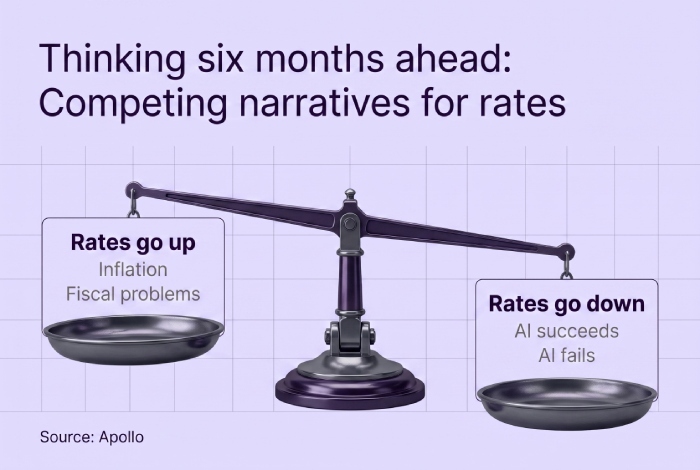
According to Apollo chief economist Torsten Slok, whether the AI boom delivers on its promises or falls apart, long-term interest rates are heading lower.
Two paths to lower rates
In a recent note titled "Think Six Months Ahead," Slok laid out two scenarios for early 2027.
If AI produces trillions of dollars in revenue, he expects the technology to boost productivity, reduce inflationary pressure, and pull long-term rates lower.
If the boom collapses, Slok estimates the Nasdaq could fall as much as 50%, sending investors toward Treasurys and driving long-term yields lower.
"In both scenarios, long rates are going to be lower," Slok wrote.
The Fed is still fighting today's problem
For now, inflation remains the Fed's priority.
Fed Chair Kevin Warsh said at Jackson Hole that recent improvements in CPI and PCE have done little to bring inflation back under control. Inflation has now remained above the Fed's 2% target for 65 consecutive months.
His comments pushed the market-implied probability of a September rate hike from roughly 35% to 56%.
📌 Bottom line: While investors remain fixated on politics and inflation, they may be overlooking a chance to lock in today's long-term yields if either outcome for AI sends rates lower.
Q2 earnings season split Big Tech into two
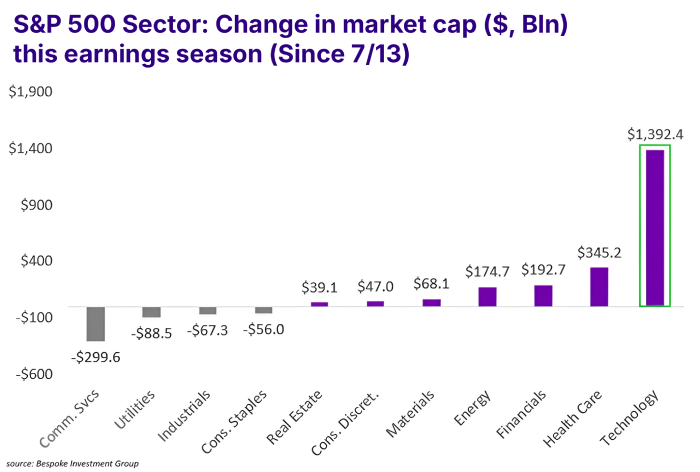
Q2 earnings season revealed a massive divide inside the S&P 500. But the more interesting split was inside technology itself.
Earnings season exposed the split
Since Q2 earnings season kicked off on July 13, the S&P 500 has added roughly $1.75 trillion in market value. Technology accounted for $1.39 trillion, or nearly 80% of that increase.
Even more interestingly, almost all of it came from just two stocks.
Microsoft added roughly $846 billion in market value, while Nvidia added another $569 billion. That is more than the entire technology sector gained over the same period.
The other 71 technology stocks collectively lost approximately $22 billion.
In other words, Microsoft and Nvidia were the technology rally.
The market rewarded proof
Microsoft and Nvidia gave investors something increasingly valuable: visible evidence that AI spending is turning into revenue.
Microsoft reported that Azure grew 43%, while Microsoft Cloud revenue climbed 27% to $59.3 billion. More importantly, the value of its future customer commitments surged 84% to $678 billion.
Nvidia's numbers were even more extreme.
Quarterly revenue jumped 106% to $96.2 billion, while data-center revenue climbed 117% to $89 billion, according to the company's latest results.
That's the proof Wall Street wants.
On the flip side, Meta and Alphabet lost roughly $344 billion combined. Both companies remain central to the AI boom, but investors are beginning to distinguish between companies selling the infrastructure and making money right here and now and those still spending enormous amounts of money in anticipation of future returns.
📌 Bottom line: The blanket AI rally is over. The market handsomely rewards companies that can prove AI is generating incremental revenue while punishing those whose results show a lack thereof.