Brace for AI stock rally

Morning Observers,
After yesterday's close, Super Micro gave investors a reason to reconsider their dismissal of the AI boom.
The AI server maker expects to report nearly $19 billion in sales for last quarter, almost $4 billion more than Wall Street expected and well above the midpoint of management's guidance.
That's a hard data point from a company that sells hardware directly supporting the AI buildout.
SpaceX also added to the demand case. Its AI business brought in more revenue than Starlink last quarter. Elon Musk also said the company has been "inundated" with requests to rent out its computing capacity.
(Musk is a PR stuntman, so take his comments with a grain of salt.)
But the AI boom has another side to the story: the cost.
SpaceX is spending billions on AI computing capacity and expects that spending to more than double this quarter. Financing costs are also exploding. Coreweave's bonds are yielding roughly twice the average for junk bonds.
No company wants to fund its growth at 15%, especially when there's no end in sight to the spending cycle.
So while strong sales make it harder to argue that AI demand is disappearing, they don't tell us whether AI companies are getting any closer to turning a profit.
That's why all eyes are now on hyperscalers. They did their homework during the last earnings season, and I expect them to cook up some creative estimates for how they'll ROI on capex.
First up is Meta, which reports after today's close.
- Dan Runkevicius, Editor

💼 Salesforce makes a $5.7 billion post-SaaSpocalypse bet
Salesforce is buying Nasdaq-listed marketing platform Braze for $5.7 billion, making a major acquisition after taking a beating in this year's SaaSpocalypse. The deal expands Salesforce's reach in AI-powered marketing and customer engagement, but investors seemed unimpressed: Salesforce shares fell after the news.
🇫🇷 Bessent brushes off French bond market turmoil
U.S. Treasury Secretary Scott Bessent sees little risk that France's bond market troubles will spread to global markets. "I don't anticipate a spillover from what's happening in France," he said Tuesday. French bond yields are on the rise over concerns about rising government debt, political gridlock over spending cuts, and a potential Frexit.
🇨🇳 China's trade surplus is closing in on $1 trillion
China recorded a $938 billion trade surplus in the first nine months of 2026, up $67 billion from the same period a year earlier, according to government data. In September alone, the surplus widened by $50 billion year over year to $134 billion, the second-highest monthly total on record. Strong exports, including equipment used to build AI data centers, have helped drive the increase.
⚡ U.S. electricity prices are up 40% since 2019
U.S. electricity prices continue to climb, with rising demand from AI data centers adding to pressure on power costs. The average residential electricity rate reached 19.6 cents per kilowatt-hour in August, up 11% since January 2025, according to Federal Reserve and BLS data. Prices are now 40% higher than in 2019.
🚀 Trump thanks Musk for his $10 billion SpaceX giveaway
President Trump praised Elon Musk as a "legendary friend" on Tuesday, a day after announcing plans to give every American child one SpaceX share through Trump Accounts. The gift could cost Musk more than $10 billion if extended to all Americans under 18, giving millions of children a stake in the privately held space company, now valued at more than $2 trillion.
AI's biggest valuation risk may come from open-source models
The AI boom has produced extraordinary valuations, but cheaper competition could make them harder to justify.
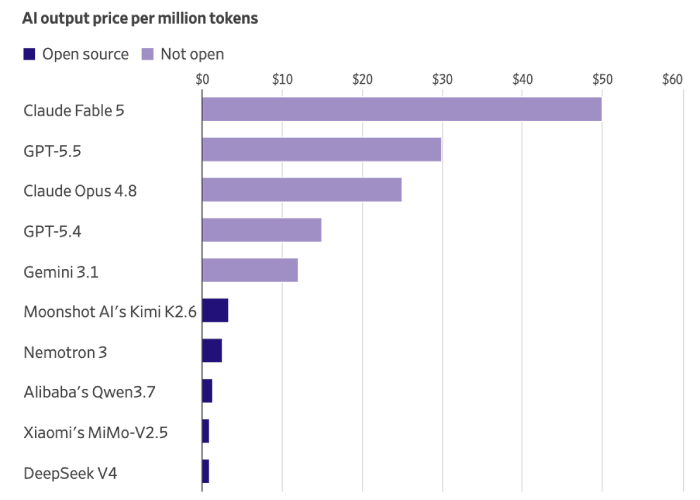
Chinese open-source models cost a fraction of what OpenAI, Anthropic, and Google charge. According to OpenRouter data, Anthropic's Claude Fable 5 costs roughly $50 per million output tokens, more than 50 times as much as competing models from DeepSeek and Xiaomi.
Even Google's Gemini 3.1, the cheapest proprietary model in the comparison, costs roughly four times as much as Moonshot AI's Kimi K2.6.
AI's valuation problem
That price gap matters for AI companies whose valuations have extraordinary revenue growth priced in.
OpenAI has reached $50 billion in annualized revenue, well below the previously reported $70 billion. Meanwhile, Anthropic reported $16.8 billion in third-quarter revenue, nearly four times its total for 2025.
But strong revenue growth hasn't stopped Anthropic from hemorrhaging money.
The company recorded a staggering $80.7 billion net loss in the first half of 2026. And cheaper alternatives from DeepSeek, Alibaba, and Moonshot give businesses more options to cut AI spending.
For now, restrictions on Chinese models in the U.S. and other Western markets remain the biggest moat of American AI labs.
📌 Bottom line: OpenAI and Anthropic are counting on enormous revenue growth to justify their valuations, but cheaper Chinese models could force them to charge less for the same services.
Has the bond market hit rock bottom?
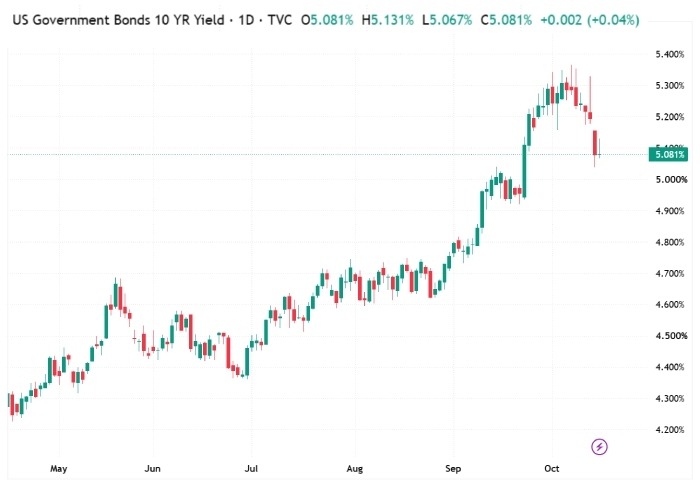
The 10-year Treasury yield has climbed nearly 150 basis points since before the Iran war began, making borrowing more expensive across the economy.
But with the U.S. midterm elections approaching, Apollo sees several reasons to think yields may be nearing a peak.
Has the 10-year yield reached a peak?
Apollo chief economist Torsten Slok believes the approaching midterms could increase the chances of a Middle East peace agreement or prompt the U.S. government to take steps to boost oil supplies.
Either could make inflation less of a worry by lowering energy costs and potentially sending bond yields lower.
Beyond oil, higher borrowing costs are already hurting housing and auto sales. Widening credit spreads among AI companies also suggest investors are demanding higher returns to lend to them.
The bond market is already responding
Slok published his note on Oct. 6, a week after the 10-year Treasury yield surged above 5.30% for the first time in more than two decades.
Since then, yields have fallen roughly 25 basis points, returning to the low 5% range. The retreat has coincided with a selloff in AI stocks, which may have drawn more investors into U.S. government bonds.
📌 Bottom line: If the 10-year Treasury yield has peaked, longer-duration bonds could be a great addition to a portfolio. Investors would earn interest while also benefiting from rising bond prices as yields fall.