Bonds found an unlikely buyer

Morning Observers,
The AI funding race is coming to the Far East
China's DeepSeek is planning to raise up to $15 billion at a $75 billion valuation in its latest funding round. Tencent and battery maker CATL are among the biggest investors, according to the term sheet.
The raise follows the release of DeepSeek's V4 Flash model, which has reinforced the company's pitch: AI models that can challenge OpenAI and Anthropic on performance while costing less.
That low-cost pitch comes with a hefty capex bill, though. The Chinese AI giant plans to deploy at least 160,000 of Huawei's top AI chips at a massive data center in Inner Mongolia.
The project could create one of the largest known clusters of Huawei accelerators.
DeepSeek has also released software developed with Huawei to help program its chips, putting the startup close to the center of China's effort to build a domestic AI stack.
Once the round closes, DeepSeek is expected to restructure ahead of a possible IPO in early 2027. That would make it one of the most closely watched Chinese listings in years.
- Dan Runkevicius, Editor

💰 Magnificent Seven ETF draws big money again
Investors are piling back into the Magnificent Seven despite concerns about lofty AI valuations. The Roundhill Magnificent Seven ETF (MAGS) pulled in $171 million last week, its third straight week of inflows, according to Goldman Sachs. The fund has now recorded inflows in 12 of the past 13 trading sessions, one of its strongest runs since launching in 2023.
🏗️ Data center spending hits another record
AI investment keeps showing up in construction spending. U.S. data center construction jumped 73% from a year earlier in August to a record annualized rate of $85 billion, according to Census Bureau data. Spending has risen by $76 billion, or 823%, since early 2021 and now far exceeds spending on office construction.
🪙 Tokenized stocks are coming to Wall Street
OKX could become one of the first major crypto exchanges to offer tokenized U.S. stocks after filing with the SEC. Its filing covers digital versions of 63 stocks, including Nvidia, Apple, and McDonald's, with each company given 30 days to opt out. If approved, the exchange could eventually let investors trade the tokens around the clock.
💵 The U.S. dollar is getting its haven appeal back
Political and fiscal turmoil in Europe are boosting demand for the U.S. dollar as a haven. The euro fell to a 17-month low on Monday, while the U.S. Dollar Index rose 0.3% to 102.24. Treasury yields climbed, too, with the 10-year topping 5.34%, its highest level in 24 years.
🧩 Intel gets left behind in the tech rally
Intel stock fell 2.6% on Monday despite a broader rally in the tech sector. The drop came after reports that Taiwan Semiconductor Manufacturing (TSMC) was discussing a role in Elon Musk's Terafab project. Back in April, Terafab selected Intel's next-generation 14A node as its sole manufacturing process technology. If TSMC joins, one of Intel's biggest chipmaking rivals would enter a project where Intel had secured a key position.
Bitcoin is breaking an old rule of the debasement trade
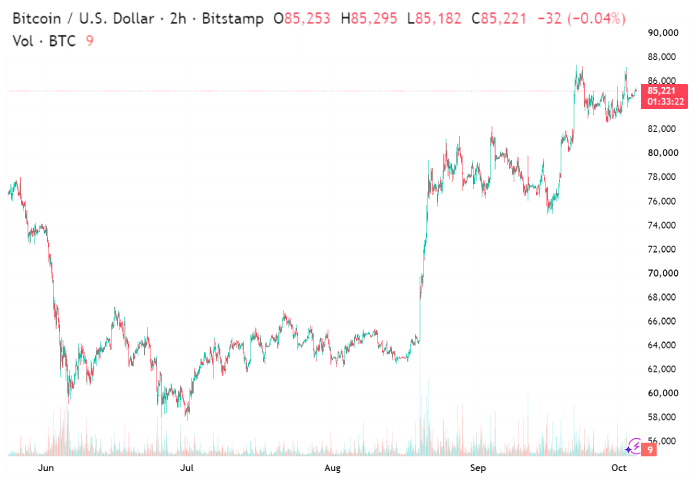
Bitcoin briefly climbed back above $87,000 last week and is up about 33% since August, when the Treasury announced a significant increase in long-term Treasury buybacks.
More surprising, Bitcoin kept climbing even after the Fed raised interest rates. That contradicts the usual assumption that the debasement trade needs low rates.
Is Bitcoin still a debasement trade?
Arche Capital managing partner Vanessa Grellet says concerns about government debt and the long-term purchasing power of currencies continue to support Bitcoin.
In her view, the rally shows that "the debasement trade doesn't need low rates."
In fact, Bitcoin is trading near its highest level in eight months despite little regulatory progress in Washington. The CLARITY Act failed to advance in the Senate, leaving crypto investors in the legislative dark.
Gold's rally points to a two-year trend
While Bitcoin has grabbed most of the attention lately, gold's rally suggests the debasement trade has been underway for two years, according to the Brookings Institution.
Gold is back around $4,200, down 25% from its record high. But it's still doubled since early 2024.
"It may be tempting for policymakers to dismiss this phenomenon as an idiosyncratic move driven by gold bugs," Brookings wrote. "But the scale and length of gold's rally make it harder to dismiss as a short-lived trade."
📌 Bottom line: Bitcoin's rally after a Fed rate hike suggests the debasement trade doesn't depend on low rates. Gold has been making the same case for two years, and Bitcoin now appears to be following its lead.
The Treasury has found an unlikely buyer: retail
While the Treasury is bending over backwards to sell its long-dated debt, one group of buyers is stepping in: individual investors.
The problem is that bonds have been in a bear market for years, so trying to call the bottom could mean catching a falling knife.
Retail steps in to buy long bonds
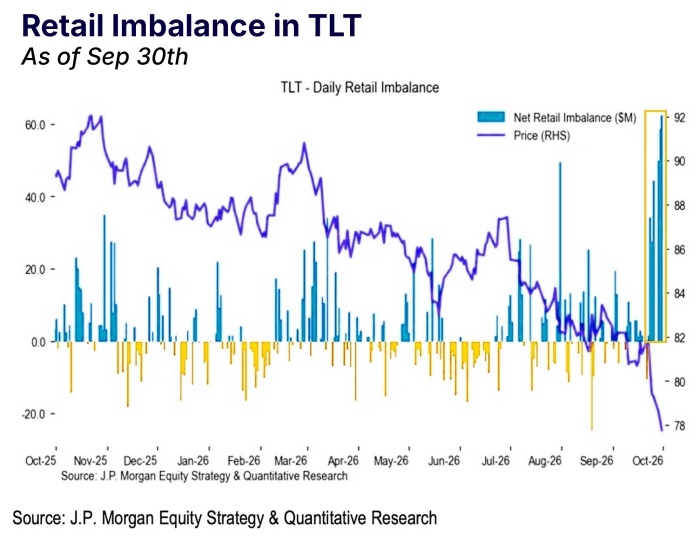
Retail investors bought $170 million of the iShares 20+ Year Treasury Bond ETF (TLT) over three trading days last week, according to JPMorgan data.
Wednesday alone brought $61 million in purchases, the largest daily total in at least a year.
The buying came as TLT fell 1.9% for the week. The fund remains 55% below its 2020 peak.
There's a case for buying here. TLT yields more than 5%, and its long duration means the fund could gain significantly if long-term yields start to fall.
That upside comes with a catch: TLT is also sensitive to higher interest rates. A further 1-percentage-point rise in yields could knock roughly 15% off the fund's price.
High yields can still go higher
The 30-year Treasury yield recently reached 5.7%, its highest level since 2002. For investors willing to hold long-dated debt, that offers considerably more income than Treasurys did for much of the past decade.
But there's no guarantee that yields have maxed out. Inflation, heavy government borrowing, and growing Treasury issuance could push them higher, adding to losses for long-bond investors.
📌 Bottom line: Retail investors could eventually be right about long-term Treasurys and still be painfully early.