BlackRock turns on long bonds



Morning Observers,
Foreign investors apparently haven’t received the memo that America’s fiscal path is supposed to be scaring buyers away.
Over the past 12 months, foreign holdings of U.S. Treasurys have jumped by $549 billion. According to analyst Wolf Richter, roughly half of that increase has flowed into long-term Treasurys, not just short-term bills, where investors can earn attractive yields without taking much duration risk.
That’s a surprisingly strong vote of confidence for the long bond at a time when Washington is running enormous deficits and fiscal discipline has become more slogan than policy.
BlackRock, however, sees a trap.
Its portfolio managers argue that the long bond no longer offers the predictable protection investors have come to expect. The problem isn’t that countries such as Turkey have sold Treasurys to defend their currencies, or that investors demand greater compensation for Washington’s fiscal excesses.
The deeper risk is that nobody, not even the Federal Reserve, seems able to map the path of interest rates with much confidence.
Inflation remains stubborn enough to complicate rate cuts, while heavy government borrowing puts upward pressure on longer-term yields. That leaves long-bond investors exposed to an ugly possibility: yields rise further, prices fall, and the supposedly safe asset delivers another painful lesson in duration risk.
For investors who still want government-backed safety, BlackRock’s message is blunt: stick to the short end of the curve.
That warning is becoming harder to dismiss as the 10-year Treasury yield pushes above 4.6% and approaches the market’s unofficial danger zone near 5%. Foreign buyers may still love America’s debt, but the price of that affection is rising.
Let’s dive in.
— Sam Bourgi, Interim Editor
|
|


📉 Hedge funds are dumping U.S. tech stocks
Hedge funds have sold U.S. technology stocks at the fastest pace on record over the past two months, according to Goldman Sachs’ Prime Services desk. The market value of their tech holdings has fallen by a cumulative 10% over the period, helping drive the S&P 500 Information Technology Index down around 10% since early June as investors continue to question lofty AI valuations.
🇨🇳 China’s weak growth is raising pressure for more stimulus
China’s 10-year government bond yield moved higher after the People’s Bank of China left its key interest rates unchanged for a 14th consecutive month. The move suggests investors are reassessing expectations following weaker-than-expected second-quarter GDP growth of 4.3%, increasing pressure on Beijing to roll out additional stimulus to support the economy.
📊 More evidence of cooling inflation across the G7
Canada became the latest G7 economy to report softer-than-expected inflation, with consumer prices rising 2.8% year over year in June, down from 3.2% in May as energy prices eased. The data add to a growing trend of cooling inflation across advanced economies, though analysts warn renewed fighting in Iran could reignite price pressures by disrupting energy supplies.
📈 Chip stocks bounce back from “bear market” conditions
The Philadelphia Semiconductor Index rebounded to start the week after briefly entering a technical bear market last week, defined as a decline of at least 20% from a recent peak. Even after the pullback, the index remains up more than 100% over the past year, suggesting the sell-off reflects cooling AI enthusiasm rather than a broader reversal in the sector's momentum.
🍕 Consumers are cutting back on pizza more than other fast food
Domino’s Pizza reported better-than-expected second-quarter revenue, but U.S. same-store sales growth slowed to its weakest pace in five quarters. The results suggest consumers are becoming more selective in discretionary spending, with pizza demand weakening more noticeably than at other fast-food chains such as McDonald’s and Chipotle, as higher living costs continue to weigh on household budgets.
Why BlackRock is turning its back on long bonds
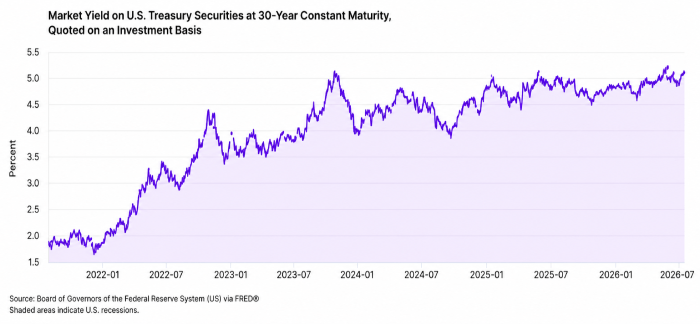
For decades, investors bought long-term government bonds for one reason: they tended to rise when stocks fell.
BlackRock no longer thinks that’s a given.
In its latest outlook, the world’s largest asset manager argues that long bonds have become too sensitive to interest-rate swings to reliably protect portfolios when stocks sell off. It’s a quiet shift with big implications… and one that challenges one of investing’s oldest rules.
The 60/40 portfolio has a problem
BlackRock now prefers short- and medium-term government bonds over long-duration debt. While Treasury bonds haven’t suddenly become riskier, inflation is proving more stubborn than expected, making interest rates far less predictable.
When interest rates rise, long bonds can suffer steep losses, reducing their ability to cushion falling stock markets the way they often did during the low-inflation era.
This isn’t a new view for BlackRock. Earlier this year, it argued that stocks and bonds are increasingly moving in tandem, weakening the diversification that underpinned the traditional 60/40 portfolio.
Duration has become the real risk
Long bonds offer slightly higher yields, but investors pay for them with much greater exposure to interest-rate moves.
A one percentage-point increase in yields can wipe out years of extra income on a 20- or 30-year Treasury. That’s why BlackRock believes the biggest risk isn’t whether the government repays its debt… it’s how sharply bond prices can fall when interest rates move higher.
📌 Bottom line: BlackRock isn’t bearish on government bonds… it’s bearish on long government bonds. If one of the world’s largest asset managers no longer sees long Treasurys as reliable portfolio insurance, investors may need to rethink what counts as a defensive asset.
BoA says the AI boom has one last line of defense
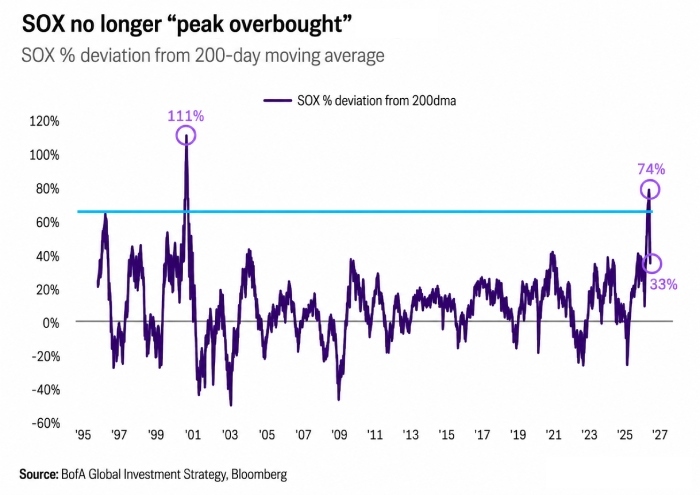
The next AI sell-off probably won’t begin with Nvidia. Bank of America thinks it’ll begin when investors stop giving the Magnificent Seven the benefit of the doubt.
In his latest Flow Show, CIO Michael Hartnett argues that the Mag 7 have become the market’s last line of defense. As long as investors continue to reward those stocks, Hartnett believes the recent weakness in semiconductors can remain contained.
The market shock absorber
Hartnett’s thesis starts with a simple contradiction. Normally, investors reward companies for spending less because lower costs boost profits. But AI has turned that relationship on its head.
For the past two years, investors have treated rising AI spending as proof the boom is real. The question is whether they’ll still reward Microsoft, Amazon, and Meta if those budgets start falling… or begin to see lower spending as evidence that AI demand itself is slowing.
SOX vs MAGS
Hartnett says the recent divergence between the Mag 7 and semiconductor stocks suggests the market is already preparing for slower AI spending.
Over the past month, the Roundhill Magnificent Seven ETF (MAGS) has gained 4%, while the iShares Semiconductor ETF (SOXX) has fallen 13%.
The real test, however, still lies ahead. If hyperscalers cut AI spending and the Mag 7 also fail to rally, it would suggest investors no longer view lower spending as a boost to margins, but as confirmation that the AI boom itself is losing momentum.
📌 Bottom line: Hartnett isn’t worried about lower AI spending. He's worried about a spending cut that fails to lift the Magnificent Seven, because that could signal investors no longer believe the AI boom will deliver.