🇯🇵 Biggest intervention since 1998


Morning Observers,
Japan’s finance minister confirmed this morning that the Bank of Japan and the U.S. Treasury coordinated a yen-buying operation on Friday.
Why now, and why the urgency?
Long story short, the yen has become the world’s biggest arbitrage trade.
Traders borrow cheap yen, sell it, then buy dollars and invest them in higher-yielding assets that more than offset the cost of borrowing the yen.
That is, in a nutshell, the yen carry trade everyone is talking about. And the result of it is almost-perpetual depreciation of the yen.
For example, the yen has been more or less in decline against the dollar since 2012. And before Friday's intervention, it was at its lowest level in more than 40 years.
For a long time, that wasn’t a problem because Japan’s economy was stuck in a deflationary cycle. But now that inflation is picking up, a weak currency has become a problem.
Japan imports a lot, and a cheap yen simply makes everything more expensive.
So on Thursday, the Bank of Japan sold $59 billion in foreign currency and assets to buy yen, most of which were likely dollar-denominated. Then Uncle Sam stepped in.
On Friday, the U.S. Treasury joined the operation to buy yen, but it sold euro reserves, not dollars, to finance it.
So why, all of a sudden, is Washington so interested in saving the yen?
One explanation is that the Fed is having a very hard time keeping long-term yields in check.
Even though the Fed is doing its best to keep rates lower, the long end of the yield curve is at its highest level in more than 20 years.
That’s a big problem for Uncle Sam because it makes borrowing more expensive across the entire economy.
Now the reason Japan matters here is that it's the largest foreign holder of U.S. Treasuries. And if the biggest Treasury holder starts selling, it means Treasuries would lose value and yields would rise.
If the Bank of Japan is left on its own, it has full discretion over which assets to sell to support the yen, and it may well choose Treasuries.
But if the U.S. Treasury lends a helping hand, Washington can decide what to sell instead. And, not coincidentally, it chose euros.
In this context, this intervention is so important that James Thorne of Wellington-Altus says this is the beginning of Bretton Woods 2.0, where capital markets, not central banks, will be increasingly in control of yields.
- Dan Runkevicius, Editor

🍎 Apple logs biggest loss since April 2025
Apple stock plunged nearly 9% intraday on Friday, marking its biggest intraday drop since April 2025, after the company warned that component shortages could weigh on iPhone sales. The warning follows similar concerns from Qualcomm earlier in the week.
🤖 Amazon’s AI spending is starting to pay off
Amazon stock surged more than 15% after the company reported another strong quarter from its cloud business, with AWS revenue climbing 37% to $42.2 billion. Investors looked past Amazon’s decision to raise planned capital spending to $220 billion because the business is finally showing operating leverage.
🇺🇸 U.S. Q2 GDP looked weaker than it was
The U.S. economy grew at a slower-than-expected 1.5% annual rate in the second quarter, but economists say the report was stronger beneath the surface. Consumer spending increased across both discretionary goods and services, suggesting households are still willing to spend despite higher interest rates. Bank of America said the data should reassure investors that the slowdown earlier this year was largely driven by temporary weather disruptions rather than a meaningful loss of economic momentum.
🥇 Gold’s rally hit another speed bump
Gold and silver fell on Friday, giving back much of the rally that followed the Federal Reserve meeting. Gold fell 1.4% to $4,101 an ounce, while silver dropped 2.2% to $57.72. Even with Friday’s pullback, gold posted its first monthly gain in five months, underscoring how quickly sentiment in precious metals can shift.
🏦 Japan may be closer to another rate hike
The Bank of Japan left interest rates unchanged at 1%, but policymakers sounded increasingly concerned that the yen’s weakness could keep pushing inflation higher. The currency rebounded overnight after suspected government intervention, following its slide to a four-decade low against the dollar.
Plot twist in China’s AI leadership
China’s AI breakthrough story hits a plot twist.
Just days after domestic memory-chip maker CXMT soared more than 460% in its Shanghai debut, news broke that China’s most advanced AI labs are relying on Nvidia hardware.
If true, China’s best-performing AI models may be the result of chip backchannels rather than efficiency gains.
Moonshot’s Nvidia problem
Chinese startup Moonshot stunned investors earlier this month after its open-source Kimi K3 model posted results that rivaled leading Western systems at a fraction of the cost.
The news dredged up memories of DeepSeek’s market-rattling breakthrough in early 2025.
This time, however, the model may not be as much of a breakthrough as it seems.
Bloomberg reported that the company trains its models on a cluster of roughly 20,000 Nvidia GPUs provided by Alibaba, one of its largest investors.
U.S. officials also alleged that Moonshot obtained restricted Blackwell chips through unauthorized channels and accused the company of using Anthropic’s AI models to help train K3.
While the claims remain unproven, they suggest that China’s leading AI companies may still depend on American hardware, even as Beijing races to replace it.
The next chip war may be about enforcement
Washington’s export controls were designed to limit China’s access to the most advanced AI chips.
If Moonshot’s reported Nvidia usage becomes part of a broader pattern, attention will shift from writing new rules to enforcing the ones already in place.
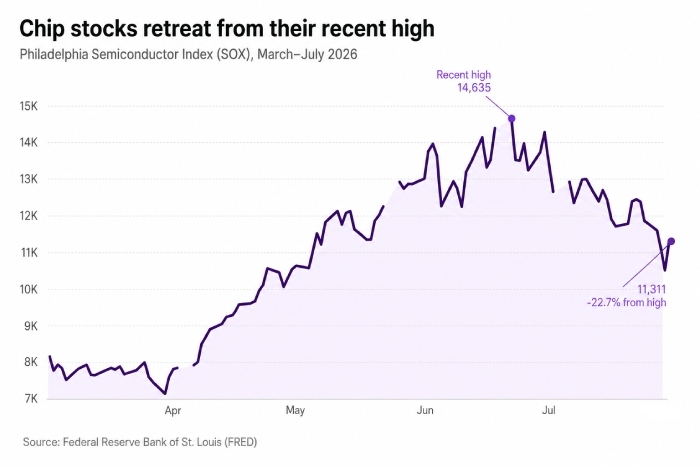
Semiconductor stocks have become increasingly sensitive to U.S.-China headlines, with the Philadelphia Semiconductor Index already down roughly 20% from its recent high.
📌 Bottom line: If China’s AI progress is less about model capability and more about hardware access, chips could be in for a comeback.
The oil crisis has second front
The U.S.-Iran ceasefire is already starting to feel like a distant memory.
Shipping disruptions are still dragging on in both the Strait of Hormuz and the Red Sea, and oil-supply fears are creeping right back into the market.
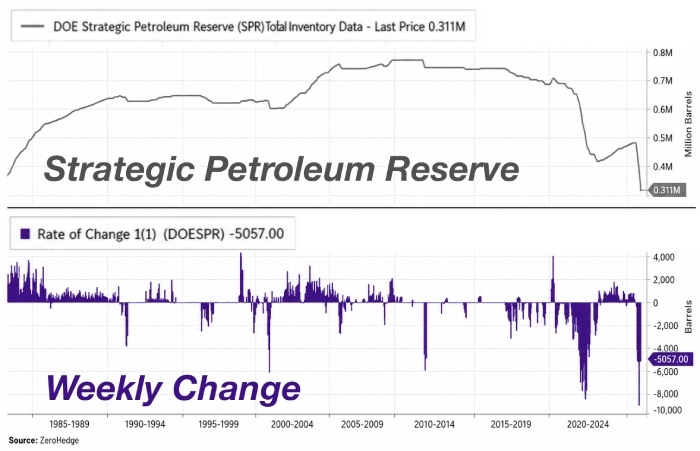
That would be uncomfortable enough on its own. But America’s emergency oil reserve is now sitting at its lowest level in more than four decades.
The buffer keeps shrinking
The latest EIA data showed the Strategic Petroleum Reserve fell by another 3.8 million barrels last week to 308 million barrels, its lowest level since 1983.
That marked the 18th straight weekly decline. Over that period, the reserve has lost more than 100 million barrels.
In other words, Washington has far less room to absorb another supply shock if the Middle East flares up again before inventories are rebuilt.
Big Oil is preparing for the unknown
High crude prices have delivered another windfall for the energy giants. ExxonMobil reported $14.7 billion in second-quarter profit, its highest since 2022, while Chevron earned $12.07 billion, a six-year high.
But neither company is acting as though these conditions will last forever.
Both are using the windfall to pay down debt and strengthen their balance sheets rather than chase aggressive expansion.
That tells you something. The oil majors are taking the cash while it is there, but they are also preparing for a market that could turn quickly.
📌 Bottom line: America’s emergency oil reserve is dwindling, giving Washington much less room to contain the next oil shock.