🧾 Big Tech's "undisclosed" spending


Morning Observers,
Alphabet became the poster child for WSJ’s investigation into Big Tech's off-balance-sheet commitments worth over $3 trillion. But is it really that bad?
So the story is that Alphabet disclosed $811 billion of future contractual obligations this quarter.
And because most of these are guaranteed commitments, yet they don’t show up on the balance sheet, the media has framed this as Alphabet’s financial engineering meant to hide its real AI costs.
Let’s play devil’s advocate here.
Of that $811 billion, $201 billion represents short-term commitments that are part of Alphabet’s normal procurement process.
The quarterly increase is not even the highest Alphabet ever reported yet, which means the short-term number isn’t really the big news here.
The biggest surprise was $707 billion of long-term commitments. That’s over 3x last quarter’s figure and unprecedented growth in this segment for Alphabet.
Headlines alluded to this as spending that comes on top of Alphabet’s capex this year. But these are long-term commitments, many of which will be fulfilled through 2030.
That’s roughly four and a half years of future spending, while some energy agreements have terms extending as far as 2054.
Still a lot, but it’s not as if Alphabet is going to start depreciating on $800 billion starting next quarter.
Now the question is why Alphabet has suddenly signed up for so much future capacity. The answer may be a combination of four things.
First, Alphabet’s AI inference is getting much more efficient. Pichai said Google lowered Gemini serving costs by 78% in 2025. Google also reduced the cost of AI responses in Search by more than 30%.
Cheaper AI means higher margins for Alphabet and much more usage because of the Jevons paradox.
Speaking of which, Alphabet is now serving 7x more tokens than a year ago. And direct model usage through API more than doubled in roughly six months. That's an extraordinary adoption rate.
Third, and this is the most spectacular part to me, everyone thought AI would cannibalize Google Search. Instead, Alphabet is using AI to expand its near-monopoly in this segment.
Last quarter, Search revenue grew 17% because AI Mode drew more eyeballs, and Google said it’s now making money from queries that historically weren’t worth monetizing.
That kind of platform synergy puts Alphabet’s AI economics on a completely different level from companies that have to build an AI business from scratch.
Finally, there's a lot of concern about Alphabet’s commitments, but its clients’ commitments and profitability are growing at the same time.
Alphabet’s Cloud operating margin increased from 21% to 35%. The best part is that the amount by which Alphabet’s cloud clients outspend their initial commitments is also constantly growing.
Last quarter, they exceeded their locked-in capacity by 50%, up from 45% a quarter earlier.
So that’s your devil’s advocate take on Google’s spending spree.
- Dan Runkevicius, Editor

🇯🇵 Japan’s GDP miss puts the yen back in focus
Japan’s economy grew at an annualized 1.1% in the second quarter, down from 2.1% in the prior quarter and well below the 2% consensus forecast. The miss complicates the policy outlook as Tokyo looks for ways to support the yen, particularly as the effects of its joint currency intervention with the United States begin to fade.
🚀 Anthropic’s revenue just exploded
Anthropic told prospective investors that second-quarter revenue surged at least 14-fold from a year earlier to more than $11.5 billion. The AI company also posted positive adjusted operating income in the second quarter of 2026. That's a major milestone ahead of a potential blockbuster IPO.
💰 Nvidia is putting $105 billion behind OpenAI
Nvidia has agreed to commit as much as $105 billion to support a massive Ohio data center campus that OpenAI plans to lease, according to a financial filing. If completed as envisioned, the complex would rank among the world’s largest data centers.
⚠️ U.S.-Iran ceasefire extension in limbo
Investors started off the week with reports that the U.S. and Iran had extended their 60-day ceasefire following “backchannel” negotiations between the two countries. But Iran later pushed back on parts of those reports, leaving oil hovering near $90 a barrel.
🥇 Gold is closing in on $4,500
Gold prices climbed as high as $4,485 to start the week, their strongest level since early June. Bullion has now rebounded more than 12% from last month’s low below $4,000 an ounce, thanks to a weaker dollar, institutional demand, and dialed-back expectations for Fed rate hikes.
The dollar trade is getting dangerously crowded
The U.S. dollar has been a wrecking ball across commodities, emerging markets, and global currencies this year.
But there’s a problem with the bullish dollar thesis: almost everyone now agrees with it. And crowded trades have a nasty habit of going in the opposite direction.
Everyone piled into the dollar
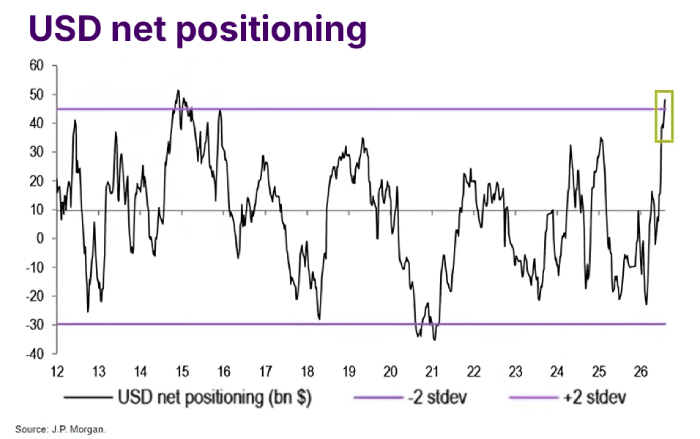
According to JPMorgan data, speculative net-long positioning in the U.S. dollar has climbed to roughly $48 billion, the highest since 2015. That’s more than four times the level three months ago.
Hedge funds and asset managers are now on track for a sixth consecutive month of net-long dollar exposure, the longest streak since 2022.
In other words, betting on a stronger dollar is now one of the most crowded trades.
Is the tide turning on dollar longs?
The long-dollar trade made sense when it started earlier this year.
Investors spent months pricing in higher interest rates because inflation had returned, while the Iran war added another reason to hide in the world’s favorite safe-haven currency.
But the market is beginning to move the other way.
Since peaking at 101.61 in June, the U.S. Dollar Index (DXY) has fallen roughly 2%. More importantly, rate-hike expectations are fading, removing one of the strongest arguments for owning more dollars.
📌 Bottom line: A weaker dollar could give commodities, gold, and emerging markets another reason to rise. And with $48 billion betting on a stronger dollar, there’s a lot to unwind.
Why copper’s record high may be just the beginning
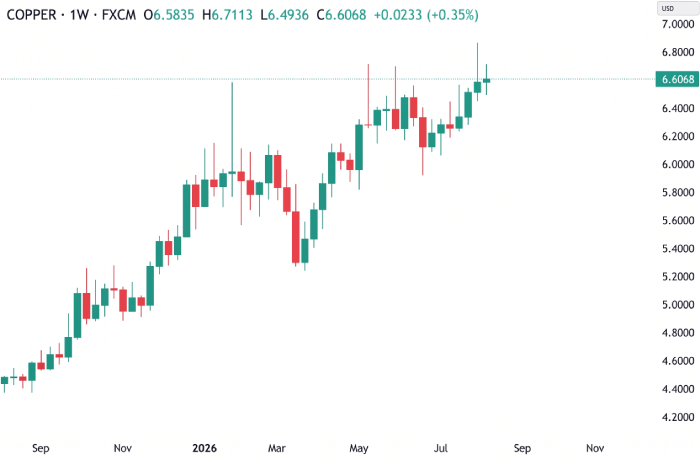
Copper prices hit an all-time high of nearly $6.90 per pound this month, extending a remarkable rally over the past year.
Normally, record prices are supposed to attract more supply, reduce demand, and push down prices. But copper is doing the opposite. Available supply is shrinking even as buyers pay record prices to secure it.
The copper shortage is showing up in futures
The clearest sign is showing up in the futures market.
On the London Metal Exchange, copper for immediate delivery recently traded at roughly a $370-per-tonne premium to copper delivered a month later, the widest gap since 2021.
Put another way, buyers are willing to pay hundreds of dollars more per tonne to get copper now rather than wait a month. Meanwhile, supply available through the LME is shrinking.
LME copper stockpiles have fallen for 42 consecutive days, the longest streak since 2014, to roughly 205,000 tonnes. Nearly half of that remaining copper is already scheduled for withdrawal.
But there’s another reason copper is becoming harder to find.
America is pulling it away from everyone else
The world isn’t suddenly running out of copper. A lot of it is getting clustered in one market: America.
The reason is that expectations for U.S. tariffs on refined copper have pushed American copper prices above prices in London. That difference has encouraged producers to ship the commodity to the U.S., leaving less available elsewhere.
In other words, the threat of tariffs is already changing global copper flows before the tariffs even arrive. That helps explain why record-high prices haven’t solved the shortage yet.
📌 Bottom line: Copper can keep rising as long as buyers are paying a steep premium for the metal today and U.S. prices keep pulling supply away from other markets.