🏭 Big Tech is becoming "Big Industry"


Morning Observers,
Big Tech is becoming “Big Industry.” So how long can companies with utility-like capital needs continue trading at software-like valuations?
Consensus capex estimates for Microsoft, Alphabet, Amazon, Meta, and Oracle have jumped from $485 billion in January to $730 billion today.
At this rate, these companies could collectively spend more on capex than they generate in free cash flow by 2027.
For every additional $1 of operating cash flow they are expected to generate between 2025 and 2027, approximately $1.57 could go toward additional investment (Reuters).
That sounds less like software and more like a power company.
For perspective, U.S. electric utilities spent roughly $1.37 on capital projects for every $1 of operating cash flow they generated in 2024.
The difference is that utilities can ask regulators to let them recover those investments through higher electricity rates. Big Tech has no such guarantee.
They are taking on utility-like capital investments while still being valued on the assumption that they will deliver software-like returns.
So does that software valuation premium still make sense? Investors are no longer so sure.
Google and Tesla fell 8% and 15% after reporting strong earnings but even larger spending plans. And the Mag 7 now trades at their smallest valuation premium to the rest of the S&P 500 in a decade.
This week we will get more answers.
Microsoft, Meta, Amazon, and Apple report earnings on Wednesday and Thursday. All eyes will be on things that once seemed almost irrelevant to technology investors: capital spending, debt, and depreciation.
Morgan Stanley’s Lisa Shalett plays devil’s advocate in this debate.
In her view, the capex panic overlooks Big Tech’s earnings growth and its crucial role as an “AI orchestrator,” which is more immune to LLM commoditization and productive gains than the rest of AI stocks.
So, in a future where AI inference gets Moore’s Law-ed down and language models become commodities, who ultimately captures the most value?
That is an interesting AI thought exercise.
— Dan Runkevicius, Editor
|
|


📊 Big Tech earnings take center stage
Another pivotal week of earnings is underway, with Microsoft, Meta Platforms, and Apple all reporting results that could shape expectations for AI spending. So far, roughly 85% of S&P 500 companies have topped profit estimates in Q2, pointing to a resilient earnings season despite geopolitical tensions and higher energy prices.
⚽ World Cup gives U.S. services a boost
The U.S. services sector, which accounts for more than three-quarters of GDP, expanded faster than expected in July, although economists say the improvement may reflect a temporary boost from the FIFA World Cup. S&P Global’s U.S. Services PMI climbed to 53.6 from 51.2, well above expectations, with any reading above 50 signaling expansion.
📉 U.S. stocks post longest losing streak since March
The S&P 500 is coming off its second straight weekly decline, its longest losing streak since March, after an $890 billion sell-off in the Magnificent Seven stocks on Thursday. Portfolio managers say investors continue to overreact to developments in the Middle East, though similar pullbacks have historically created attractive buying opportunities.
🧊 Retail investors retreat as momentum trade fades
The speculative momentum trade, where investors pile into the market’s best-performing stocks in anticipation of further gains, is losing steam. A basket of 50 stocks favored by retail investors has fallen 13% in July, putting it on track for its worst monthly performance since 2022, according to Bloomberg. Weekly net purchases of individual stocks have also dropped to their lowest level since the pandemic, according to Vanda Research.
🚗 Tesla’s sell-off accelerates
Tesla stock plunged 18% last week after the EV maker reported disappointing quarterly results, including negative free cash flow for the first time in two years. Investors are increasingly concerned about the company’s AI spending as competition in the EV market intensifies, while CEO Elon Musk once again pushed back his timeline for launching Robotaxi services.
The IPO curse is worse than you think
SpaceX’s blockbuster IPO has investors dreaming about the next major listing. History suggests they’re dreaming about the wrong thing.
The uncomfortable truth is that IPOs haven’t rewarded public investors for years. They’ve mostly rewarded the people selling. Fresh data from Apollo shows the problem has become even harder to ignore.
Six straight losing years
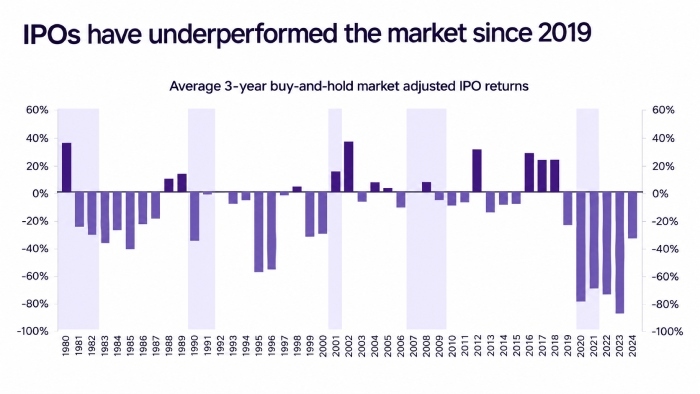
According to Apollo Asset Management, every group of companies that went public since 2019 has underperformed the broader market over the following three years.
On average, those companies trailed the market by between 25% and 90%, marking the worst sustained stretch of underperformance in more than four decades.
The data also challenges one of Wall Street’s favorite narratives: that buying exciting companies early is a winning strategy. Outside of a handful of periods, most notably after the dot-com crash and between 2016 and 2018, IPOs have generally been poor investments.
The easy money is already gone
Today’s IPO isn’t what it used to be. Instead of funding years of expansion, many companies arrive after those years have already happened.
Record-low interest rates and stimulus helped companies sell shares at sky-high prices. When rates rose, many of those valuations quickly unraveled. Meanwhile, much of the market’s gains have come from a small group of AI and mega-cap tech stocks, making it even harder for new listings to keep up.
📌 Bottom line: The IPO is increasingly an exit for insiders rather than an entry point for investors. If that trend continues, buying the hottest new listing may remain one of the worst ways to get exposure to the next generation of great companies.
What if semiconductor stocks are actually undervalued?
With the Philadelphia Semiconductor Index (SOX) surging more than 100% over the past year, the consensus on Wall Street is that chip stocks are overvalued. But what if the opposite is the case?
Despite the rally, semiconductor valuations look surprisingly ordinary because earnings have kept pace with stock prices.
Semiconductors are driving earnings growth
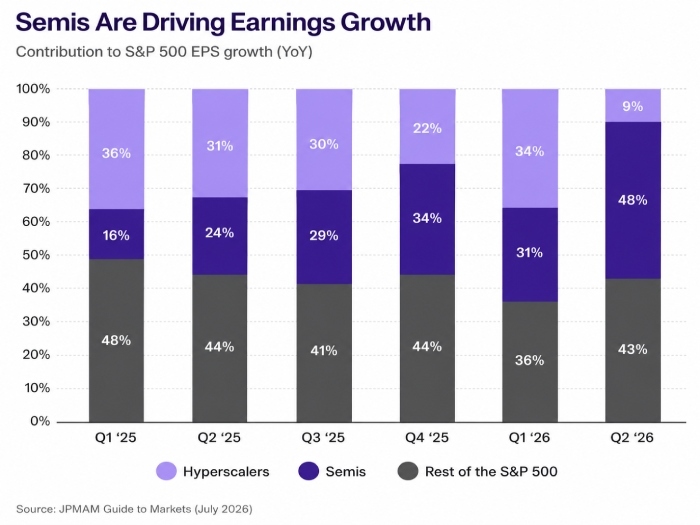
Over the past two years, semiconductor companies have taken up an increasing share of S&P 500 earnings growth.
In Q1 2025, they accounted for 16% of the index’s earnings growth. By Q2 2026, that figure is expected to reach 48%, according to JPMorgan data. Meanwhile, hyperscalers’ contribution falls from 36% to 9%, while the rest of the S&P 500 remains relatively stable in the low- to mid-40% range.
In other words, semiconductor profits have risen almost as quickly as stock prices, preventing valuations from becoming as stretched as many investors think.
The gap isn’t as wide as it looks
Separate data from Citadel Securities shows that semiconductor stocks are trading close to their historical averages despite the AI boom. By early July, they traded at roughly 19.5x forward earnings. That’s slightly below their 10-year average of 19.7x and well below the 5-year average of 23.8x.
Although valuations have since climbed to around 21x following strong Q2 earnings, they’re still broadly in line with historical norms rather than the kind of lofty multiples associated with market bubbles.
📌 Bottom line: The AI boom has made semiconductor companies much more profitable, but it hasn’t made them dramatically more expensive. If earnings continue to grow at anything close to their current pace, the sector may be less overvalued than conventional wisdom suggests.