Anthropic's leaked plans

Morning Observers,
Anthropic's leaked IPO prospectus gives us an early glimpse into the valuation of the first pure AI company to go public.
Earnings multiples are out the window because the company doesn't make any money.
Anthropic burned through $8.2 billion last year, and its operating loss nearly quadrupled from a year earlier. The company is plowing most of that money into hardware and has committed to more than $500 billion in future spending (80% of it non-cancelable).
That means no money will be made anytime soon, which is normal for a company competing for the top spot in a new tech cycle.
The question is whether those investments are translating into growth. So let's move a notch up the income statement and look at revenue.
Here are three key numbers from the prospectus:
- 2025 revenue: $4.6 billion
- 2026 run rate, based on July sales: $65 billion
- 2028 estimate: $200 billion
If Anthropic keeps selling on par with July, its revenue will be up 1,313% this year. After that, it would need to grow 75% a year for two years to hit $200 billion in 2028.
That’s impressive growth, but the devil is in the extrapolation details. For example, how much of July's sales Anthropic can repeat. Was it a typical month, or did a few unusually large deals drive that run rate?
It’s no secret Anthropic has a problem with revenue concentration. According to the prospectus, two clients brought in a quarter of Anthropic's 2025 revenue, and neither contract came with a long-term commitment.
So now that we have the actual sales and wannabe sales, let's put them in perspective.
Anthropic is targeting a $2 trillion valuation for its IPO:
- At $4.6 billion in 2025 revenue, that's 435x sales (trailing)
- At $65 billion in 2026 revenue, that's 31x sales (forward)
- At $200 billion in 2028 revenue, that's 10x sales (forward)
For perspective, SpaceX IPO'd at 49x forward sales. Meta trades at 7x, Alphabet at 7x, Microsoft at 10x, and Nvidia at 10x.
All else being equal, Anthropic's IPO isn't as crazy as SpaceX's. But it will only reach a normal sales multiple for Big Tech if everything goes according to plan over the next two years.
We'll see very soon how much confidence the market has in that.
- Dan Runkevicius, Editor

📉 Stocks give up gains as Treasury yields climb
U.S. stocks turned lower Wednesday, with the S&P 500 down 0.3% and September ending in the red. The index had briefly made back all its losses for the month, but the rally didn't last. Treasury yields started climbing again, and the 10-year reached its highest level since 2002. Stocks can recover from a weak month, but rising yields keep getting in the way.
🤖 Musk considers new Grok and X subscriptions
SpaceXAI, Elon Musk's AI unit, is considering a new subscription plan that would bundle its Grok chatbot with the X social network, Bloomberg reported. The plan would include four pricing tiers. SpaceX is looking to build on its record-breaking IPO and tap into growing demand for AI. Bundling the two services could help it do that, but the real question is how many users will pay for both.
💼 Hedge funds start selling U.S. stocks
Hedge funds were net sellers of U.S. stocks last week for the first time in three weeks, according to Goldman Sachs data. Indexes and ETFs made up 57% of the selling, suggesting funds were pulling back from the broader market, not just trimming individual companies. Single stocks accounted for the other 43%. One week of selling doesn't make a trend, but it's a shift worth watching if it continues.
🏦 Fed's Williams says another rate hike can wait
New York Fed President John Williams says the Fed doesn't need to rush into another rate hike after raising rates in September. Inflation is still too high, he said, and another hike later this year may be needed. But there's no urgency to act now. That puts his comments at odds with Fed Governor Michael Barr's warning that rates will probably need to go higher. The debate inside the Fed is clearly not settled.
📊 Fewer stocks are carrying the market
Just 25% of S&P 500 stocks are above their 50-day moving average, down from 70% in mid-August and the lowest share since early April, according to Investing.com. It's also the second-lowest reading since the April 2025 "Liberation Day" market crash. The index may still be rising, but fewer stocks are taking part. That leaves more of the market's fate in the hands of a small group of AI-linked stocks.
AI prices have fallen 1 million-fold. Does that really sound like a bubble?
The AI bubble debate usually starts with sky-high stock valuations and the hundreds of billions being spent on data centers. But there's another part of the story getting far less attention: AI itself is getting much cheaper.
A historic collapse in prices
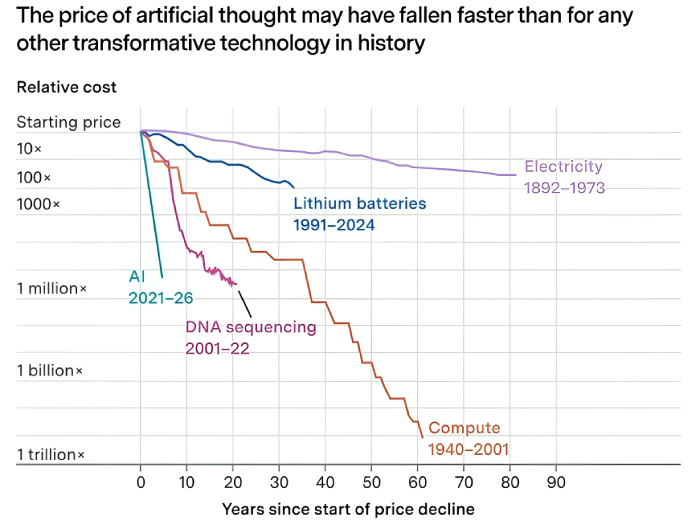
According to Epoch AI, the cost of running leading AI models has fallen roughly 1 million-fold since 2021. That's an unusual trend for a technology supposedly caught in a speculative frenzy.
DNA sequencing, one of the fastest-falling costs in modern technology, took roughly two decades to get 1 million times cheaper. Computing took nearly 40 years to do the same.
What the bubble argument may be missing
Falling prices alone don't mean AI isn't in a bubble. But they do show that the economics are improving quickly, even as record amounts of money pour into the sector.
Alphabet, Microsoft, Meta Platforms, and Amazon are spending heavily on AI as the cost of using it keeps falling. At the same time, newer models are using more tokens per task, pushing up overall token usage.
Nvidia, AMD, Broadcom, Micron, and SK Hynix are tied to the other half of the trade. If lower prices bring in enough new users and usage, demand for chips and memory can keep rising even as AI gets cheaper.
📌 Bottom line: High valuations and enormous capital spending can still lead to bad investments. But the bubble argument looks shaky when the product at the center of the boom has become 1 million times cheaper, and usage keeps growing.
The real reason investors discounted the latest PCE inflation report
At first glance, August's inflation report was exactly what investors wanted. PCE inflation came in below expectations, the previous month's reading was revised lower, and the odds of another Fed rate hike fell.
But there's a catch: the government also changed how it calculates parts of PCE.
The inflation data looked good, at first
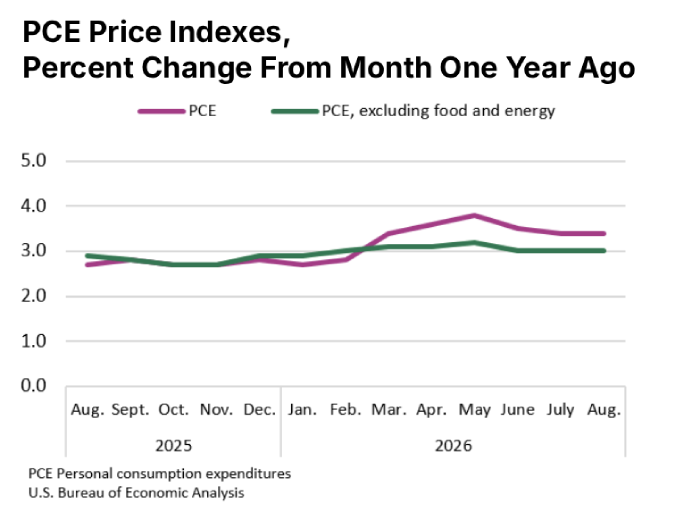
Headline PCE inflation eased to 3.4% in August from 3.7% in July, while core PCE fell to 3%, below expectations of 3.3%.
July's headline and core readings were also revised down by 0.3 percentage points each. At first, the numbers seemed to show a meaningful improvement in inflation and helped ease expectations of an October rate hike.
Part of the decline came from a new calculation
A big part of the decline came from changes in how the government measures portfolio management fees, computer software, and legal services. The revisions go all the way back to 2021.
Portfolio management is especially important. Under the old method, investment management costs could appear to rise just because a portfolio's value went up.
For example, if an adviser charged a 1% fee and the portfolio gained 20%, the dollar amount of the fee would rise even if the adviser hadn't raised the rate. The new method counts less of that increase as inflation.
By The Kobeissi Letter estimates, the changes could reduce core PCE inflation by as much as 0.2 percentage points. So, yes, inflation came in below expectations. But part of the improvement reflects a change in how it's measured.
📌 Bottom line: The latest PCE report gives the Fed a better inflation number, but not all of the improvement came from lower prices. Investors now have to separate actual disinflation from the effect of the new calculation.