🔥 Amazon's AI win


Morning Observers,
Amazon just reported $25 billion in annualized AI revenue, but the bigger message was what Andy Jassy said at the 11:31 mark of the earnings call.
In Q1, Amazon said AWS was generating more than $15 billion in annualized AI revenue. Last quarter, that figure crossed $25 billion.
A few notes here.
Amazon doesn't disclose how it came to that figure, so how much creative financial engineering went into it is anyone’s guess.
That’s also not actual revenue. The $25 billion figure is a run rate, which extrapolates last quarter’s sales over the next 12 months.
But taken at face value, these numbers are a big win for Amazon.
AI revenue is growing at a “triple-digit” annual rate, and it already represents at least 15% of the entire AWS business, which isn’t some niche segment.
More than half of Amazon’s operating profit comes from AWS because it is extremely profitable (~40% operating margin).
And Jassy said the AI business could eventually be ahead of the core AWS business in terms of profitability.
“We see the AI business following very much the same type of margin trajectory that we saw in the core business before, and it’s a little bit ahead of that pace.”
(Now again the question is which stage of AWS he is using for that AI “margin trajectory” comparison.)
But by far the most meaningful message from Jassy was this remark:
“For servers and networking equipment, on average, it takes a little less than three years to break even on that investment. The servers currently have a useful life of at least five to six years, and most of our AI capacity these days is being contracted for at least five-year terms.”
Two things here.
Amazon isn't blindly spending on AI infrastructure. It's locking customers in before much of that capacity has even been deployed.
In fact, Amazon’s filings confirm that its long-term contracts had a weighted-average remaining life of approximately 5.5 years last quarter.
Jassy also said Amazon typically buys servers and networking equipment only a few months before installing them when they know there's actual demand for new capacity.
Second, these investments should recoup their cost in less than three years and then generate significant free cash flow for another two to three years.
So, at face value, Amazon's math may actually start mathing.
- Dan Runkevicius, Editor

📉 Fed's favorite inflation gauge posts first monthly drop in six years
The Personal Consumption Expenditures (PCE) index fell 0.1% in June, marking its first monthly decline since 2020. The drop was largely driven by a 9.2% plunge in gasoline prices, though that relief may prove short-lived as oil prices have since rebounded.
📈 Warsh adds to bond market uncertainty
The 30-year Treasury yield climbed to its highest level since 2007. Investors dumped long-dated bonds following the FOMC meeting, which raised doubts about Fed Chair Kevin Warsh’s willingness to raise interest rates. The market remains concerned that the Fed is way behind the curve.
🤖 AI sell-off draws dip-buyers
The Nasdaq 100 rebounded 3.4% just one day after falling into a technical correction as investors rushed back into AI and Big Tech stocks. Microsoft led the recovery, surging more than 15% after reporting its fastest cloud revenue growth in four years, helping restore confidence following the latest AI-driven market rout.
📱 Qualcomm’s smartphone warning
Qualcomm, the world’s largest smartphone chipmaker, said profits this quarter will likely fall short of Wall Street’s expectations due to higher costs and component shortages. The company is also losing Apple as a customer, adding to signs that the global smartphone market is slowing this year.
🌮 Yum! says Taco Bell is recovering from lettuce contamination
Yum! Brands said its Taco Bell business is starting to recover from the cyclospora outbreak linked to contaminated lettuce that sent sales plunging earlier this month. The stock has also bounced from its 12% decline with three straight daily gains, although the damage remains significant. Taco Bell visits dropped by as much as 31% in mid-July, and U.S. same-store sales fell 2% for the quarter ended July 27.
The dollar just broke a Wall Street rule
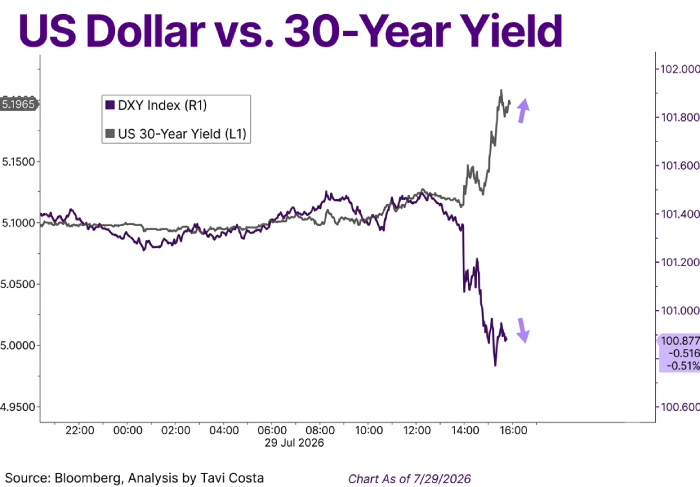
Higher Treasury yields are supposed to strengthen the U.S. dollar. Investors earn better returns, money flows into America, and the currency rises.
But that relationship appears to be breaking down.
On Wednesday, after the Fed left rates on hold, the 30-year Treasury yield climbed to its highest level since 2007. Instead of rallying, the U.S. Dollar Index (DXY) fell about 1.5% from its recent high.
The market is changing its interpretation
Historically, markets have interpreted rising bond yields as a sign of stronger growth or expectations that interest rates will stay higher.
Now higher yields are starting to look less like optimism about the economy and more like compensation for fiscal risk.
“You know something is fundamentally broken when yields surge and your currency can’t rally,” wrote Otavio Costa, founder of Azuria Capital.
“America’s debut burden is turning higher yields into evidence of fiscal stress.”
America’s interest bill is becoming the story
Washington is expected to spend roughly $1.05 trillion on interest payments in fiscal 2026 alone, according to Treasury Department projections.
That’s more than double what it paid in 2021, before the Fed began its rate-hiking campaign.
The feedback loop is becoming harder to ignore. Larger deficits require more Treasury issuance, and more issuance pushes yields higher.
Brandon Arnold of the National Taxpayers Union argues that persistent deficit spending also makes it harder for the Fed to lower interest rates because of inflation risks.
📌 Bottom line: If higher yields no longer strengthen the dollar, markets may be treating U.S. debt more like a liability than a magnet for capital.
What happens when 3% of a country gets margin called?
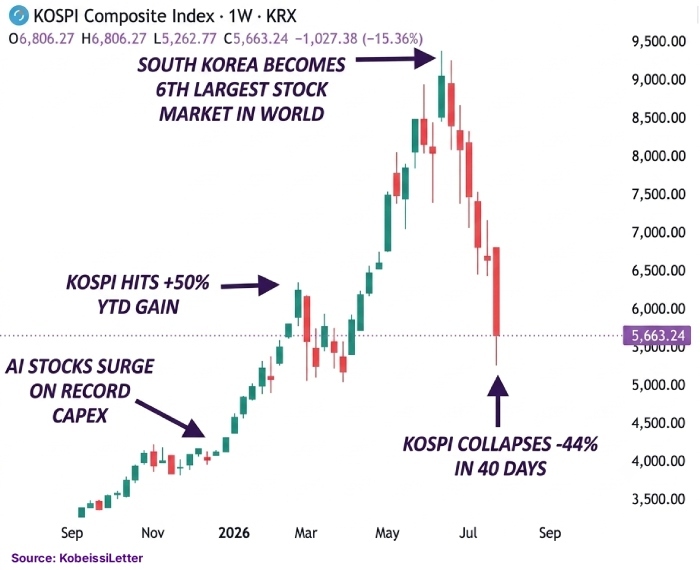
Market crashes often begin with bad news. South Korea’s began with a margin call.
According to Goldman Sachs, more than 1.2 million leveraged retail accounts had received margin calls by July 13, with 320,000–360,000 already fully liquidated.
That’s equivalent to roughly 3.4% of South Korea’s adult population.
That’s what makes margin calls so dangerous.
They don’t happen because investors think prices will fall, but because investors run out of collateral.
The U.S leverage is different but historically excessive
The U.S. probably won’t experience millions of retail margin calls.
Leverage is concentrated in hedge funds, options, leveraged ETFs, and institutional portfolios rather than individual investors. But forced selling follows the same playbook everywhere.
And that leverage is not hypothetical. Margin debt in U.S. customer brokerage accounts hit a record $1.5 trillion in June, nearly 50% higher than a year earlier.
Meanwhile, the Fed says hedge fund leverage remains near all-time highs and is concentrated among the largest funds.
So even if the U.S. avoids a Korea-style wave of retail margin calls, there is still plenty of borrowed money that could be forced out of positions.
📌 Bottom line: South Korea’s latest episode highlights the dangerous volatility of a market riddled with excess leverage.