All show, little progress

Morning Observers,
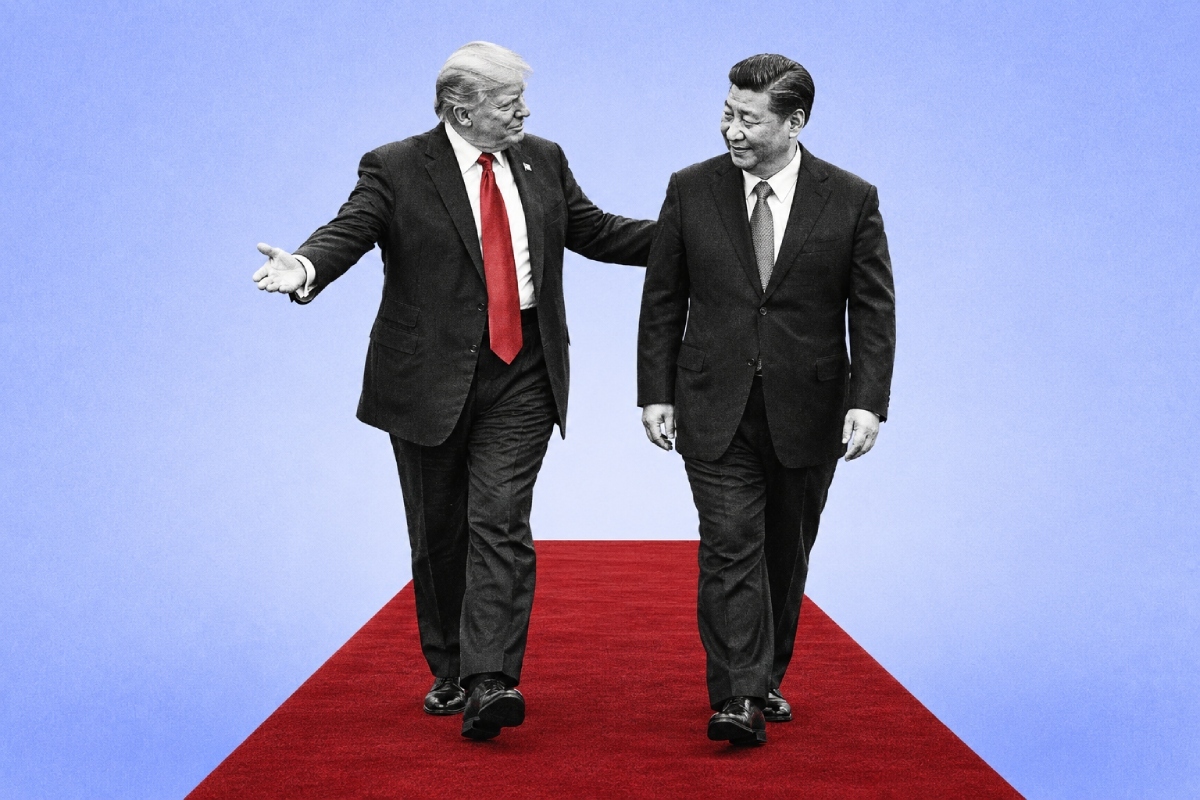
Trump rolled out the red carpet for Xi Jinping, and the biggest result of their summit so far is that the U.S. and China bought themselves two more months before their trade truce expires.
The extension was announced before the two leaders had even met.
That gives both sides more time to negotiate. But the expected tariff cuts and a new channel for AI talks had still not been announced by Thursday evening.
Meanwhile, there is no shortage of difficult issues to discuss:
- Xi pressed Trump to change Washington's position on Taiwan
- The two countries are competing over AI, with Xi urging cooperation to keep it "under human control"
- China continues to buy Iranian crude, while weapons inspectors have found evidence of Chinese-supplied components in Houthi weapons
Trump called Xi a friend and said the two had "never gotten along better." But the warm language hasn't yet produced much in the way of concrete progress.
Chinese stocks in Hong Kong fell during the summit, suggesting investors were looking for more than a state dinner, a bald-eagle statue, and a tour of the new White House helipad.
The next two months will show whether this truce can lead to a broader deal or simply delay the next trade fight.
- Dan Runkevicius, Editor

📈 Treasury yields are moving fast
The 10-year U.S. Treasury yield climbed to 5.16% on Thursday, its highest level in 19 years. The bigger story is how quickly yields have risen, jumping roughly 70 basis points this month as higher oil prices add to inflation concerns and investors price in more aggressive Fed rate hikes.
🏠 Mortgage rates are back above 7%
Higher bond yields are quickly spilling into the housing market. The average 30-year fixed mortgage rate rose to 7.03% this week, topping 7% for the first time since January 2025, according to Freddie Mac. That's up from 6.95% last week and 6.30% a year ago, adding another hurdle for already-stretched homebuyers.
💸 Small-cap ETFs see massive outflows
Investors are pulling money from small caps. The iShares Russell 2000 ETF (IWM) recorded $3.3 billion in outflows last week, its second-largest weekly withdrawal this year. Meanwhile, the S&P 500 has outperformed the Russell 2000 for five straight weeks, its longest such streak in at least a year.
🥤 Pepsi is raising prices again
PepsiCo is raising prices on some chips, dips, and sodas just months after cutting snack prices to win back consumers. Doritos, Ruffles, and SunChips are among the brands facing low-to-mid single-digit percentage increases, while prices are also rising on some Tostitos salsa and Fritos dips. Pepsi is joining other food companies raising prices due to higher energy and fertilizer costs.
🏦 Fed officials are speaking in unison about more hikes
Philadelphia Fed President Anna Paulson said additional hikes may be needed, while New York Fed President John Williams said policymakers still have "a lot of work to do." Cleveland Fed President Beth Hammack warned that supply shocks could keep inflation higher, while Richmond Fed President Tom Barkin pointed to elevated costs across the economy.
Streaming inflation is in a league of its own
Streaming was supposed to make television cheaper. Instead, the companies that disrupted cable have discovered that subscribers will tolerate price increases far above inflation.
Streaming inflation accelerates
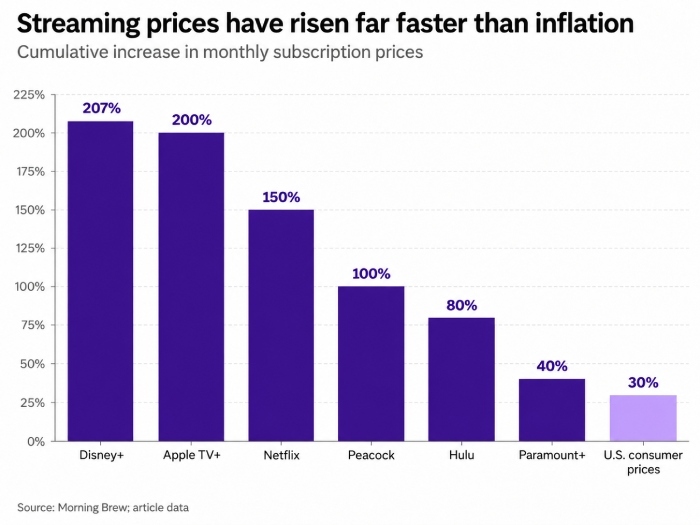
According to data compiled by Morning Brew, the price of Netflix's standard ad-free plan has risen 150% since 2010. Disney+ is up 207% since its 2019 launch, Apple TV is up 200%, Peacock has risen 100%, Hulu is up 80%, and Paramount+ is up 40%.
The increases are also becoming more frequent.
Disney+, Apple TV, and Peacock have raised prices in each of the past four years, while Hulu has done so in four of the past five. Netflix has raised prices in three of the past five years.
For comparison, overall U.S. consumer prices have risen roughly 30% since the end of 2019.
Price hikes are showing up in profits
Netflix stopped reporting quarterly subscriber totals last year, signaling how much the economics of streaming have changed.
Subscriber growth still counts, but revenue and profit per customer now carry more weight. There's no better example of that shift than Disney.
Its streaming business generated $450 million in operating income in the first quarter of fiscal 2026, up 72% from a year earlier. Much of this increase is due to Disney's operating margin reaching 8.4%.
Disney expects that margin to reach 10% for the full year.
📌 Bottom line: Streaming companies have raised prices several times faster than inflation while keeping the subscription model that built their businesses. That shows these companies have much more pricing power than previously thought.
China is challenging Wall Street’s de-dollarization consensus
Wall Street has spent years treating two ideas as conventional wisdom: China is stuck in deflation, and de-dollarization is mostly hype.
However, the growing divide between Chinese and U.S. bond markets is starting to challenge both assumptions.
China's bond market tells a different story
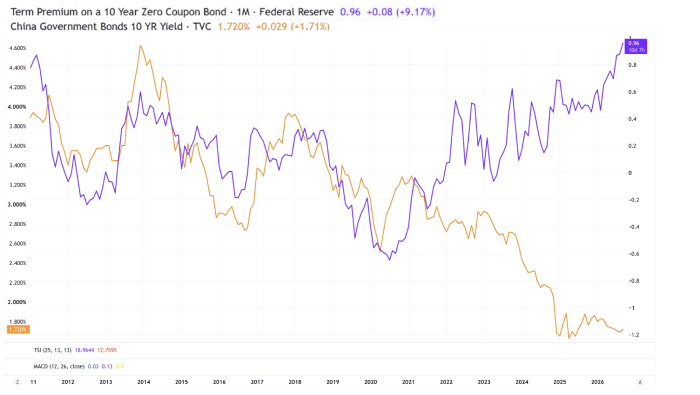
According to an analysis by market commentator Luke Gromen, a widening gap has opened between China's 10-year government bond yield and the U.S. 10-year Treasury term premium.
(The term premium measures the extra return investors demand to hold long-term Treasurys.)
Gromen's argument is that if de-dollarization really is a myth, China's savings should continue flowing into Treasurys and help bring down U.S. borrowing costs.
Instead, bond investors are demanding more compensation to lend long-term even as Chinese yields fall. Gromen sees the divergence as a sign that less Chinese money is flowing into U.S. Treasury markets.
Beijing's Treasury holdings have plunged
China's Treasury holdings fell to $618 billion in July, their lowest level since August 2008 and less than half their 2013 peak of more than $1.3 trillion, according to data from the Treasury Department.
The timing matters: Washington is looking for new buyers just as long-time Treasury holders pull back, and borrowing costs are rising.
The 10-year Treasury yield hit 5.16% this week, its highest level in nearly two decades.
📌 Bottom line: China is buying fewer Treasurys at a time when Washington is issuing more debt. That puts more of the burden on other buyers, who are already demanding higher yields.