All-out Big Tech crash

Morning Observers,
Just like Alphabet the day before, Amazon disappointed yesterday, falling short of expectations on the top and bottom line, and cash flow.
There's some chatter in my inbox that these earnings may have been taken too much at face value, if for no other reason than base effects. Last year, Amazon booked a $9.5 billion pre-tax gain from Anthropic.
There's just one thing you can't deny, and it's that Amazon is spending like there's no tomorrow. But why wouldn't they?
If a leading company controls most of the plumbing of a technology the world runs on, then that technology gets an upgrade, and everyone rushes to build the rails for it paying in advance, should that company just stop spending?
Of course not.
Amazon is not an e-commerce company on the bottom line. It's not a consumer-facing company like Alphabet or Meta on the bottom line. It's a B2B cloud company.
There's a big difference between many AI players, including Alphabet, pulling spending forward and figuring out how to monetize it later, and Amazon, which is making money on new cloud capacity from day one.
The result is that AWS is growing at its fastest pace in nearly five years, with a record operating margin.
Amazon is also guiding for another two years of 40% AWS growth. And judging by the earnings call and how Andy Jassy framed things, Amazon is clearly positioning itself as the cloud leader of the AI era.
Here's an interesting remark from him that seems to have been overlooked.
"On the core side, it's important to remember that the vast majority of global IT spend, about 85%, is still on premises, and we're in a 10- to 20-year cycle where that equation will flip to the cloud."
The other good thing about Amazon is that it's AI future-agnostic. Whether AI consolidates around a duopoly of LLMs or develops into a decentralized network of SLMs and open-weight models, Amazon still makes money as long as AI adoption grows.
Of course, there's a risk of efficiency gains, but whether they're a threat or an opportunity depends on where you stand on the Jevons paradox.
- Dan Runkevicius, Editor
|
|

📈 Fed's favorite inflation gauge hits a five-month high
The Fed's preferred inflation gauge, the Personal Consumption Expenditures (PCE) price index, accelerated to 3.6% in September, its highest reading since May. Core PCE, which excludes food and energy, also climbed to 3.1%, a five-month high.
🏛 Warsh wants fewer Fed rate decisions
Fed Chair Kevin Warsh is planning a major change to how the central bank sets interest rates. Beginning in fall 2027, one of the Fed's eight annual meetings will focus on long-term strategy rather than rate decisions. By 2028, Warsh expects to reduce rate-setting meetings to six per year, down from eight.
💳 Mastercard earnings show Americans are still spending
Mastercard beat Wall Street's earnings estimates as gross dollar volume rose 7.2% from a year earlier to $2.95 trillion. The results suggest consumer spending remains strong despite higher prices and a sluggish labor market. However, the figures include both credit and debit card purchases, making it difficult to determine how much of that spending is being financed through borrowing.
₿ Bitcoin ETFs attract fresh inflows as BTC tops $80,000
Investors are returning to U.S. spot Bitcoin ETFs as Bitcoin recovers above $80,000. The funds attracted $176 million on Tuesday, following $110 million on Monday, according to CoinGlass data. BlackRock's iShares Bitcoin Trust (IBIT) recorded $986 million in October inflows, putting it on track for a fourth consecutive month of net inflows. Despite the recovery, analysts see $85,000 as a major resistance level following a security breach at crypto exchange Binance on Thursday afternoon.
💻 Intel stock falls about 21% after hours
Intel beat Q3 estimates. But it forecast Q4 revenue of $15 billion to $16 billion, well below the $17.07 billion consensus. Data Center and AI revenue surged 78% to $7.3 billion, but PC chip sales fell 5%, while memory shortages and a two-week shutdown at Intel's Israel plant constrained supply.
Apple and the Nasdaq just broke their 40-year relationship
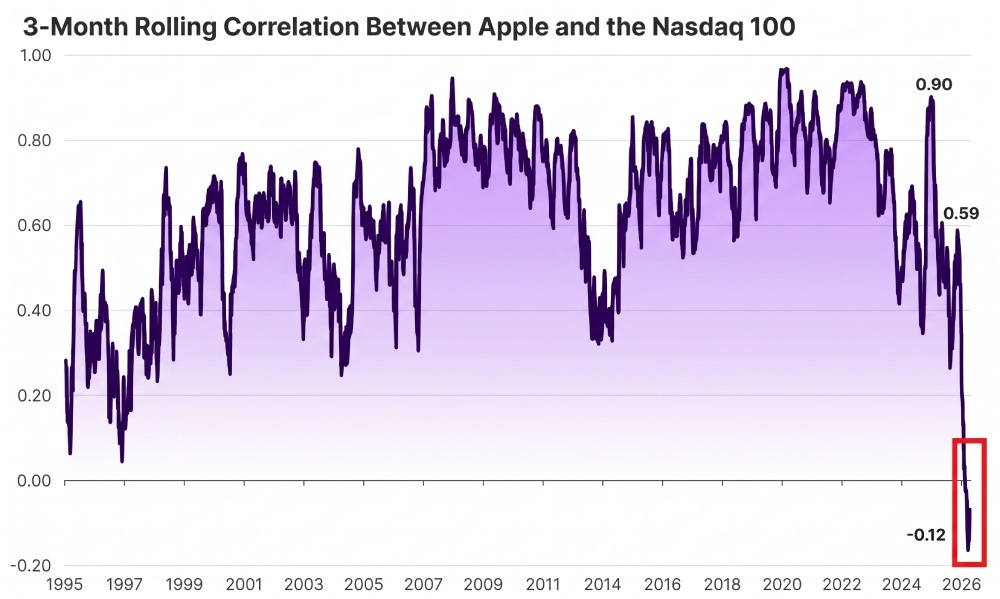
Apple was once synonymous with the Nasdaq's success. Now, for the first time in four decades, the stock has decoupled from the technology-heavy index.
The split is a result of AI stocks increasingly driving the Nasdaq 100, while Apple continues to make its money selling flagship consumer products.
Apple breaks from the Nasdaq
The three-month rolling correlation between Apple stock and the Nasdaq 100 has fallen to -0.12. It's the first negative reading since the early 1980s.
The correlation has stayed negative for two straight months. During that stretch, Apple stock gained 9.7%, while the Nasdaq 100 rose just 0.2%.
As recently as June 2025, the correlation stood at 0.90, meaning Apple and the index were moving almost in lockstep.
Apple remains one of the Nasdaq 100's largest constituents, so a negative correlation would have been almost unthinkable for much of the past two decades.
Apple's $3,000 iPhone finds buyers
While much of the technology sector is pouring money into AI, Apple is still selling expensive smartphones.
The company's first foldable smartphone, the iPhone Duo, sold out its initial online preorders within minutes of its Oct. 16 launch, pushing delivery estimates into January.
New iPhones almost always sell out. But the iPhone Duo did it within minutes despite prices ranging from $1,999 to $3,199.
📌 Bottom line: Apple's break from the Nasdaq 100 shows how much the index has changed as AI stocks take up more of its performance.
DoorDash found $17 billion for Instacart. Mamdani wants to know where workers’ money went
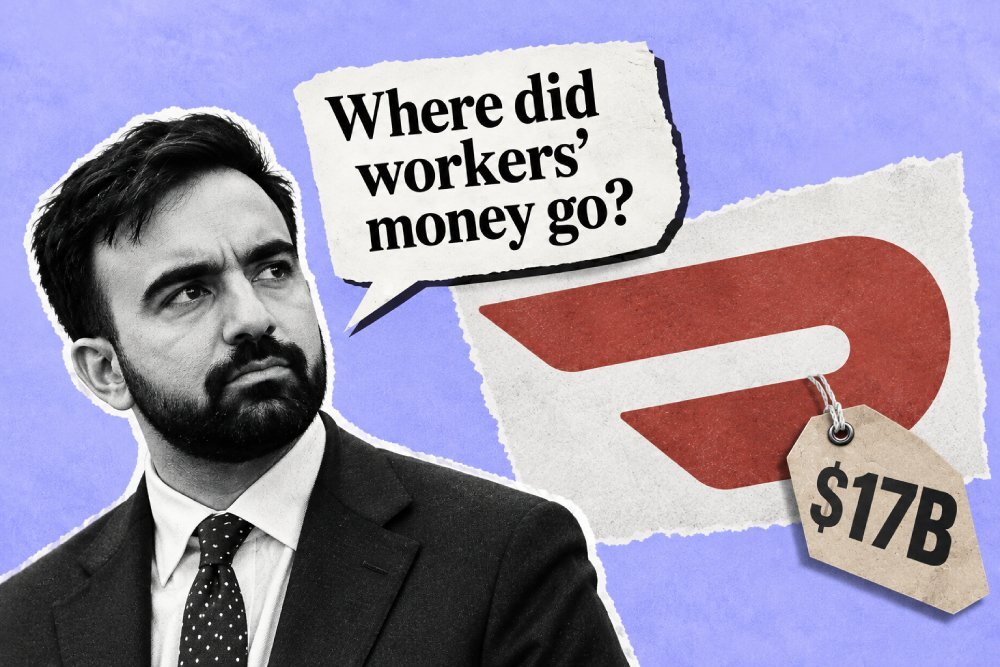
DoorDash announced a $17 billion deal to acquire Instacart on Thursday, saying the merger would bring cheaper deliveries and more choices for consumers.
New York City Mayor Zohran Mamdani had a different question: How could a company that had just agreed to pay $131.5 million over delivery wage violations suddenly find $17 billion to buy one of its biggest competitors?
Mamdani calls out DoorDash
Last month, New York City reached a record settlement with DoorDash for violating its delivery worker laws. More than 260,000 workers were affected, with over $115 million set aside for back pay.
"Just last month, DoorDash couldn't seem to find the money to pay their deliveristas," Mamdani wrote on X. "This week, they've managed to find $17 billion to acquire one of their main competitors."
Mamdani argued that the acquisition could mean higher prices for customers and worse conditions for workers, accusing DoorDash of putting corporate greed ahead of the people who deliver its orders.
Will consolidation make groceries more expensive?
Federal Trade Commission research offers a warning.
Its analysis of grocery mergers found that acquisitions in already concentrated markets led to higher prices. In less concentrated markets, some mergers reduced them.
DoorDash accounts for 59% of U.S. spending on delivery platforms, compared with Instacart's 18%, according to the Associated Press. The deal would put two major delivery platforms under one roof, potentially leaving customers and workers with fewer alternatives.
DoorDash says combining DashPass and Instacart+ could save members roughly $100 million a year in subscription fees. But those savings won't mean much if delivery charges and grocery prices rise.
📌 Bottom line: DoorDash says the merger will save customers money, but fewer competitors could give the company more freedom to raise prices.