🏦 AI’s Lehman Brothers moment? Not so fast...


Morning Observers,
Here’s a sneak peek into how Nvidia could help its customers finance up to $500 billion worth of its chips.
A few weeks ago, Nvidia announced a partnership with major banks to create new financing platforms for GPU purchases by its biggest customers.
Nvidia framed this initiative as turning “chips into an investment,” and BlackRock compared it to the creation of mortgage-backed securities in the 1970s.
But how this will actually work, nobody knows yet.
The imagination is already running wild, and some critics are taking the idea literally, suggesting that Wall Street would simply package GPUs into long-term securities.
For real estate, that makes sense. But for a rapidly depreciating tech with a competitive life span of perhaps two to three years, that sounds bonkers.
So what will actually back this debt?
There’s one creative financing model that cloud providers already use to minimize risk for the creditors bankrolling their new data centers.
Take CoreWeave’s $8.5 billion loan from this March.
Instead of borrowing the money directly under the parent company, CoreWeave created a special-purpose vehicle (SPV), which borrows the money, buys the GPUs, rents out the compute, and makes payments to the lenders.
The GPUs and contractual obligations associated with that incremental compute sit inside the SPV.
In CoreWeave’s case, this SPV is even “non-recourse,” which means CoreWeave’s creditors can’t lay claim to the SPV’s assets even if the parent company goes bankrupt.
Now where things get interesting is that much of this incremental compute is locked in under fixed-term contracts with committed payments.
That means the ultimate “guarantor” on the loan is not CoreWeave itself, nor simply the GPUs as collateral, but the future payments from cloud customers.
So the credit chain is as follows:
Money goes to SPV > SPV builds incremental compute > Cloud customer owes contractually committed payments > those payments service the debt
And because a large share of CoreWeave’s contracted revenue comes from hyperscalers with enormous cash flows, the risk that the end customer fails to make good on those payments can be relatively low.
That’s why this specific loan was rated investment grade and sold at roughly a 5.9% yield.
What earned it such a high rating was not the chips, nor CoreWeave itself, but the contractually committed revenue from the incremental compute that is isolated inside an SPV.
The risk is that not every customer is a hyperscaler with bottomless pockets. And we still don’t know where up to $500 billion worth of Nvidia GPUs will ultimately end up, if anywhere.
- Dan Runkevicius, Editor

🏦 Treasury ramps up bond buybacks after brutal selloff
The U.S. Treasury is stepping up its intervention in the bond market after a punishing selloff sent yields surging, with the 30-year reaching its highest level since 2007. Starting in September, Treasury will at least double the maximum size of buybacks for bonds maturing in 10 to 30 years, from $2 billion to $4 billion per operation.
💵 Dollar takes its biggest hit in three weeks
The U.S. dollar suffered its biggest decline in three weeks as the Treasury move sparked a rally in government bonds. The dollar index dropped 0.7%, while the greenback lost between 0.4% and 1% against 10 major currencies, including the euro, British pound, and Swiss franc. Gold was among the biggest beneficiaries, climbing back above $4,500 an ounce.
🧬 Moderna explodes 150%
Moderna stock surged 156% after the drugmaker reported a successful late-stage trial for its experimental skin cancer vaccine. The personalized mRNA therapy, developed with Merck, delivered the first positive Phase 3 results for this type of cancer vaccine, giving investors a major reason to reconsider a stock that has struggled since the pandemic-era vaccine boom faded.
💰 SK Hynix launches $29 billion buyback
South Korean memory-chip giant SK Hynix unveiled plans to buy back 40 trillion won ($29 billion) of its shares and return more profits to investors. This could be an attempt to shore up confidence after the stock lost more than half its value in just two months. Shares rose more than 2% on the announcement as the company moved to reassure investors rattled by the broader selloff in AI-related stocks.
📉 Chip stocks can’t catch a break
The broader U.S. market bounced back while chip stocks took another hit over fears of AI valuations and mounting debt risks. The Philadelphia Semiconductor Index fell another 2.1%, pushing its five-day decline beyond 5%. Even after gaining 64% this year, the index is now nearly 20% below its June peak.
Why the Treasury’s ‘Not QE’ could feel like it
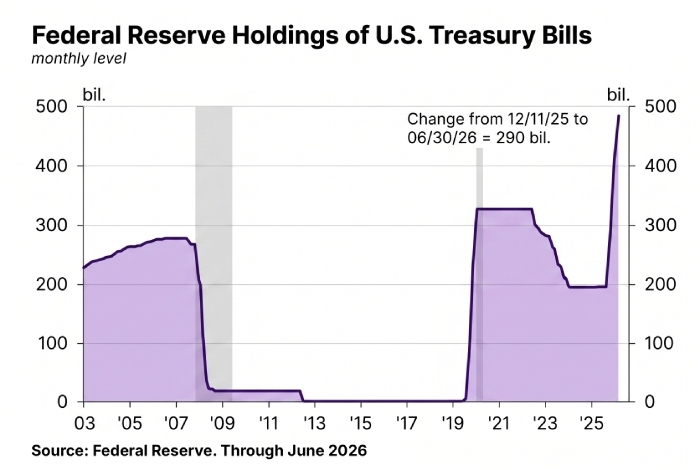
The Treasury Department insists that its latest bond market intervention isn’t quantitative easing (QE). Technically, it’s right. But markets trade the effect, not the acronym.
The Fed buys short, Treasury buys long
Traditional QE involves the Fed creating reserves to buy government bonds, particularly longer-dated ones, to push down borrowing costs and pump money into the financial system.
That’s not quite what’s happening today.
Since January, however, the Fed has purchased nearly $250 billion in Treasury bills, including roughly $160 billion in reserve-management purchases.
The Fed says these purchases aren’t QE because the goal is to maintain enough cash in the banking system rather than deliberately drive down long-term interest rates.
Meanwhile, Treasury is working on the other end of the market. Starting Sept. 9, it will at least double the size of certain buybacks for 10- to 30-year bonds, from $2 billion to at least $4 billion per operation.
A buyback that doesn’t buy down the debt
Treasury calls the operation a “buyback,” which makes it sound like Washington is paying down its debt. It isn’t.
Treasury is buying old bonds while issuing new ones to pay for them. With deficits still running high, it’s essentially swapping one form of debt for another.
“It’s debt reshuffling, not debt reduction,” said Creative Planning’s Charlie Bilello.
Or put another way, the combination can produce some QE-like effects, just split between two institutions.
📌 Bottom line: This isn’t QE in the traditional sense. But more money flowing into the bond market could achieve some of the same effects, barring a rebellion from bond vigilantes.
American investors are missing out on China’s chip boom
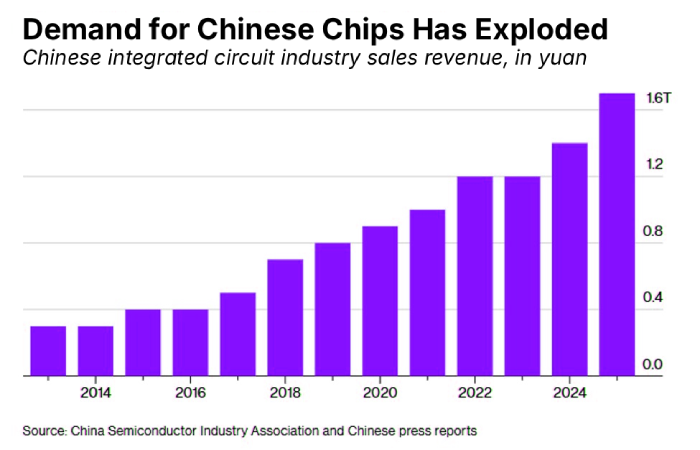
U.S. export restrictions have slowed China’s chip industry, but that hasn’t stopped China from gaining global market share.
Chinese-headquartered semiconductor companies now account for roughly the same share of global chip sales as Taiwan. For investors outside China, there’s just one problem...
There isn’t an obvious way to trade this boom.
China isn’t a small player anymore
Chinese chip industry revenue jumped 22% in 2025 to a record $245 billion, according to new data from the China Semiconductor Industry Association.
Separately, Chinese-headquartered semiconductor companies now account for roughly 6% of global semiconductor sales, roughly even with Taiwan and just behind Japan and the EU at around 7% each.
U.S.-headquartered companies still dominate with roughly 53% of the market, while South Korea accounts for 21%. But China is no longer a rounding error.
North American investors may already own the other side
Many of China’s biggest semiconductor companies trade primarily in Hong Kong or mainland China, putting them out of easy reach for many North American investors.
Broad China technology ETFs don’t completely solve the problem.
Funds like the Invesco China Technology ETF (CQQQ) and iShares MSCI China Multisector Tech ETF (TCHI) hold plenty of Chinese technology stocks, but semiconductor exposure still represents only part of their portfolios.
The irony is that investors may already be exposed to China’s chip boom, ust from the wrong side.
China has historically been a major market for U.S. semiconductor equipment companies, including Applied Materials, Lam Research, and KLA.
Those companies are already restricted in what they can sell to China, while Chinese equipment makers are increasingly competing for business at home.
📌 Bottom line: American investors are underexposed to one of the fastest-growing semiconductor markets in the world.