AI valuations aren't what they seem


Morning Observers,
Everyone is obsessed with AI valuations right now, but what is it that we're actually assigning a dollar value to?
One of the biggest bullish arguments today is that the market is successfully flushing out excesses without breaking the market.
Overleveraged AI stocks like CoreWeave are getting repriced to junk. Earnings reports have gone from AI fantasyland to companies actually committing to ROI on capex, and some already guiding to it.
But perhaps the most important sign that the AI trade may be past peak delulu is valuations.
On a forward P/E basis, hyperscaler valuations have fallen by between 15% and 65% (sorry, Oracle) from their 2025 peaks.
Meanwhile, Nvidia, the linchpin of the entire multi-trillion-dollar AI buildout, is now worth half as much as it was in 2025 relative to its earnings
The question now is what exactly we are valuing.
If you read about stock valuations in the news, 9 times out of 10, they're referring to forward P/E. It's the bread and butter of public company valuations, but it has its drawbacks.
The biggest one is that it measures a company's value based on what it will earn in the future, and those estimates can be way off, especially late in the cycle.
See the chart below. The blue line shows actual earnings, while the red line shows what analysts expected a year earlier.
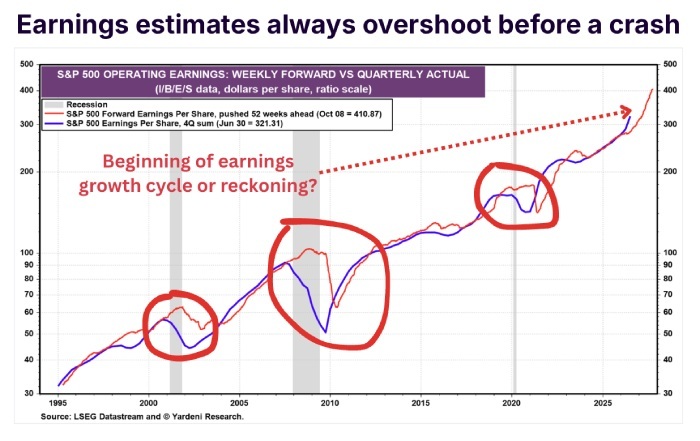
Note that there wasn't a single crash where analysts didn't overshoot. Not a single one. And the bigger the crash, the more analyst expectations were over the top.
Judging from the shape the red line is taking right now, we're either at the beginning of a big earnings growth cycle... or a reckoning.
- Dan Runkevicius, Editor

📉 Chip stocks fall for seventh straight day
The Philadelphia Semiconductor Index fell for a seventh consecutive session Thursday, closing down 0.9% and marking one of its longest losing streaks of the year. The benchmark, which tracks major chipmakers at the center of the AI boom, is now nearly 22% below its June record high.
📈 Wholesale inflation jumps to 6.3%
Following a hotter-than-expected consumer inflation report, wholesale prices also rose faster than expected in September. The Producer Price Index (PPI) climbed 6.3% from a year earlier, well above economists' 5.3% forecast. It was the second-highest annual reading since November 2022, adding to expectations that the Fed could raise interest rates at its Oct. 27-28 meeting.
📉 U.S. Treasury yields drop from multi-year highs
The tech selloff has sent investors back into the relative safety of U.S. government bonds, pulling Treasury yields down from multi-decade highs. The benchmark 10-year yield hovered around 5.05% Thursday, roughly 30 basis points below its October peak.
📊 Schwab's trading boom shows retail investors remain active
Charles Schwab's latest earnings suggest individual investors haven't stepped away from the markets. The brokerage beat profit expectations as average daily trading volume surged 44% to 10.7 million trades. Bank deposits and net interest margin fell short of forecasts, but the jump in trading activity suggests retail investors remain engaged despite recent market turbulence.
🚗 Tesla finally brings back the Roadster
After years of delays, Tesla finally unveiled its long-promised Roadster sports car Thursday, reviving a model it discontinued more than a decade ago. The reveal could give Tesla another revenue source as the company faces questions about its aging lineup and lack of new models. Investors appeared unimpressed, with Tesla stock falling Thursday.
Wall Street veteran Jim Bianco sees the best bond opportunity since 2009
The global bond selloff has raised concerns about rising borrowing costs. But for Wall Street veteran Jim Bianco, the surge in yields is an investment opportunity he hasn't seen in 17 years.
Why 5% yields shouldn't scare investors
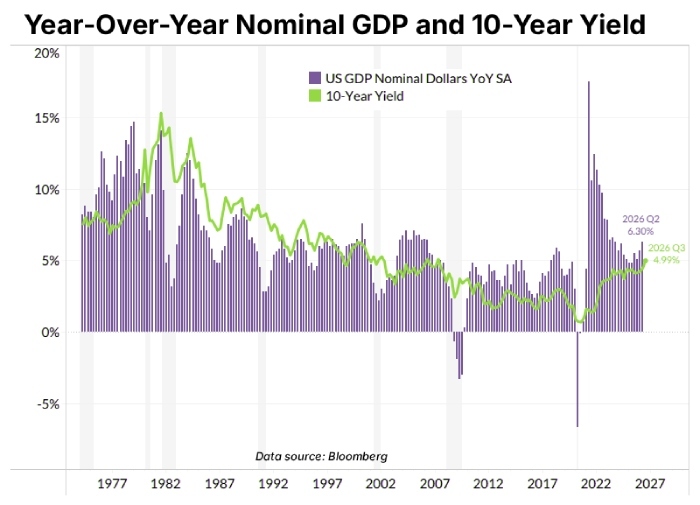
In a recent post on X, Bianco Research founder Jim Bianco argued that bond yields should generally reflect economic growth plus inflation.
Since 2022, the U.S. economy has averaged 2.4% annual growth after adjusting for inflation, while core inflation has averaged 3.36% in the post-COVID period. Together, those figures point to nominal economic growth of roughly 5%–6%.
For years, Bianco argued that Treasury yields were too low relative to economic growth and inflation.
With yields on five- to 30-year Treasurys now above 5%, he believes investors are finally earning interest rates that better reflect economic conditions.
The "bond math" has changed
Higher yields also mean investors can earn more interest, giving them a bigger cushion if bond prices fall.
According to Bianco, the Bloomberg U.S. Aggregate Bond Index now yields 5.6%. That means yields could rise by another percentage point over the next year before investors start losing money overall.
Bianco's calculations show how much the odds have shifted in investors' favor. A 10-year Treasury could return 5.3% over the next year if yields stay where they are, or 12.7% if they fall by one percentage point.
Even if yields rise by a full percentage point, the interest earned would offset much of the decline in the bond's price. This is the largest cushion since 2009.
📌 Bottom line: For investors looking to lock in income, current Treasury yields offer an opportunity rarely seen since the financial crisis.
The next mortgage crisis may not be like the last
The economist who warned about the 2008 subprime mortgage crisis sees another reckoning ahead for mortgage lenders.
This time, Peter Schiff argues, homeowners don't even have to miss payments for higher rates to inflict trillions of dollars in paper losses on the industry.
A $2 trillion mortgage problem
Schiff estimates that $8.3 trillion in outstanding fixed-rate mortgages carry an average interest rate of 4.6%, with roughly 25 years left until maturity.
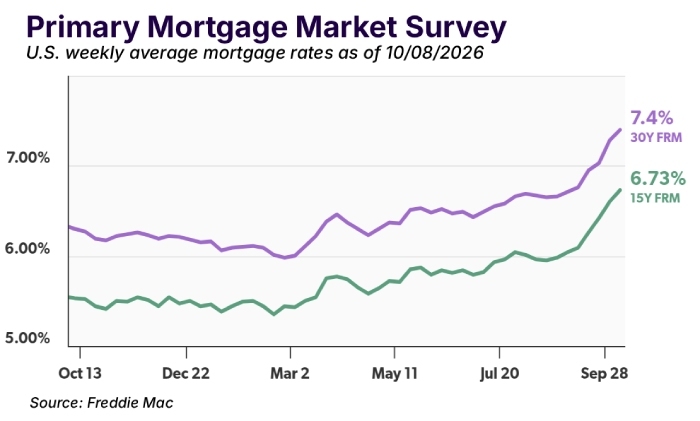
With new mortgage rates closer to 7.5%, Schiff calculates that those older loans have already lost $2 trillion in market value. If rates reach 8.5%, he estimates the paper losses could swell to $3 trillion.
For comparison, Schiff says realized mortgage losses during the 2007–2010 financial crisis totaled about $450 billion. Those losses stemmed from defaults; today's estimates reflect changes in interest rates.
Mortgage stocks tell their own story
Although Schiff has warned about another mortgage crisis before, the stock market offers some evidence that higher interest rates are weighing on mortgage investment companies.
The VanEck Mortgage REIT Income ETF (MORT), which tracks companies that invest in mortgages and mortgage-backed securities, lost roughly 23% from January 2022 through mid-October 2026, including dividends.
The S&P 500 gained more than 72% over the same period. That gap shows how poorly mortgage-related investments have performed even as the broader stock market has rallied.
📌 Bottom line: Schiff's warning hinges on interest rates staying higher or climbing further, which could deepen paper losses on older, lower-rate mortgages.