🚨 AI trade has a new problem


Morning Observers,
Yesterday’s chip sell-off looked like a textbook case of rising yields knocking down expensive growth stocks. But there's a twist...
The Philadelphia Semiconductor Index plunged about 5% for its worst session since July. Micron Technology was down 7%, Sandisk 9%, and Nvidia lost more than 2%.
Rising yields are part of the problem, but Silicon Valley is no longer just a price taker in the bond market.
Hyperscalers are borrowing so much that they may be starting to raise their own cost of capital.
For the first few years of the AI boom, hyperscalers could finance their spending out of the enormous cash flows generated by their existing businesses.
That's no longer the case.
Alphabet, Amazon, Meta, and Oracle had already issued about $194 billion of bonds through July, which is nearly 80% more than they issued during all of 2025.
Goldman Sachs expects hyperscalers to issue roughly $250 billion worth of bonds this year and $400 billion in 2027.
And all of that borrowing has consequences beyond Silicon Valley.
The Dallas Fed estimates AI bond issuance could dump as much as $360 billion of 10-year-equivalent duration onto the markets this year.
That’s equivalent to roughly one-eighth of the supply from the Treasury itself.
BlackRock says governments, hyperscalers, and other companies are increasingly competing for the same pool of capital, and that creates a strange feedback loop for the AI trade.
The more hyperscalers borrow to build out AI, the more they risk pushing up the very borrowing costs they depend on.
Yesterday, we got a glimpse of what happens when that feedback loop collides with a crowded trade.
Let’s dig in!
- Dan Runkevicius, Editor

― Yardeni draws the line at 5%
Ed Yardeni isn’t sounding the alarm over the bond selloff just yet. The Yardeni Research president believes the U.S. economy and corporate earnings can withstand a 10-year Treasury yield between 4% and 5%. But with the benchmark yield already near 4.73%, that cushion is shrinking. Yardeni said a move above 5% would put the “bond vigilantes” back in focus.
📉 Higher yields hit the AI trade
Tuesday’s chip rout showed how vulnerable the AI trade is to rising borrowing costs. The Philadelphia Semiconductor Index briefly sank more than 6% as investors reassessed chipmakers amid concerns about the debt supporting the AI buildout. The selling spread across tech, pulling the Nasdaq 100 down 1.7%.
⚖️ Social media faces a courtroom test
Social media stocks came under pressure as Meta headed to court over allegations that Facebook and Instagram were deliberately designed to encourage compulsive use among young people. The case could have implications beyond Meta for an industry built around keeping users engaged. The Global X Social Media ETF (SOCL) fell 2.2% Tuesday and is down 3% over the past five trading sessions.
🤖 AI is eating into Baidu’s old business
Baidu has now posted five consecutive quarters of declining revenue, exposing the pressure on the advertising business that made it China’s dominant search company. The company is spending heavily on AI just as ByteDance and a growing crop of chatbots compete for the attention that once flowed through traditional search. Baidu now has to fund its AI transition while defending the business that pays for it.
👟 Nike’s problem goes beyond the stock
Nike stock is down roughly 78% from its 2021 peak and recently hit its lowest level since September 2014. While the shares may look cheap compared with the past, the underlying business has also weakened. Nike has lost global sports-footwear market share for three consecutive years, with China emerging as a particular trouble spot. Brand recognition alone hasn’t been enough to stop the slide.
Retail is quietly taking the other side of the Nvidia trade
Nvidia stock is up roughly 20% this year. But beneath the rally, a strange split is developing between Wall Street and individual investors.
Retail investors are buying Nvidia at a pace that makes the rest of the Magnificent Seven look almost irrelevant. At the same time, institutional ownership has been slowly moving in the opposite direction.
Mom and pop can’t get enough NVDA
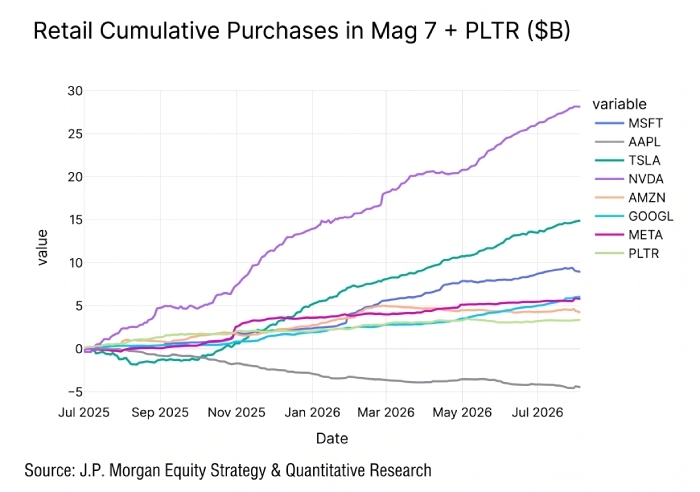
Between July 2025 and July 2026, retail investors made $27 billion in net purchases of Nvidia stock, according to JPMorgan data. That’s nearly twice the roughly $15 billion poured into Tesla, the second-most-bought name.
Apple stands alone on the other side, with roughly $5 billion in net retail sales over the period.
More striking is how quickly retail’s Nvidia buying accelerated.
Retail investors had accumulated only around $5-$6 billion of Nvidia by October 2025. Nine months later, that figure was approaching $27 billion.
Wall Street has been cashing in
Professional investors have been heading in the other direction.
WhaleWisdom’s 13F data shows institutions held 436 million fewer Nvidia shares at the end of Q1 than at the end of Q4 2025. That decline came as retail buying was accelerating.
Some of the institutional selling is almost certainly profit-taking after Nvidia’s massive run. But the divergence is hard to miss: professional investors have been trimming while mom-and-pop keep piling in.
📌 Bottom line: Retail investors have poured into Nvidia just as institutions have taken some money off the table. For now, that relentless retail demand is giving the stock another source of support even as Wall Street becomes more selective.
SaaSpocalypse hasn’t reached Wall Street’s spreadsheets
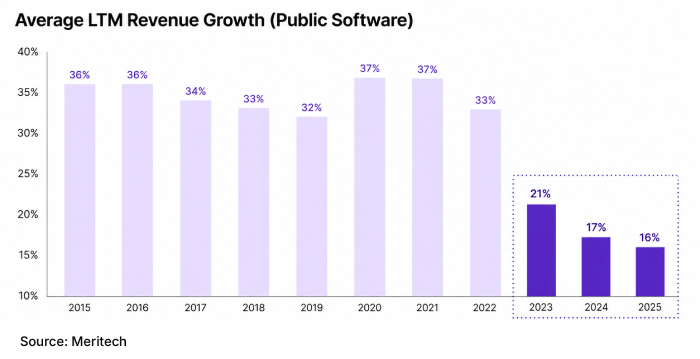
Software stocks have been crushed by fears that AI will upend the industry. But there’s one place where the “SaaSpocalypse” is barely visible: Wall Street earnings estimates.
That disconnect could be one of the market’s most overlooked risks.
Wall Street still expects almost everyone to win
Apollo analyzed Wall Street forecasts for more than 200 publicly traded software and white-collar services companies. Just 10 are expected to see declines in both revenue and EBITDA over the next two years.
In other words, despite all the talk of AI eating software, analysts still expect more than 95% of these companies to avoid simultaneous declines in sales and operating earnings.
Apollo sees three ways those forecasts could prove too optimistic: AI directly replacing existing products, companies needing fewer workers, and AI-native competitors taking market share.
Slower growth, weaker pricing power, or lower margins would be enough to make current earnings forecasts look optimistic.
If Apollo is right, the selloff may have further to go
Software stocks have already taken a beating. The iShares Expanded Tech-Software Sector ETF fell roughly 37% between its October high and April low amid fears of a SaaSpocalypse, while ServiceNow, Workday, Datadog, and Salesforce have also suffered steep declines.
Those losses largely reflect fears about what AI could do. If Apollo is right, earnings forecasts have yet to reflect what that disruption could actually mean for revenue and profits.
That leaves room for another leg lower if analysts begin cutting their estimates.
📌 Bottom line: If revenue and margin forecasts start falling across the sector, it would suggest the SaaSpocalypse has moved beyond valuation fears and into the underlying business.