AI stocks are falling

Morning Observers,
AI stocks are falling, and the South Korean KOSPI index is down 10% for the week this morning after a few remarks from the Intel and Broadcom CEOs.
At a panel discussion in Singapore yesterday, both shared concerns over the cost of AI financing. And the media, in particular, picked up on Broadcom CEO Hock Tan's comparison of AI investors to casino gamblers.
I think those remarks were a little blown out of proportion. So let's talk about what they actually said.
Tan's biggest criticism was directed at AI labs that are up to their necks in debt to train LLMs that don't yet have a viable business model.
Even now that AI companies are successfully locking in enterprise clients, Tan says most of that demand so far is for pilot projects.
"When you are a kid you go to a video arcade, you play," he said. "Your parents give you $10 of tokens, you finish it in 10 minutes and you haven't learned anything."
So while OpenAI and Anthropic are bragging about impressive run-rate revenue growth, the biggest question is whether their clients are actually getting an ROI on that inference.
Intel CEO Lip-Bu Tan went along with Hock, except that he sees Chinese open-weight models, not a lack of inference ROI, as the biggest threat to AI labs.
I got a note yesterday from UBS CIO Mark Haefele, who perfectly pointed out that news of OpenAI's lower run rate led to the biggest Nasdaq drop since August.
All of this just shows how much of the AI trade now hangs on OpenAI and Anthropic proving they can ROI on capex while helping their clients ROI on inference.
And my guess is that the motive behind these remarks is to manage expectations.
Chipmakers are backlogged for the next few years. And the last thing they want is a major crash because of unrealistic expectations.
Meanwhile, Anthropic's IPO and earnings are going to be some of the most important macro events moving forward.
- Dan Runkevicius, Editor
|
|

🪙 Gold ETFs pull in a record $30.7 billion
Investors poured a record $30.7 billion into gold-backed ETFs in the third quarter, according to new data from the World Gold Council. Global holdings rose by another 67 tonnes last month, reaching a record 4,256 tonnes. The buying spree strongly suggests private gold demand remains robust.
🏦 Bank stocks slide into correction territory
America's biggest banks are heading into earnings season on shaky ground. The KBW Bank Index, which tracks major U.S. bank stocks, has fallen more than 10% since mid-August, putting it in correction territory ahead of Tuesday's earnings reports. The selloff has come alongside surging Treasury yields and the Fed's first rate hike since 2023.
🤖 Salesforce gets a rare "Buy" rating
Salesforce climbed Monday after Bank of America upgraded the cloud software giant to "Buy," citing its potential to benefit from growing AI demand. The bank raised its price target from $160 to $285, implying roughly 22% upside from current levels. It's a notable vote of confidence for Salesforce, which got caught up in the "SaaSpocalypse" earlier this year.
🌯 Starbucks shuts down Chipotle takeover rumors
Starbucks says it has no plans to buy Chipotle Mexican Grill, putting an end to speculation about a potential restaurant industry megadeal. The denial came Monday, after the Financial Times reported last week that Starbucks had worked on a takeover proposal. The rumor drew extra attention because Starbucks CEO Brian Niccol previously ran Chipotle, making a reunion of the two restaurant giants an intriguing possibility.
📈 Fed's Hammack says rates may need to rise further
Cleveland Fed President Beth Hammack says interest rates need to rise further to bring inflation under control. She pointed to a resilient economy and said she'd favor smaller, more frequent hikes over larger moves. Her comments come as investors have pushed back expectations for the Fed's next rate hike from October to December.
The Mooch wants to bring back Clinton-era taxes to fix the deficit
Anthony "The Mooch" Scaramucci thinks the solution to America's debt problem has been sitting in the history books for more than two decades. The catch is finding a politician willing to use it.
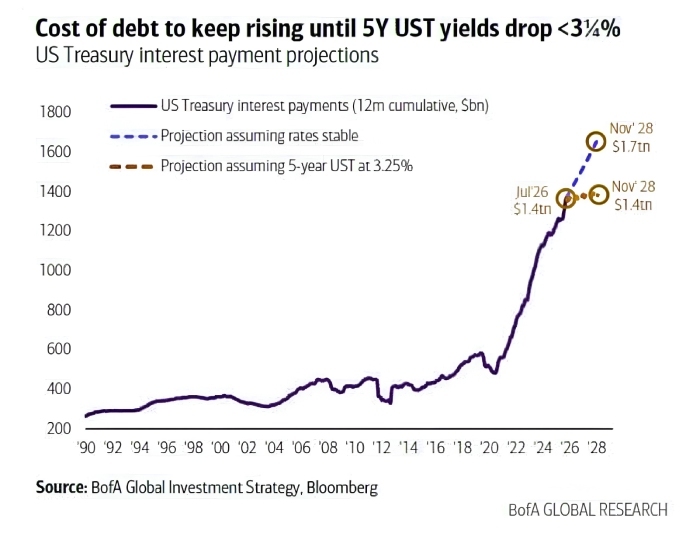
With federal debt at $40 trillion and the 10-year Treasury yield approaching 6%, the former Trump adviser believes Washington is running out of room to avoid difficult fiscal decisions.
Bring back the Clinton tax rates
Appearing on the Don Lemon Show, Scaramucci warned that current deficit and interest rate projections would translate into $2.4 trillion in annual interest payments, more than the government spends on Social Security.
"This isn't apocalyptic. It's just math," he later wrote.
His proposed fix is to restore Clinton-era tax rates, when the top federal income tax bracket was 39.6%, compared with 37% today, and the corporate tax rate was 35%, versus 21% now.
Combined with other fiscal adjustments, Scaramucci estimates the changes could reduce cumulative deficits by $10 trillion to $12 trillion over the next decade.
Of course, his interest calculation assumes the entire debt carries a 6% rate, rather than the government's actual mix of borrowing costs.
The political math is worse
The Congressional Budget Office reported that the federal deficit reached nearly $2 trillion in the fiscal year ending Sept. 30, roughly 12% higher than in 2025.
The deficit is expected to exceed 6% of GDP, up from 5.8% last year. Even so, Scaramucci doesn't expect Republicans or Democrats to embrace his proposal.
With the midterm elections approaching, neither party has made deficit reduction a central campaign issue.
President Trump has even floated $5,000 checks for American adults if Republicans retain control of Congress, a proposal that could cost more than $1 trillion.
📌 Bottom line: Washington's borrowing costs are becoming harder to ignore, but the political incentives still favor more spending. The midterms may offer little reason to expect that calculation to change.
Intel and AMD have a $60 billion Nvidia problem
Nvidia already dominates the market for AI chips. Now it could be coming for the business that made Intel and AMD household names.
Vera is growing faster than its rivals
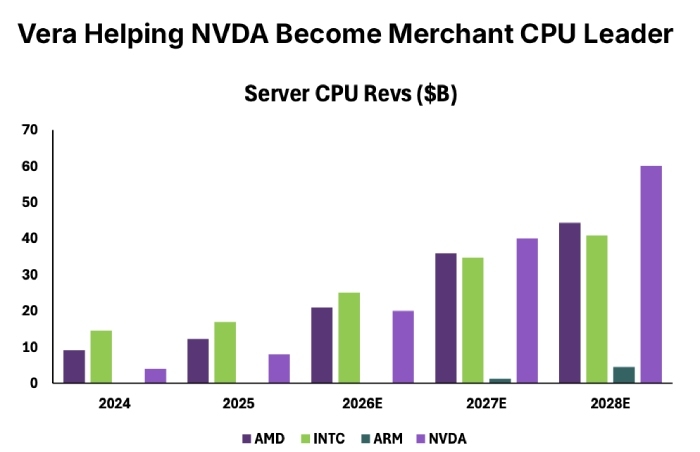
According to analyst Shay Boloor, Nvidia's Vera processor could help push the company's server CPU revenue from $4 billion in 2024 to $60 billion by 2028.
For comparison, AMD's server CPU revenue is projected to reach $44 billion by 2028, while Intel's could hit $41 billion.
Boloor attributes much of Nvidia's potential growth to agentic AI, where AI systems can perform tasks and make decisions with limited human involvement, increasing demand for server CPUs.
Nvidia already has the upper hand
Nvidia's expansion into CPUs comes at a time when the company already rakes in far more profit than Intel and AMD combined.
In its latest reported quarter, Nvidia generated $59.7 billion in net income on $96.2 billion in revenue. By comparison, AMD earned $2.3 billion on $11.5 billion in revenue, while Intel reported a quarterly loss on sales of $16.1 billion.
📌 Bottom line: Intel and AMD have spent decades competing for the server CPU market. They may soon have to worry more about Nvidia than each other.