📉 AI memory stocks crash

Morning Observers,
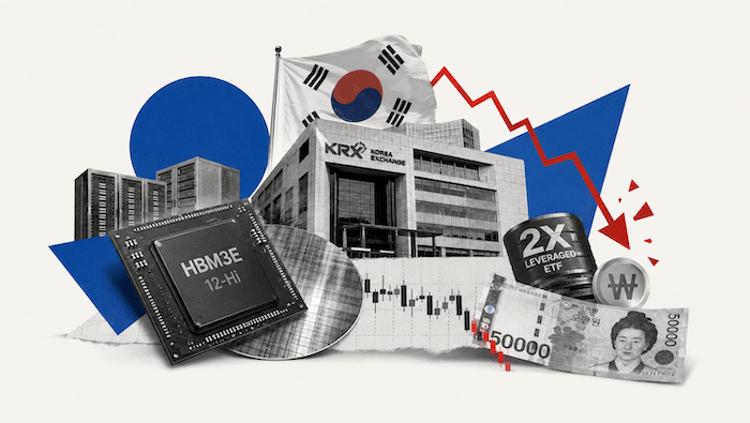
The AI memory boom just hit an air pocket, with South Korean stocks crashing nearly 10% and triggering a trading halt this morning.
Yesterday, I wrote that the stock market rally has been broadening both down the AI supply chain and geographically. And yet, everything still rests on a single failure point: AI capex spending.
Today, we saw that in action.
South Korea’s benchmark Kospi index crashed 10%, triggering a 20-minute circuit breaker. Memory chipmaker SK Hynix fell more than 12%, while Samsung Electronics lost more than 10%.
The reason? Yesterday, American hyperscalers, which are the biggest AI capex spenders, dropped on worries that they may be getting ahead of themselves with spending.
In other words, it took a few analyst comments about capital discipline and one bad session in hyperscalers to send an entire country’s stock index into a correction.
Why? Two things: momentum and leverage.
Korean stocks went parabolic this year after the country became one of the biggest hotspots for investing in memory chips, which is the latest chokepoint in the AI supply chain.
SK hynix, "the Nvidia of South Korea," is now the world’s biggest memory chipmaker and even overtook Samsung as South Korea’s most valuable company.
But it’s not just the memory boom that made the Korean rally so fragile.There is also a lot of leverage involved.
On May 27, South Korea launched its first single-stock leveraged ETFs tied to Samsung and SK Hynix. These products offer 2x the daily move of the underlying stock. And individual investors went bonkers.
From May 27 to June 12, they bought 8.2 trillion won of these single-stock leveraged/inverse products. South Korea’s Financial Supervisory Service said retail investors made up 92.7% of net buying.
Now regulators are sweating over the fact that they let a leverage grenade roll into an already hot stock market and are mulling “stabilizing measures.”
So, for now, this looks more like a violent unwind of an overcrowded and overleveraged memory-chip trade than a clean fundamental break in AI.
- Dan Runkevicius, Editor
|
Five things to know before opening bell
🛢️ Oil drops as Hormuz traffic resumesOil prices pulled back Monday after the Strait of Hormuz reopened to commercial traffic over the weekend. Roughly 6 million barrels of crude aboard three U.S.-sanctioned supertankers also entered the waterway, reinforcing the view that exports are continuing for now. WTI crude fell about 3% to $73.75 a barrel, while Brent dropped to $77.68.🇪🇺 European stocks back in leadershipEuropean stocks continued to outperform on Monday as easing inflation and improving growth expectations supported the region following the de-escalation of tensions in the Middle East. The Stoxx Europe 600 rose 0.6% and is up roughly 1.5% this month, while the S&P 500 has fallen about 1% over the same period, extending Europe’s lead over U.S. stocks.🚀 SpaceX stock tanks on massive bond planSpaceX shares dropped 16% Monday, extending losses for a third straight session after the company confirmed plans to issue investment-grade bonds for the first time. The offering, expected to raise around $20 billion, would mark one of the largest debt financings by a private company and reflects SpaceX’s growing capital needs as it scales Starship, Starlink, and other long-term projects.🇬🇧 British bonds, sterling rise after Starmer resignationU.K. financial markets stabilized after Prime Minister Keir Starmer’s resignation, with investors taking comfort in the emergence of Andy Burnham as the leading replacement candidate. The reduced likelihood of a prolonged leadership battle helped lift the pound against both the dollar and the euro, while the yield on the U.K.’s 10-year government bond fell to 4.80% after an initial bout of selling.⚡ Chevron, Microsoft ink 20-year dealChevron and Microsoft signed a 20-year agreement to supply natural gas-fired electricity to a proposed West Texas data center, highlighting the enormous energy demands created by the AI boom. The facility, known as Project Kilby, is expected to begin generating power by 2028 before eventually reaching 2.67 gigawatts of capacity. The deal marks Microsoft’s latest push to expand its data center infrastructure as it competes with Alphabet and Amazon for cloud and AI leadership.
The biggest AI trade may not be tech
Every new data center, transmission line, transformer, and power upgrade has one thing in common: they all require copper. The metal is becoming the hidden constraint behind the world’s biggest infrastructure buildout in decades.
The bull case for copper
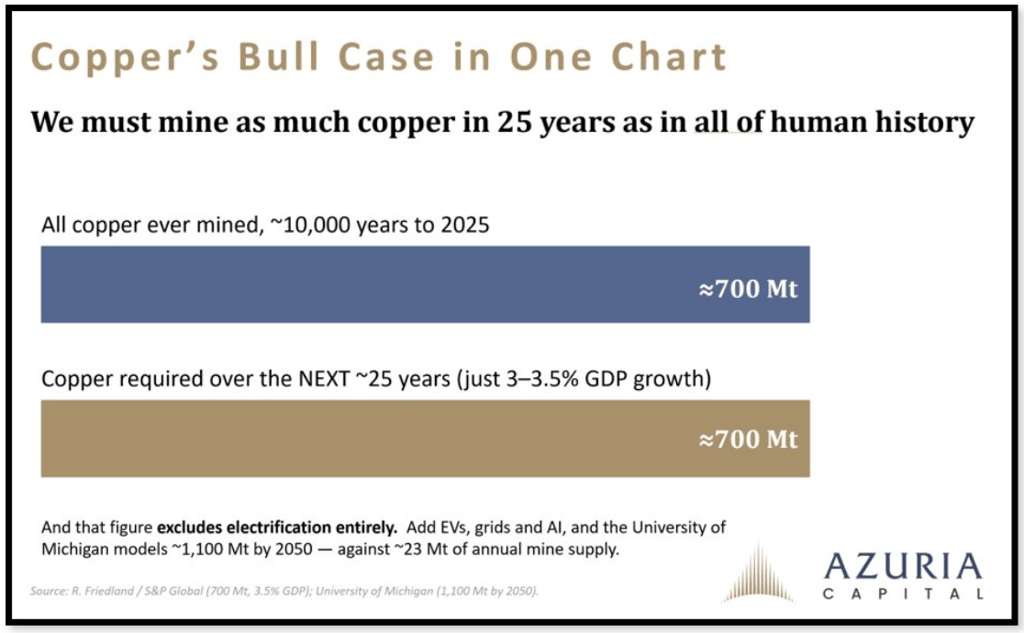
Azuria Capital founder Otavio Costa recently highlighted a staggering statistic: humanity has mined roughly 700 million metric tons (MT) of copper over the past 10,000 years.
According to data from the University of Michigan, the world may need roughly that same amount again over the next 25 years.
That forecast doesn’t require an economic miracle. It assumes global GDP grows a fairly ordinary 3% to 3.5% annually while AI, electric vehicles, renewable energy, and grid expansion continue.
If that happens, copper demand would rival the combined impact of the Industrial Revolution, electrification, telecommunications, and emerging-market urbanization.
Copper is still undervalued
Copper has quietly climbed about 30% over the past year, but it’s still up less than 50% over five years, which is a surprisingly modest move if demand is entering a structural shift rather than a normal commodity cycle.
Investors are already positioning for that possibility. The Global X Copper Miners ETF (COPX), which holds roughly 50 global copper mining companies, is up 98% over the past 12 months.
Meanwhile, the iShares Copper and Metals Mining ETF, which offers similar exposure to mining companies, has gained 88% over the same period.
📌 Bottom line: Copper is emerging as one of the simplest ways to invest in the AI buildout. The companies digging it out of the ground may end up being just as important as the ones writing the code.
Apple’s next iPhone could give us a glimpse into future inflation
Investors are watching gasoline prices for their next inflation signal. They may want to watch Apple’s next product launch instead.
If analysts are right, this fall’s iPhone could be the first major consumer product to reflect the AI infrastructure boom in its price tag.
Electronics prices are quietly surging
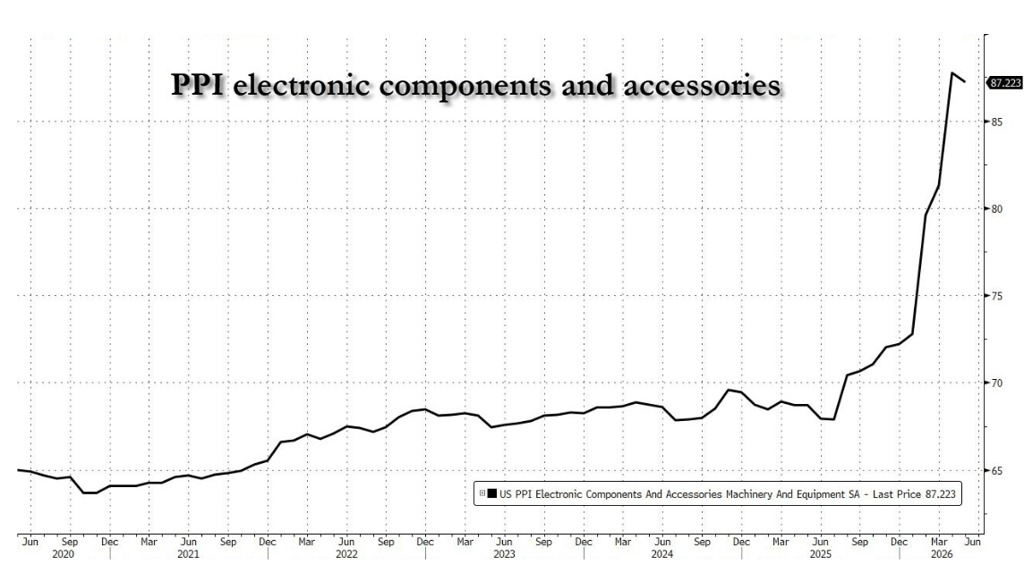
The U.S. Producer Price Index (PPI) for electronic components and accessories, which tracks prices manufacturers receive for electronic parts, barely changed between 2020 and 2024.
Then it jumped from the high 60s in late 2025 to 87.2 by mid-2026, a roughly 30% increase in just a few quarters.
That’s an unusually big move for an industry that had enjoyed years of stable prices. More importantly, it began before the Iran war, suggesting energy isn’t the main culprit.
One likely driver is the race to build AI data centers. Exploding demand for memory chips, networking equipment, and other electronic components is pushing up the cost of everything from servers to smartphones.
Apple may be the first real test
If those higher component costs are going to reach consumers, Apple’s next iPhone is one of the first places investors should look.
CEO Tim Cook said the company can no longer absorb the “unsustainable” cost increases suppliers are passing on and confirmed that price increases are coming.
While he declined to say which products will become more expensive, analysts overwhelmingly expect this fall’s iPhone lineup to bear the brunt.
Analysts expect iPhone prices to rise by roughly $300, pushing the starting price of an iPhone 18 Pro to around $1,399.
📌 Bottom line: If Apple’s next iPhone arrives with a triple-digit price increase, it may mark the moment when higher chip costs start becoming a consumer inflation problem.