AI FOMC meeting

Morning Observers,
Nvidia's earnings call felt less like an earnings call and more like an AI FOMC meeting.
Nvidia delivered about as big a beat as it gets yesterday. Both revenue and earnings topped already astronomical estimates. The company also expects revenue to grow 75% next year (above expectations as well).
But nothing moved the stock more in after hours than remarks from CFO and interim CEO Colette Kress.
After the board kicked out Huang, one of Wall Street's biggest concerns was that new leadership might stop bankrolling neoclouds or adopt a more conservative approach to financing.
There's a lot at stake. Nvidia's fastest-growing segment (AI Clouds, Industrial & Enterprise) accounts for half of YoY data center growth and depends heavily on neoclouds, many of which are short on cash.
Kress herself admitted that guidance for another astronomical year is partly contingent on Nvidia customers' access to capital.
So far, Nvidia is sticking with the status quo, saying it will continue to support its customers.
Although analysts picked up on Kress's remarks about customer scrutiny and new disclosure language around backstops, she confirmed during the Q&A that nothing has changed.
The company is simply spelling things out more clearly to address growing concerns about its financing operations.
This "hold" confirmation from the new chief of the "central bank of AI" lifted Nvidia and neoclouds after hours. Some are set to open up double digits this morning.
- Dan Runkevicius, Editor

🗣️ Huang breaks his silence
Ousted Nvidia CEO Jensen Huang says he would return if the board asked. In his first public statement since resigning last week, he thanked employees, investors, business partners, and customers for their support. He said he would be "honored" to return as CEO. But on yesterday's earnings call, Nvidia chairman Harvey Jones said the board does not intend to reinstate him. Interim CEO Colette Kress also told investors the company is focused on moving forward.
🏦 Goldman Sachs is still bullish on gold
Gold has fallen 31% from its January peak, but Goldman Sachs expects a steady recovery over the next two years, backed by record central bank buying. The bank forecasts gold at $4,650 by the end of 2027 and $5,600 in 2028, above its previous record. Goldman expects central banks to buy an average of 60 tonnes a month through 2028.
🚀 Anthropic IPO set for Thursday
Claude developer Anthropic is expected to make its Nasdaq debut Thursday under the ticker ANT. The company plans to offer 825 million Class A shares at an estimated $70 to $78 apiece. Retail investors in the U.S. and other countries could receive up to 20% of the offering.
📈 Treasury yields remain above 5%
The 10-year Treasury yield edged lower Tuesday but stayed above 5.10%, extending its longest stretch above 5% in more than two decades. Yields crossed that level more than a week ago as fresh selling in government bonds pushed borrowing costs higher on persistent inflation concerns.
🎬 Disney beats earnings expectations
Walt Disney topped Wall Street's revenue and earnings forecasts, helped by strong streaming growth. Operating income from the division that includes Disney+ and Hulu doubled to $824 million in the fiscal fourth quarter, thanks to higher subscription and ad revenue. Overall sales climbed 16% to $25.9 billion, while adjusted earnings reached $1.77 per share.
Are defensive stocks in a bubble?
The AI selloff has investors searching for safer places to park their money. Consumer staples have become a favorite, but their rally is raising a new question.
Has Wall Street accidentally inflated another bubble?
Staples are crushing tech
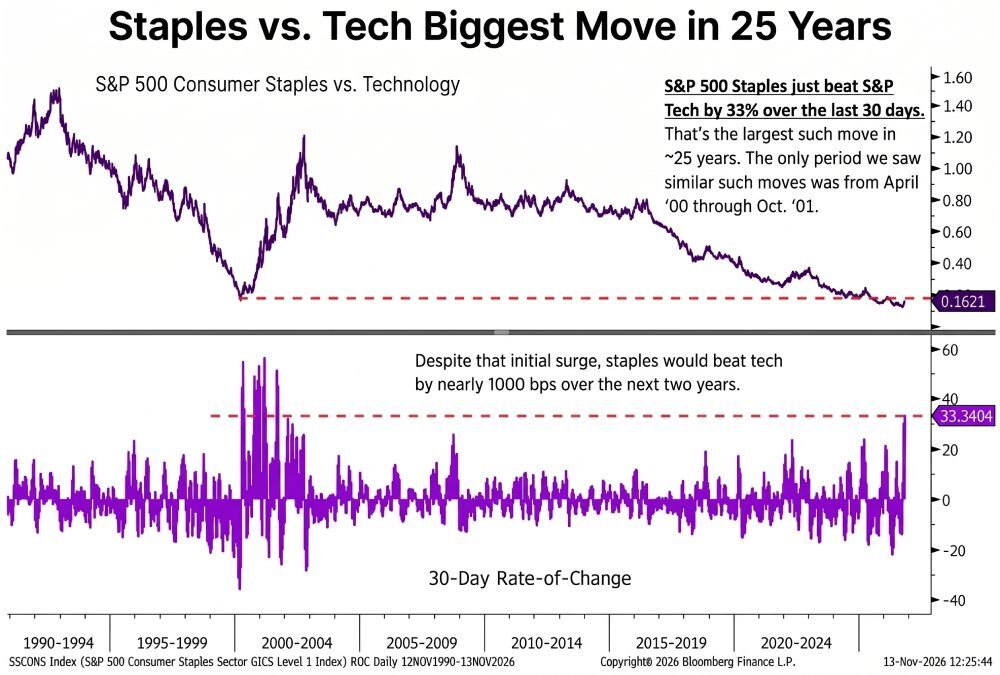
Over the 30 days through Nov. 13, the S&P 500 consumer staples sector beat technology by 33 percentage points, its biggest relative gain since the dot-com era 25 years ago, according to BTIG.
That gap is a result of a big rally in staples alongside heavy losses in tech over the past month.
Consumer staples are up more than 20% this year, with roughly half those gains coming in the past month.
Meanwhile, the S&P 500's information technology and communication services sectors have each fallen at least 11.5% over the past month.
"It's starting to look like the real bubble might be in defensive stocks, not tech," wrote portfolio manager Connor Bates. But Bates isn't alone in questioning the shift.
HSBC's Alastair Pinder recently described the rotation from tech into defensive stocks as "vicious, and in our view, overdone."
📌 Bottom line: Consumer staples are attracting investors looking for shelter from the tech selloff. But the speed of the rally leaves the defensive sector itself vulnerable to a reversal.
Food inflation is back
Americans who thought the worst of food inflation was behind them may be in for another unpleasant surprise.
October's CPI report showed food prices are picking up again, and major food manufacturers are warning that costs could keep rising into 2027.
Grocery prices are climbing again
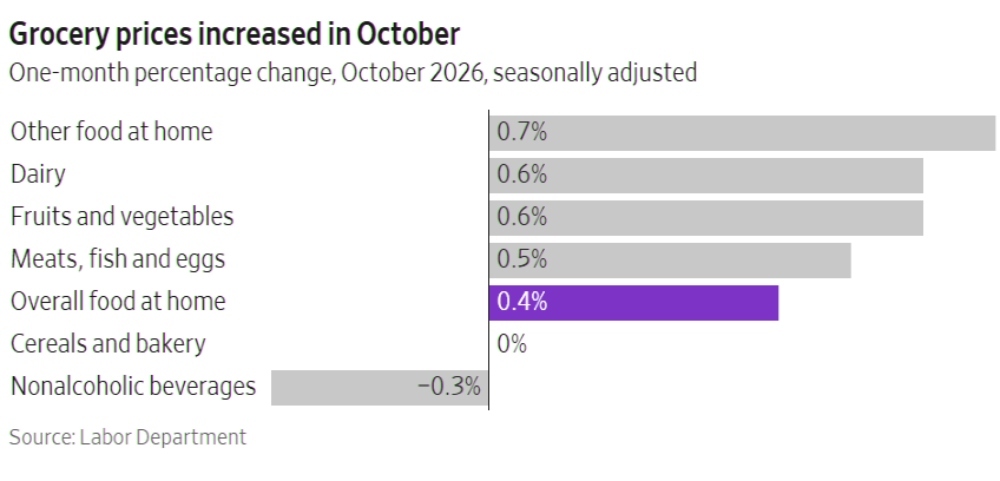
According to the Bureau of Labor Statistics, grocery prices rose 0.4% in October, the biggest monthly increase in six months. Restaurant prices also posted their largest monthly increase since December 2025.
Nearly every major grocery category got more expensive. Cereals and bakery products were unchanged, while nonalcoholic beverages fell 0.3%.
"The worst is yet to come," warned Scotiabank economist Olivier Gervais, pointing to further price increases in the coming months.
Food companies are sounding the alarm, too
Food manufacturers are facing the same squeeze. Kraft Heinz, which generates $26 billion in annual revenue, warned last week that rising costs are getting harder to manage.
CEO Steve Cahillane acknowledged the strain on household budgets, warning that "the consumer is in a fragile state, [but] there's clearly more inflation."
📌 Bottom line: Food companies face a tough call heading into 2027: absorb higher costs or pass them on to consumers who are already cutting back. Either way, profits and household budgets could take a hit.