😵💫 AI debt binge gives investors "indigestion"


Morning Observers,
PIMCO just confirmed one of the hidden consequences of the relentless AI borrowing we discussed earlier this month.
Its CIO, Marc Seidner, said that the flood of debt from AI companies is creating "indigestion" in fixed-income markets, and that is becoming a problem for everyone.
Hyperscalers will issue $279 billion worth of bonds this year. And just yesterday, SoftBank announced that it would seek another $10 billion loan on top of a $10-20 billion bond sale to refinance the $40 billion bridge loan it used to fund its OpenAI investment.
It is also preparing a record $6.3 billion retail bond sale in Japan. All of this supports its commitment to invest nearly $65 billion in OpenAI.
The problem is that this money does not come from some separate AI jar. Amazon, Alphabet, and SoftBank, as well as the US government, are competing for the same capital.
Every new 20-30-year bond from Big Tech must be absorbed by the same pension funds, insurers, and foreign institutions that normally buy long-term Treasuries.
That helps explain why even borrowers with the equivalent of perfect "credit scores" are being forced to pay more.
Amazon's latest $25 billion bond sale priced at a spread of roughly 1.2 percentage points over Treasuries, about twice what it might have paid last year.
PIMCO analysts also believe the sheer volume of AI issuance may have materially contributed to pushing the 10-year Treasury yield toward 4.75%.
And this is probably only the beginning. JPMorgan estimates that AI investment could reach $5.5 trillion by 2030. Operating cash flow and new equity may cover only around one-quarter of it, leaving bonds, loans, and private credit to fill much of the gap.
The biggest takeaway here is that AI companies are beginning to compete for credit in order to keep their cost of capital attractive to Wall Street.
Only this time, debt-addicted Uncle Sam wants a piece of that pie too, and very much so.
- Dan Runkevicius, Editor

🌊 Nvidia: the tide that lifts all ships
Nvidia's stronger-than-expected earnings provided another point of support for the AI trade. The chipmaker's shares rose more than 8% on Thursday, helping lift the Nasdaq 100 by more than 1.4% as gains spread to semiconductor and other AI-linked stocks. The results suggested that demand for AI infrastructure remains resilient and offered investors further evidence that elevated spending across the sector is continuing.
💰 Moderna cashes in on its monster rally
Moderna is taking advantage of its suddenly much higher share price. After the stock more than doubled in a single session, the biotech said it plans to raise $2 billion through convertible notes, with proceeds earmarked for its cancer vaccine business and debt repayment. The deal allows Moderna to capitalize on renewed investor demand while raising fresh capital for a business it hopes will become its next major source of growth.
🇯🇵 Japan goes all-in on memory chips
Japan is getting a massive new AI infrastructure bet. Kioxia Holdings and SanDisk plan to invest more than $31 billion over six years to expand NAND flash memory production in Japan. The spending comes as AI data centers drive demand for memory and storage, pressuring manufacturers to increase capacity. For Japan, it's also another major step toward rebuilding its position in the global semiconductor supply chain.
👀 Wall Street gives ServiceNow another look
ServiceNow jumped more than 10% on Thursday as investors continued to reassess the cloud software company's prospects for turning AI adoption into revenue. The move builds on recent optimism from Bank of America, which said it remains confident in ServiceNow's AI monetization potential despite recent challenges. Shares have rebounded about 29% over the past month but remain down for the year.
🌏 Is the AI trade heading overseas?
Investors are starting to look beyond the U.S. for the next winners of the AI boom. Bank of America's latest Fund Manager Survey identified Taiwan and Japan as the markets expected to benefit most from the next phase of the AI cycle, while China tied with the U.S. and South Korea ranked last. The results suggest the AI trade may be broadening from U.S. megacap tech to Asian markets deeper in the semiconductor and memory supply chains.
You can't "buy back" the bond vigilantes
The Treasury's recent efforts may have temporarily lowered rates, but they do little to reverse the fiscal forces pushing borrowing costs higher in the first place.
Druckenmiller says fix the deficit
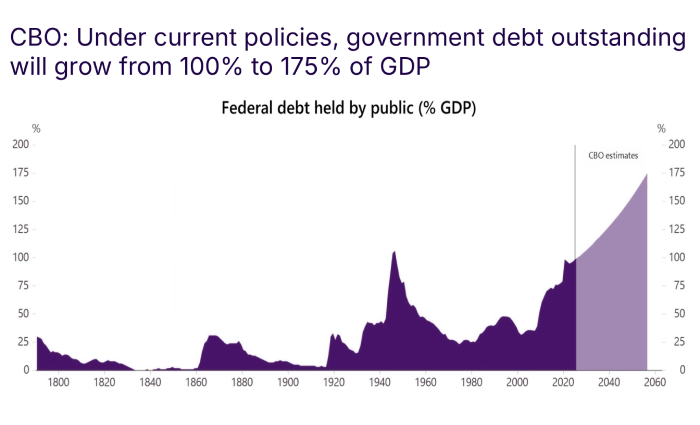
Since 2006, US gross federal debt has increased by $32 trillion, compared with a $19 trillion increase in annual nominal GDP. Debt has grown nearly fivefold, while the economy has grown by less than 2.5 times.
What once looked like crisis-era fiscal spending is becoming the new normal.
The CBO projects that federal debt held by the public will rise from roughly 100% of GDP toward 175% under current policies. The OMB, meanwhile, forecasts deficits near 5% of GDP in the coming years, compared with a current pace closer to 6%.
That may sound like an improvement, but a deficit equal to 5% of GDP would still be unusually large for a healthy economy.
It also means the Treasury will need to keep issuing enormous quantities of debt before the next recession, financial crisis, or national emergency even arrives.
More competition
At the same time, Washington is facing more competition for capital.
Hyperscalers are borrowing heavily to finance data centers, chips, power generation, and other parts of the AI buildout. Their long-term bonds are competing with Treasuries for the same money from pension funds, insurers, asset managers, and foreign institutions.
In other words, the government's financing needs are increasing just as some of the world's largest companies are beginning one of the biggest investment cycles in history.
That competition makes it harder for Washington to attract buyers without offering higher yields.
Treasury buybacks can change which bonds investors hold and temporarily improve how the market functions. But they can't erase the deficit or the need to attract trillions of dollars in fresh capital.
📌 Bottom line: A 5% deficit when the economy is healthy leaves Washington little room when the next downturn arrives. For investors, that makes higher long-term rates increasingly a fiscal problem.
Raymond James: The AI boom is moving beyond GPUs
It’s becoming a lot harder to call the top of the AI boom. According to new analysis from Raymond James, AMD could offer a preview of where the chip rally goes next: CPUs.
From GPUs to CPUs
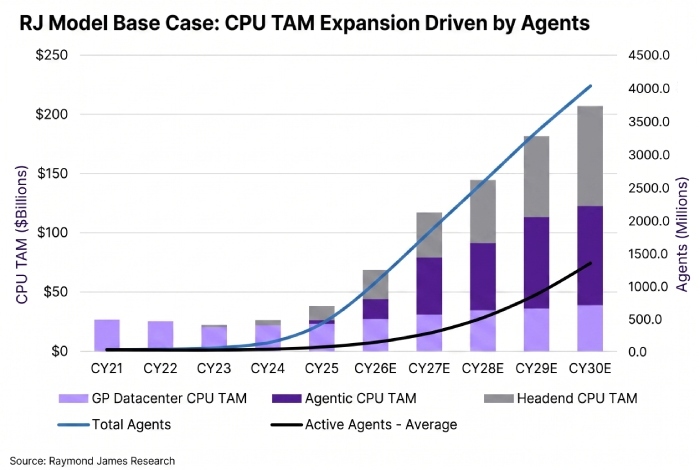
The first phase of the AI boom belonged overwhelmingly to GPUs, the chips doing the heavy lifting behind model training and inference. But the rise of AI agents is creating greater demand for CPUs.
That's why Raymond James expects the server CPU market to surge from roughly $33 billion today to $201 billion by 2030, with about $168 billion tied to AI workloads.
The firm had expected AMD's GPU business to overtake its server CPU business sooner, but surging CPU demand has pushed that moment further into the future.
What a second wave could look like
AI’s GPU-led wave was enormous.
Semiconductor stocks have surged roughly 300% since the AI frenzy began. Raymond James thinks CPUs could provide another leg.
Its AMD forecast gives some sense of the potential: the firm upgraded AMD to “Strong Buy” and set a $641 price target, implying roughly 40% upside from current levels.
UBS is even more bullish, with a target above $700, or more than 50% upside.
📌 Bottom line: The first wave concentrated enormous gains in companies selling the chips that train AI models. A CPU boom would spread those dollars across a much larger part of the server market… and potentially create a new group of winners.