📈 AI bulls are back


Morning Observers,
CoreWeave soared nearly 20% yesterday, suggesting that Amazon’s AI math may be bringing the bulls back.
Last week, Amazon reported a triple-digit increase in its AI cloud revenue run rate and said AI already accounts for roughly 15% of AWS revenue.
Andy Jassy also said that the AI business could eventually be ahead of the core AWS business in terms of profitability and that their data centers will break even in less than three years.
That was enough to soothe two AI fears: 1) AI cloud demand plateauing and 2) capex capital discipline. And one way to trade this reversal was the most direct listed proxy for GPU-cloud demand: CoreWeave.
Another positive development was CoreWeave's new partnership with Leidos, which is effectively a $15 billion federal government contractor.
The companies plan to provide secure AI infrastructure to U.S. intelligence and defense agencies.
That does not change the fact that CoreWeave, like many other AI cloud companies, is spending nearly all of its cash flow on data centers while taking on more debt.
But Andy Jassys' comments probably gave investors more confidence that, a few years from now, all this investment will begin paying off.
Meanwhile, bond investors are imposing stricter capital discipline on the company.
Just days earlier, CoreWeave tried to raise $2.6 billion to buy and install the GPUs needed to fulfill contracts with Anthropic and several other large customers.
The company was forced to increase the yield by 1.25 percentage points and offer additional protections to find enough buyers for that tranche.Between Amazon’s comments and the terms of this financing, there seems to be quite a lot of capital discipline in this increasingly debt-driven stage of the AI expansion.
- Dan Runkevicius, Editor

💊 Big Pharma eyes record-breaking merger
AstraZeneca has explored acquiring Bristol Myers Squibb in what could become the largest pharmaceutical deal on record. The combined company would be worth nearly $400 billion, strengthening AstraZeneca’s position in oncology while giving Bristol Myers a larger platform as it prepares for patent expirations on blockbuster drugs, including Eliquis and Opdivo. The talks remain preliminary, and no agreement has been reached.
🕊️ Iran and the struggle for diplomacy
After initially denying reports of an agreement with the U.S. to reopen the Strait of Hormuz, Iran said negotiations to increase shipping through the critical waterway are making progress. Markets welcomed President Trump’s decision to avoid further military escalation, sending oil prices down 6% at the start of the week and lifting stocks.
🚀 Amazon joins the $3 trillion club
Amazon stock climbed nearly 5% on Monday, pushing the company’s market capitalization to $3.08 trillion after a 15% surge on Friday driven by blockbuster AWS earnings. Amazon is now only the fifth company to surpass the $3 trillion milestone, joining Apple, Microsoft, Nvidia, and Alphabet.
💴 U.S. signals readiness for more yen intervention
U.S. Treasury Secretary Scott Bessent said Washington is prepared to join Japan in additional currency interventions if needed after the two countries carried out a coordinated yen-buying operation on Friday. The intervention came after the yen hit a fresh 40-year low against the dollar.
🇨🇳 China’s AI “death zone” is here
China’s latest wave of AI model launches is rapidly closing the gap with Silicon Valley and creating a death zone for anyone that cannot compete on performance. Alibaba’s Qwen3.8-Max and Moonshot AI’s Kimi K3 have delivered performance comparable to leading U.S. models, raising fresh questions about whether American chip sanctions are actually slowing China’s technological ascent.
The people who know their companies best have stopped buying
CEOs can talk their book all they want, but nothing says more about what the people who know their companies best are thinking than what they do with their own money.
And lately, they’ve stopped buying their own stocks.
The quietest warning on Wall Street
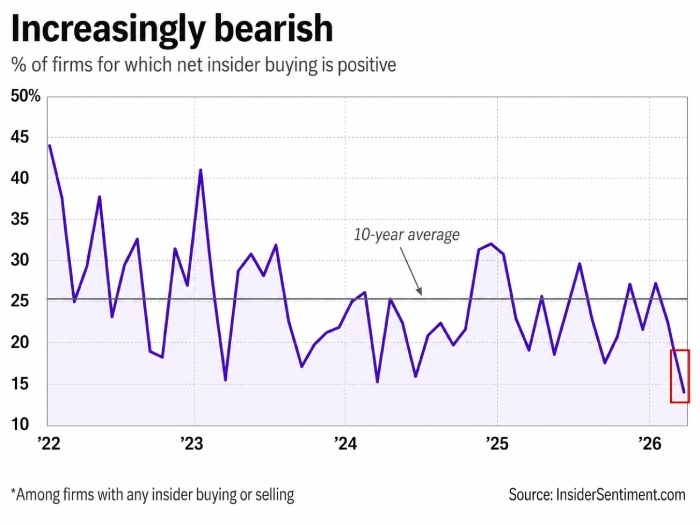
According to InsiderSentiment, just 14.8% of U.S. public companies recorded more insider purchases than sales in July, the lowest monthly reading in at least 21 years.
The figure has fallen 12 percentage points since February and now sits well below the 10-year average of 25%. Back in January 2022, nearly 44% of companies recorded net insider buying.
Only consumer staples, materials, and utilities saw net executive purchases. Among large-cap companies, just 3.2% recorded more buying than selling in July.
When your own stock is no longer a bargain
Insider buying tends to surge when management believes the market is undervaluing the business. Conversely, it dwindles when executives no longer see their own shares as bargains.
That pattern has persisted throughout 2026.
EPFR tracked $77.6 billion in insider stock sales during the first half of the year, even as the broader market climbed to fresh record highs.
📌 Bottom line: Corporate insiders tend to buy when they think the market has become too pessimistic. If that buying returns, it could be an early sign that executives see opportunities again.
Why Treasury yields rose after the Fed stopped talking
Most investors assume bond yields move because of what the Fed says. Last week, they may have moved because of what it didn’t say.
The market didn’t react in real time
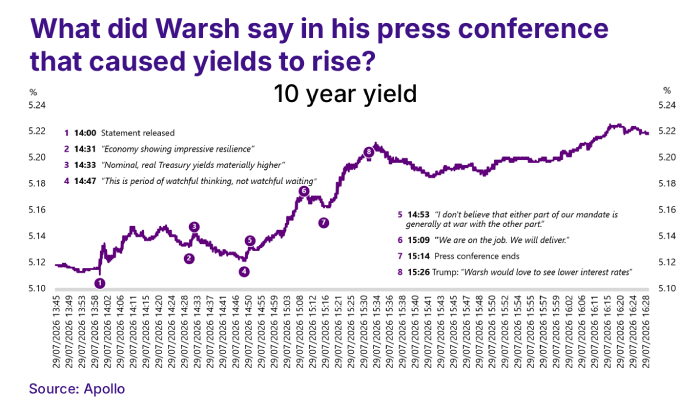
Long-term Treasury yields surged to multi-decade highs last week, yet nothing Fed Chair Kevin Warsh said during his post-FOMC press conference appeared to trigger the move.
According to Apollo chief economist Torsten Slok, yields actually fell after several of Warsh’s more hawkish comments.
The biggest jump didn’t come until after the press conference ended, suggesting that investors were instead reacting to what the Fed had left unsaid.
According to Slok, markets were left trying to answer a question the Fed never addressed: exactly how it plans to bring inflation back to its 2% target.
The destination is clear, but the route isn’t
Warsh’s Fed has made it abundantly clear that inflation must return to 2%. What he failed to communicate is exactly how he intends to achieve that.
Will the Fed keep interest rates higher for longer? Will it continue shrinking its balance sheet? Or will it rely on other tools to slow inflation?
Each path would affect the economy differently, yet investors have little sense of which one the Fed intends to follow. That uncertainty is forcing them to demand a higher return for holding long-term government debt.
📌 Bottom line: The Fed doesn’t have to raise interest rates for borrowing costs to rise. As long as investors are left to fill in the blanks themselves, economists warn that a 30-year Treasury yield near 5.3% and a 10-year yield above 4.7% could become increasingly difficult for the economy and the federal government to absorb.