5% yields are back

Morning Observers,
Wall Street’s brief reprieve from rising Treasury yields is over. Bond yields surged again this week after another hotter-than-expected inflation report revived expectations of a Federal Reserve rate hike in December.
The 10-year Treasury yield climbed to 5.01% on Tuesday, up nearly 20 basis points from last week’s low. The 30-year yield also jumped 10 basis points, adding to a selloff in government bonds.
Seema Shah of Principal Asset Management warned that Fed Governor Chris Waller has “put 50 basis points on the table,” suggesting investors may need to prepare for more than one rate hike.
For much of this year, investors looked past stubborn inflation, soaring energy prices, the Iran war, and political turmoil. Strong corporate earnings have helped keep stocks afloat, even as borrowing costs climbed.
But higher interest rates are starting to take their toll on stock valuations.
The S&P 500 now trades at 19.3 times projected earnings, down from 22.2 times at the start of the year. Stocks have continued to reach new highs, but investors are paying less for each dollar of expected profit. Technology heavyweights such as Nvidia have also felt the effects, even before the recent drama involving CEO Jensen Huang.
“The rise in interest rates has already had a huge impact on the stock market,” said Bob Doll, chief investment officer at Crossmark Global Investments. “P/E ratios have fallen three turns. The impact is very direct, but hidden because earnings have been so phenomenal.”
Strong earnings have cushioned the impact of rising borrowing costs so far. But how much longer can that continue?
Let’s break it down.
- Sam Bourgi, Interim Editor
|
|

📈 Inflation is accelerating again
U.S. consumer prices rose 0.4% in October, while core inflation increased 0.3%. Both readings exceeded economists’ expectations. Although the BLS didn’t publish year-over-year comparisons because of the October 2025 government shutdown, economists estimate annual inflation is running around 4%, twice the Fed’s 2% target.
🎄 Goldman Sachs expects December rate hike
The latest inflation report makes a December interest rate hike all but certain, according to Goldman Sachs’ Lindsay Rosner, who sees the possibility of further increases in 2027. Rosner believes inflation concerns now outweigh “wider AI jitters” over excessive investment and falling technology stocks.
🤖 Anthropic’s IPO valuation expectations shrink
Anthropic is seeking IPO funding at a $1.4 trillion fully diluted valuation, according to Bloomberg, well below earlier expectations of $2 trillion to $2.2 trillion. Despite the lower figure, Goldman Sachs analysts project the AI startup’s annual revenue could reach $685 billion by the end of the decade.
📈 TSMC reports 60% sales surge
Taiwan Semiconductor Manufacturing Co. reported a 60% increase in October sales, offering new evidence of strong demand for AI chips despite concerns about excessive data center spending. The company’s revenue reached $17.9 billion during the month.
📉 Nvidia selloff deepens amid Huang scandal
Nvidia stock fell further Tuesday, extending a recent selloff that began after CEO Jensen Huang admitted to an affair with a woman suspected of working for Chinese intelligence. The stock has lost 30% over the past month. The scandal could have consequences beyond Nvidia, given Huang’s unusually close involvement in shaping U.S. trade policy. “In 35 years, I haven’t seen a chip CEO with this much direct influence on export policy,” said Patrick Moorhead, CEO of Moor Insights & Strategy.
The AI boom has a “recycling” problem
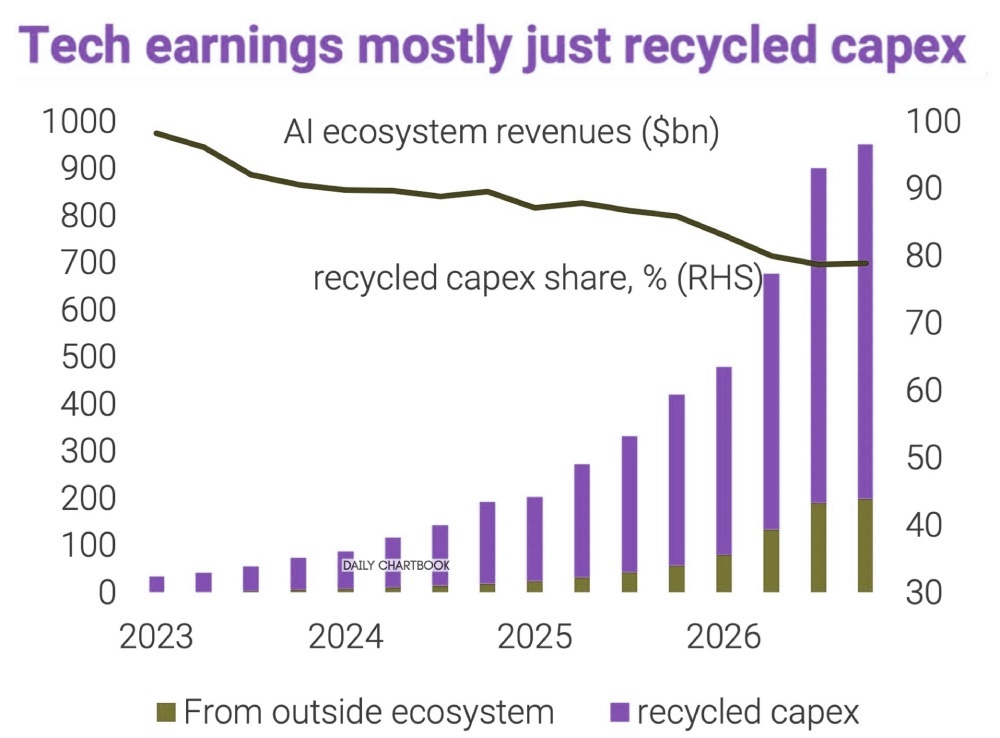
The AI industry is on track to generate nearly $1 trillion in revenue this year, a staggering figure for a technology still in its early stages. But that growth raises an uncomfortable question: How much of that revenue comes from genuine customer demand, and how much comes from technology companies spending within their own ecosystem?
Where AI’s revenue comes from
TS Lombard estimates that roughly 80% of AI ecosystem revenue comes from recycled capital expenditures, rather than purchases by businesses and consumers outside the industry.
In practice, this means money spent building AI infrastructure becomes revenue for chipmakers, cloud providers, and other technology companies, many of which are also investing heavily in AI.
The recycled share has fallen from nearly 100% in 2023, while revenue from outside customers is projected to reach $200 billion by late 2026. But it’s still only about a fifth of the industry’s projected total.
What happens when the spending slows?
Chipmakers have benefited enormously from the AI spending spree. But with so much of their revenue tied to data center construction, even a modest pullback by their biggest customers could take a sizable chunk out of sales.
Whether demand from businesses and consumers can grow fast enough to offset a slowdown remains uncertain. An October study published by the National Bureau of Economic Research found that just 2.9% of U.S. consumers paid for a major generative AI service.
📌 Bottom line: Six months ago, investors seemed willing to overlook the AI industry’s reliance on its own spending. The recent tech selloff suggests that tolerance is fading.
Nvidia and Google are headed for a memory showdown
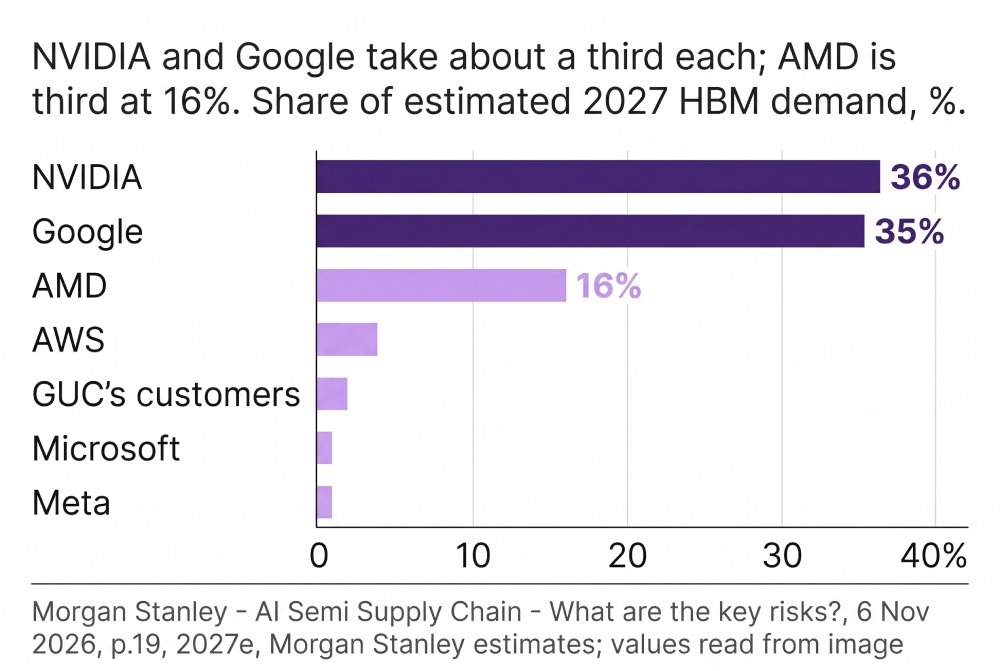
Nvidia has dominated the market for AI chips, but Google is becoming a serious competitor with its own processors. By 2027, the two companies could account for nearly equal shares of global high-bandwidth memory (HBM) demand, putting them in direct competition for a critical AI component.
Google is catching up
Morgan Stanley estimates that Google could account for 35% of global HBM demand in 2027, nearly matching Nvidia’s 36%. Together, the two companies would account for 71% of projected demand, with AMD a distant third at 16%.
Nvidia remains the dominant supplier of AI accelerators, but Google’s growing investment in its own Tensor Processing Units (TPUs) could make it an equally important buyer of HBM.
HBM allows AI chips to move large amounts of data quickly, making it essential for training and running AI models.
Which stocks could benefit?
The competition could drive more business to the world’s three major HBM manufacturers.
SK Hynix, Samsung Electronics, and Micron Technology could all see higher sales as Nvidia and Google expand AI chip production. Despite their recent declines, these stocks have already surged this year, driven by booming demand for AI memory.
📌 Bottom line: With three companies projected to account for 87% of HBM demand in 2027, memory manufacturers could charge higher prices if demand outpaces production. But their reliance on a handful of customers also leaves them vulnerable to spending cuts.