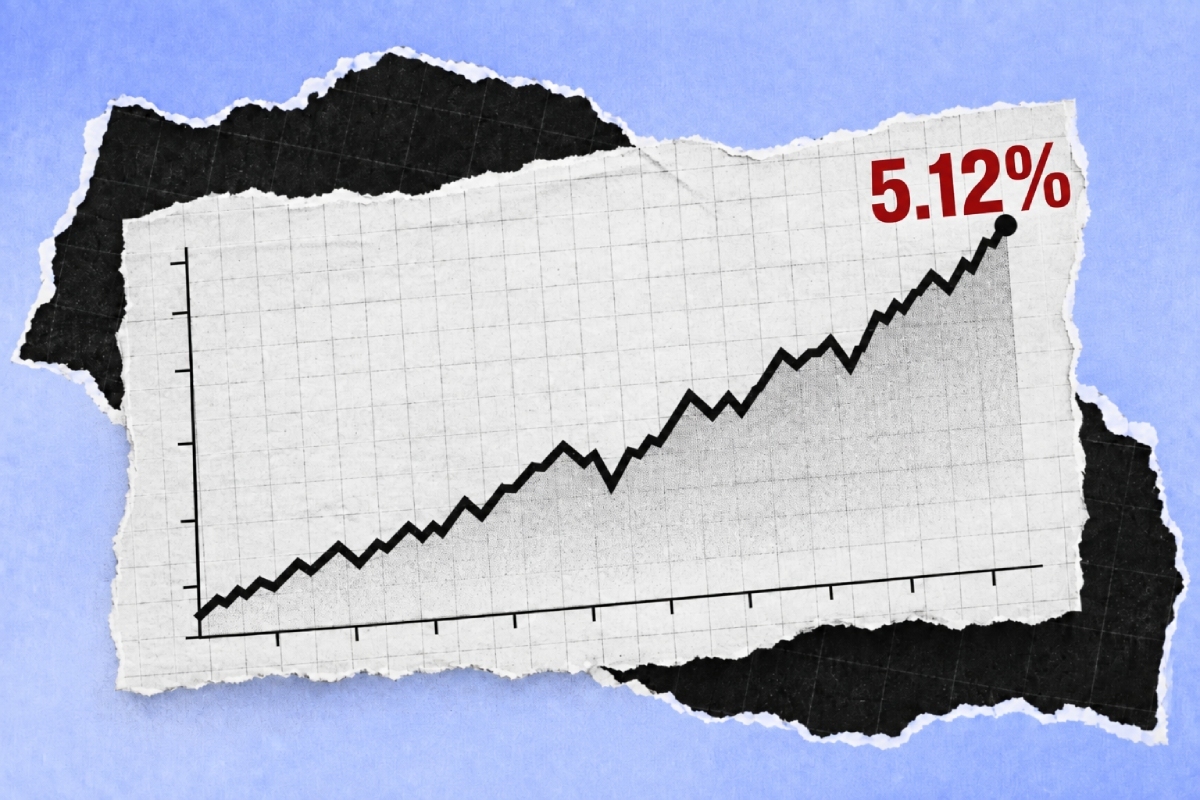
10-year yield hit 5.12%!

Morning Observers,
The 10-year yield hit 5.12% in its biggest one-day move since last April!
The obvious trigger was yesterday's PMI report, which effectively pointed to the strongest expansion in business activity since 2015.
Nothing sums it up better than this quote from S&P Global's chief business economist, Chris Williamson:
"Barring the spike in demand following the opening up of the economy after the COVID lockdowns, the latest improvement in business activity is the greatest recorded since early 2015."
At the same time, input prices rose at their fastest pace in nearly four years, driven in part by higher energy and transport costs.
The almost synchronized jump in yields across the curve tells us that markets are now pricing in higher rates for longer. The odds of another hike in October also rose from a coin flip to roughly two-thirds.
If Warsh's Fed has to start a new tightening cycle, the biggest question now is whether we're heading for stagflation or reflation.
For most of this year, stagflation has been a bigger fear than reflation has been an opportunity. So far, the knee-jerk reaction in futures has been negative. But this report may tilt the scales.
Plus, recent data releases and Fed remarks show that the economy is picking up speed:
- The Fed raised its 2026 growth forecast to 2.3% from 2.2% and lowered its unemployment forecast to 4.1% from 4.3%
- August retail sales rose 1.2%, beating expectations. Employers also added 162,000 jobs, beating expectations, and unemployment held at 4.1%, also better than expected
- Every speech by a Fed governor over the past few weeks has pointed to a growing economy
If we are in a Goldilocks economy, that's historically positive for stocks.
On the other hand, rising yields may trigger a rotation out of tech names that can't earn their way out of higher discount rates, especially now that the AI buildout is becoming more debt-dependent.
- Dan Runkevicius, Editor

📈 After a brief pause, bond yields surge again
The bond market’s brief reprieve didn’t last. The 10-year Treasury yield surged to 5.12% on Wednesday, its highest level since 2007, while the 30-year yield reached 5.35%, matching levels last seen that year. The renewed bond selloff suggests investors are betting that rates will stay higher for longer.
🏦 Treasury gears up for another bond purchase
The Treasury Department announced it will purchase $6 billion of longer-dated government debt on Thursday, continuing Secretary Scott Bessent’s expanded buyback program aimed at slowing the recent rise in borrowing costs.
🚀 U.S. economy flashes strong growth sign
U.S. business activity accelerated in September, with the S&P Global Composite PMI rising to 58.4 from 56.0, on a scale where 50 separates growth from contraction. Employment grew at the fastest pace in more than four years, but input prices also rose at the quickest pace since 2022.
💻 Microsoft wins over a former skeptic
Stifel upgraded Microsoft stock to "Buy" and raised its price target to $575 from $530, implying roughly 16% upside from current levels. The firm’s analysts expect stronger Azure growth and rising OpenAI revenue, putting some of their earlier concerns about margins and heavy AI spending to rest.
🚢 Chinese exports to the U.S. are surging
Chinese exports to the U.S. jumped 34% year over year in August to $42.5 billion, topping $40 billion for a third consecutive month. The rebound is largely a result of stronger U.S. demand for AI-related electronics produced in China.
The K-shaped economy has a seat map
An affordability crisis and a weak job market have widened the divide between America's haves and have-nots.
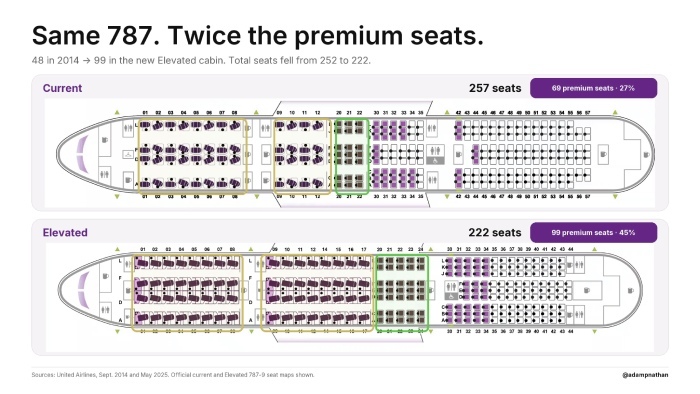
United Airlines may have produced one of the clearest illustrations of this "K-shaped economy" yet: a seat map. Its newest 787-9 has fewer seats overall, but far more room for passengers willing to pay up for business class and premium economy.
Fewer seats, more premium
United's new "Elevated" 787-9 has 99 business-class and premium-economy seats, up from 69 on its current 787-9. At the same time, total seating fell from 257 to 222, meaning 30 more premium seats and 35 fewer seats overall.
The shift is even more striking compared with United's first 787-9 in 2014, which had 48 business-class seats and no premium-economy cabin.
The newest version has more than twice as many seats across the two premium cabins, despite carrying fewer passengers overall.
Airlines know who can still spend
The redesign comes as flying is already getting more expensive.
Airfares in June, July, and August were 25% higher than a year earlier, according to the Consumer Price Index, while surging jet fuel costs threaten to push fares higher as the holiday travel season approaches.
United's seat map offers another clue about where airlines see the money.
Rather than squeezing as many passengers as possible onto each plane, it's giving more cabin space to business class and premium economy, where fares can be much higher.
📌 Bottom line: The K-shaped economy isn't just showing up in housing, stocks, and consumer spending. Airlines are now redesigning planes around the customers who can still afford to pay more.
Nvidia is trading like McDonald’s (yes, really)
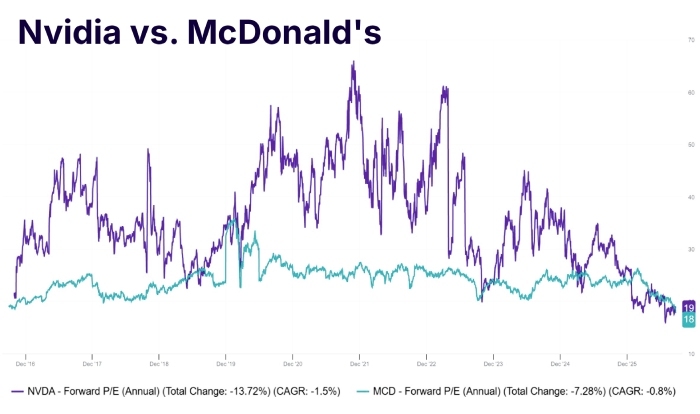
Nvidia has become a key cog in the global AI economy, but investors are no longer paying a huge premium for its growth.
The chip giant now trades at roughly the same forward earnings multiple as McDonald's, despite the two companies having almost nothing in common.
Same multiple, very different businesses
According to Fiscal.ai data, Nvidia and McDonald's trade at around 19 and 18 times forward earnings, respectively.
Nvidia once commanded a far higher multiple, but years of rapid earnings growth have brought its valuation much closer to that of a mature fast-food company.
The comparison gets stranger when looking at the businesses themselves.
McDonald's U.S. business has recently struggled with traffic and sales growth, while Nvidia's latest quarterly revenue jumped 106% year over year, including 117% growth in its data center business.
The stocks tell a different story
Investors are also paying similar multiples despite a wide gap in recent returns. McDonald's stock is down 22% over the past year, while Nvidia has gained more than 25%, even after its recent swings.
While McDonald's offers something Nvidia doesn't, a 51-year record of dividend growth, the gap in recent performance is hard to ignore.
📌 Bottom line: Nvidia's stock may look expensive after its record run, but its earnings have grown even faster.