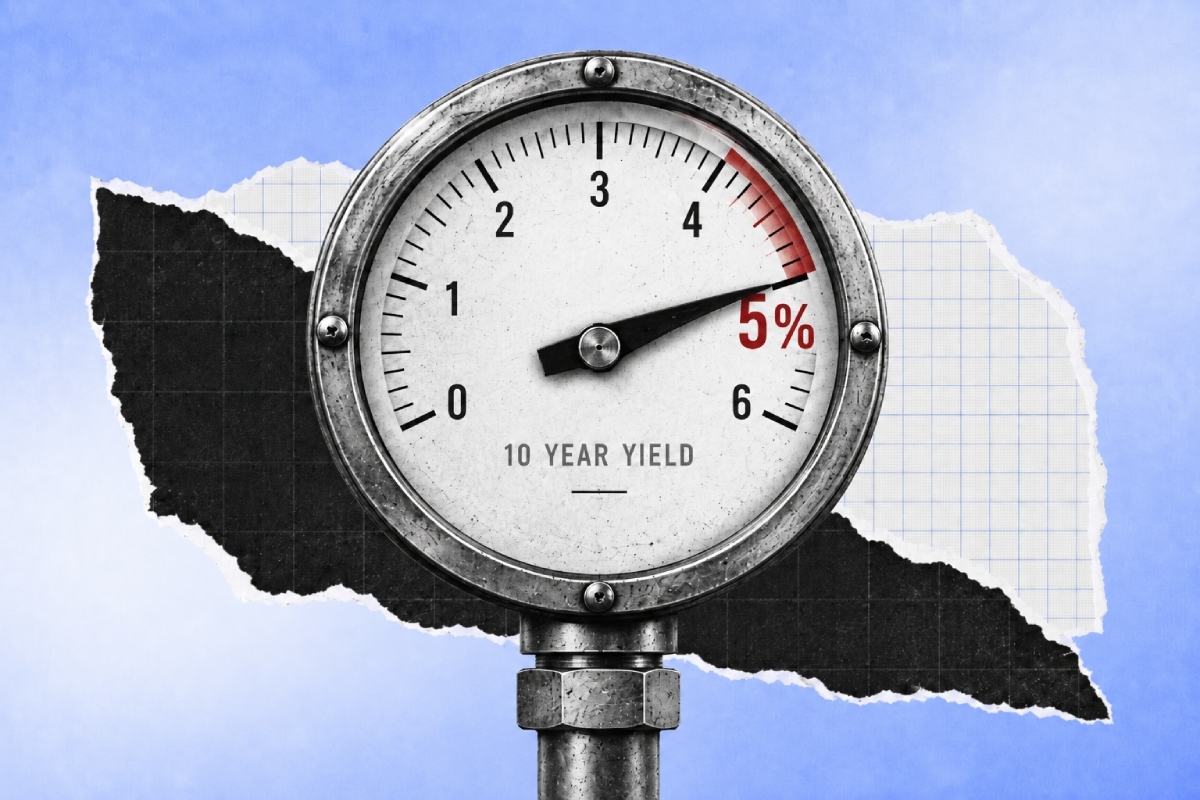
10-year yield has crossed 5%!

Morning Observers,
It's official! The 10-year yield has crossed the 5% mark for the first time since 2007.
There's been a lot of speculation about what's responsible for rising long-term yields, including inflation risk and term premium.
But there's another widely underreported driver that might have been the biggest contributor to rising yields since the end of July.
One way to decompose nominal yields is to break them down into two components: real yields and inflation expectations.
The real yield is the compensation investors demand after accounting for expected inflation over the bond's lifetime.
For all the headlines about Iran and inflation, 10-year inflation expectations have been more or less flat since the start of the war.
And nearly all the increase in nominal yields came from rising real yields.
That means investors aren't demanding compensation for higher inflation risk. So, if it's not inflation, then it must be term premium?
Not necessarily. The San Francisco has a model that breaks down nominal yields into term premium and expected short-term rates over the next 10 years.
And surprise, surprise, the term premium isn't the only explanation for Washington's rising borrowing costs.
From late February to the end of July:
- Expected short rates over the next 10 years: +49 bp
- Term premium: +21 bp
Since the end of July, the term premium has made no contribution to rising 10-year yields, according to this model.
- Expected short rates over the next 10 years: +25 bp
- Term premium: -3 bp
What this is saying is that the market expects higher-for-longer interest rates over the next 10 years.
Higher rates can be good or bad, depending on why they are rising.
The good kind of rising rates follows higher demand-side inflation, which happens during strong economic growth.
The bad kind follows supply-side inflation, which typically leads to stagflation.
Considering that economic growth forecasts haven't seen any meaningful revisions, and that the biggest upticks in expected rates happened during worse-than-expected inflation data releases…
Is the market preparing for a more aggressive Fed response to persistent supply-side inflation?
That would be the opposite of how this 5% yield milestone is typically explained.
- Dan Runkevicius, Editor

🤖 AI development fears rattle markets
Semiconductor stocks that have powered the AI boom sold off on Monday as investors reacted to a new warning about the risks posed by the technology. Anthropic CEO Dario Amodei called for slowing the pace of AI development, a proposal backed by OpenAI CEO Sam Altman and Elon Musk. The Philadelphia Semiconductor Index plunged 5.9%, with Nvidia and Broadcom among the biggest decliners.
🛡️ Trump pushes back on AI guardrails
Trump rejected calls for tighter AI guardrails, arguing that slowing development would give China an advantage. “There is a SICK conspiracy going on against AI and Data Centers, and the only one that is happy about it is China,” Trump wrote on Truth Social. His comments put the White House at odds with Amodei, Altman, and Musk.
📈 10-year yield breaks 5%
The 10-year U.S. Treasury yield briefly climbed above 5% on Monday, reaching its highest intraday level since 2007. The yield has risen nearly a full percentage point over the past year, with more than half of the increase coming since June.
🚀 Anthropic moves toward IPO, while OpenAI holds off
Anthropic is moving ahead with plans to go public, selecting Nasdaq for what could be a record-breaking IPO. Meanwhile, OpenAI won’t go public this year. CEO Sam Altman said an IPO would be “ill-advised” while the company focuses on AI safety.
🐂 Wall Street says bull market can survive rate hikes
Several Wall Street banks, including Morgan Stanley, Goldman Sachs, and JPMorgan, remain bullish on stocks despite expectations for multiple rate hikes this year. “Equities typically struggle when the Fed starts to hike rates, but we expect the bull market to continue,” said Ben Snider, chief U.S. equity strategist at Goldman Sachs.
Saudi Arabia just lost its Hormuz workaround

Saudi Arabia built its East-West pipeline to reduce its reliance on oil export routes through the Persian Gulf.
When the Strait of Hormuz shut down, the 746-mile route gave the kingdom a way to keep millions of barrels flowing to the Red Sea. Now, that escape route is out of commission, too.
168 million barrels hang in the balance
The East-West pipeline had been carrying roughly 4 million barrels of crude per day during the disruption in the Strait of Hormuz, or about 4% of global oil supply.
Repairs could take as long as six weeks. At the recent flow rate, a six-week shutdown would leave as much as 168 million barrels unable to move through the pipeline.
The attack by Iran-allied Houthi forces also turns attention toward the Bab al-Mandab Strait.
Any disruption to this narrow strait would further complicate one of the few remaining routes for Middle Eastern crude to reach global markets without passing through Hormuz.
The backup supply is running dry
The timing makes the pipeline outage more consequential. Chevron CEO Mike Wirth said the buffers that kept oil prices from rising even further during the war with Iran have largely been depleted.
Governments released crude from stockpiles, while the U.S. relaxed restrictions on sanctioned oil stored aboard ships, adding barrels to the market when supply routes first came under threat.
Those options have been "played out," Wirth said at a recent conference in Texas.
📌 Bottom line: The East-West pipeline was supposed to make Saudi oil less dependent on the Strait of Hormuz. Its closure leaves the oil market with fewer ways to route around the war.
Americans face the worst income squeeze in more than a decade
The Fed may be preparing to raise interest rates just as American workers start losing purchasing power.
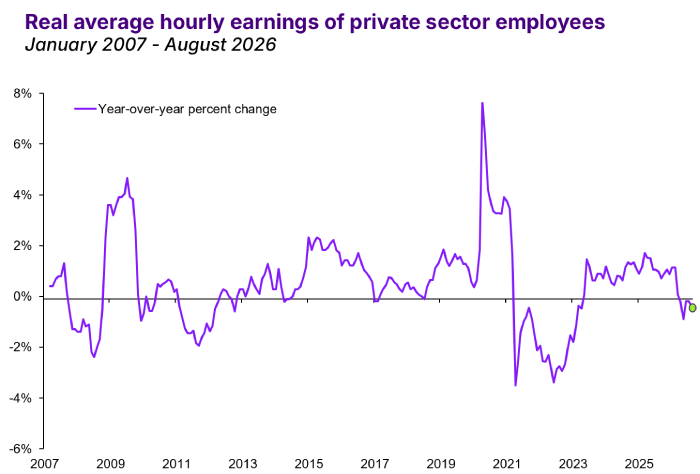
Real wages have now fallen for five consecutive months, complicating the case that the economy is strong enough to absorb multiple rate hikes.
Paychecks are losing to inflation
Real average hourly earnings for U.S. private-sector workers, which measure wages after accounting for inflation, fell 0.4% year over year in August.
In other words, prices are now rising faster than workers' pay.
August marked the fifth consecutive month of declining inflation-adjusted wages, according to Gregory Daco, chief economist at EY-Parthenon.
"We haven't seen this type of income squeeze since 2012," he wrote.
Now borrowing costs are going up
Navy Federal chief economist Heather Long said the data shows "how significant this pain is for many American households."
The "income squeeze" could become harder to absorb if borrowing costs rise, too. The Fed is expected to begin a series of rate hikes as soon as Wednesday, with additional increases expected through the end of 2026.
📌 Bottom line: Rate hikes may be justified by inflation data, but Americans will be absorbing them with less purchasing power than they had a year ago.